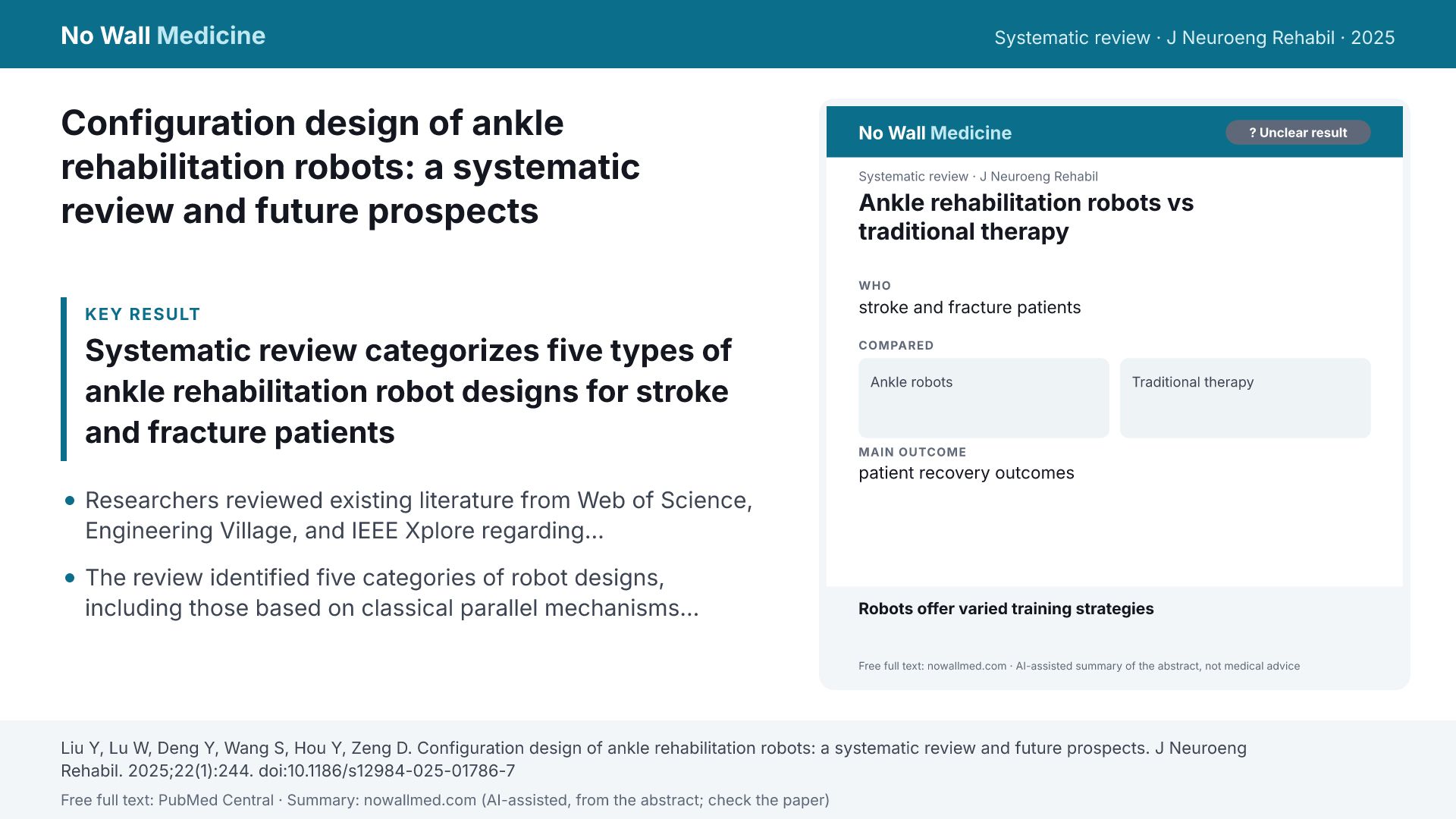
Systematic review categorizes five types of ankle rehabilitation robot designs for stroke and fracture patients
Configuration design of ankle rehabilitation robots: a systematic review and future prospects
Systematic reviewUnclear result
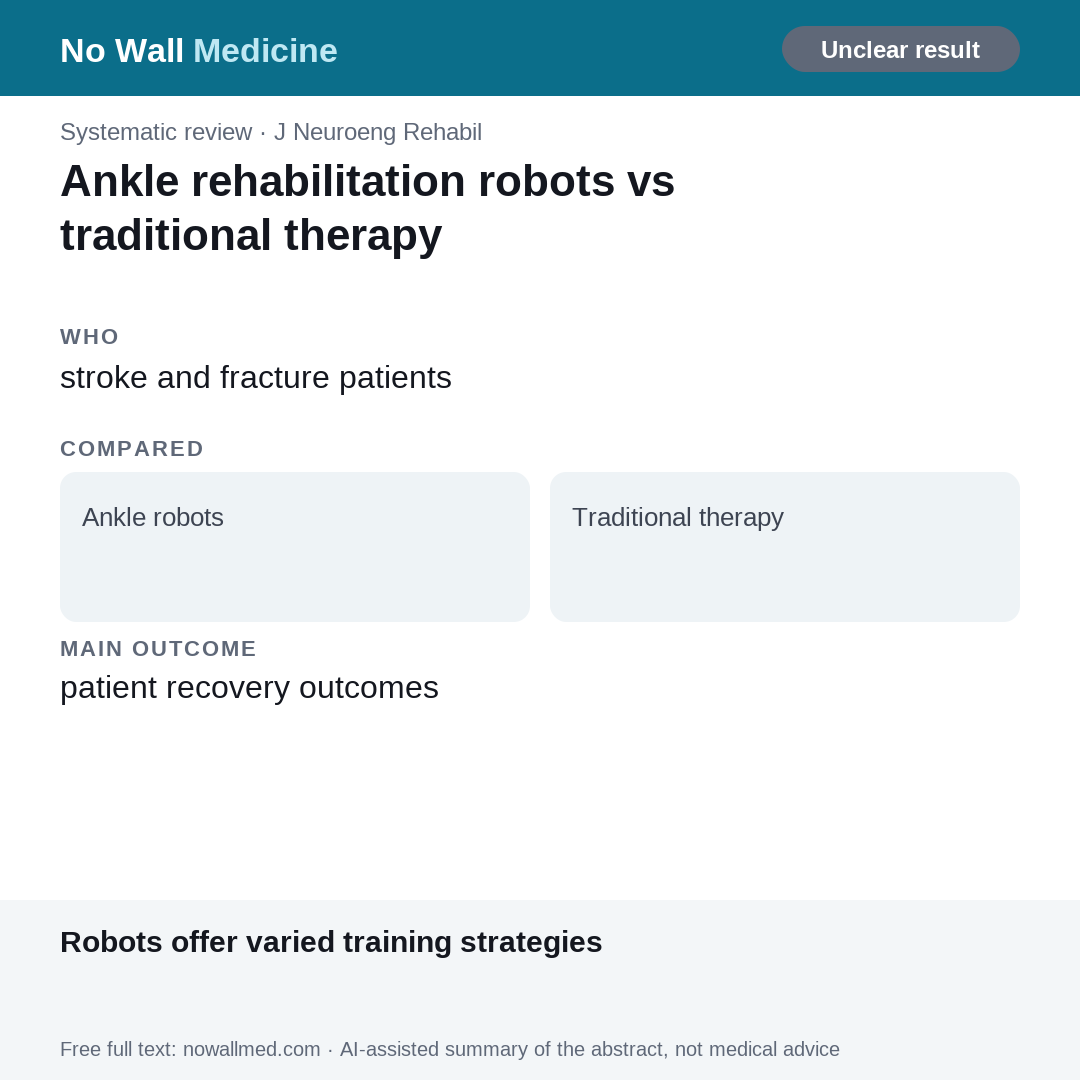
Ankle rehabilitation robots vs traditional therapy
Who
stroke and fracture patients
Compared
Ankle robots
Traditional therapy
Main outcome
patient recovery outcomes
Bottom line: Robots offer varied training strategies
Limitation: shortcomings in human-machine compatibility
J Neuroeng Rehabil · 2025-11-18Download image
Key points
- Researchers reviewed existing literature from Web of Science, Engineering Village, and IEEE Xplore regarding the configuration design of ankle rehabilitation robots.
- The review identified five categories of robot designs, including those based on classical parallel mechanisms and remote center-of-motion mechanisms.
- Current robot designs face challenges in human-machine compatibility, which refers to how well the device fits and works with the human body.
Headline and key points written with AI from the paper’s abstract, with every number checked against it. Read the paper before relying on them.
Was this summary helpful?
Subject terms
Headline, design, result, key points, caveat and citation as plain text.
Cite this article
Liu Y, Lu W, Deng Y, Wang S, Hou Y, Zeng D. Configuration design of ankle rehabilitation robots: a systematic review and future prospects. J Neuroeng Rehabil. 2025. doi:10.1186/s12984-025-01786-7
Spotted a mistake? Suggest a correction