Conjoint analyses of patients' preferences for primary care: a systematic review
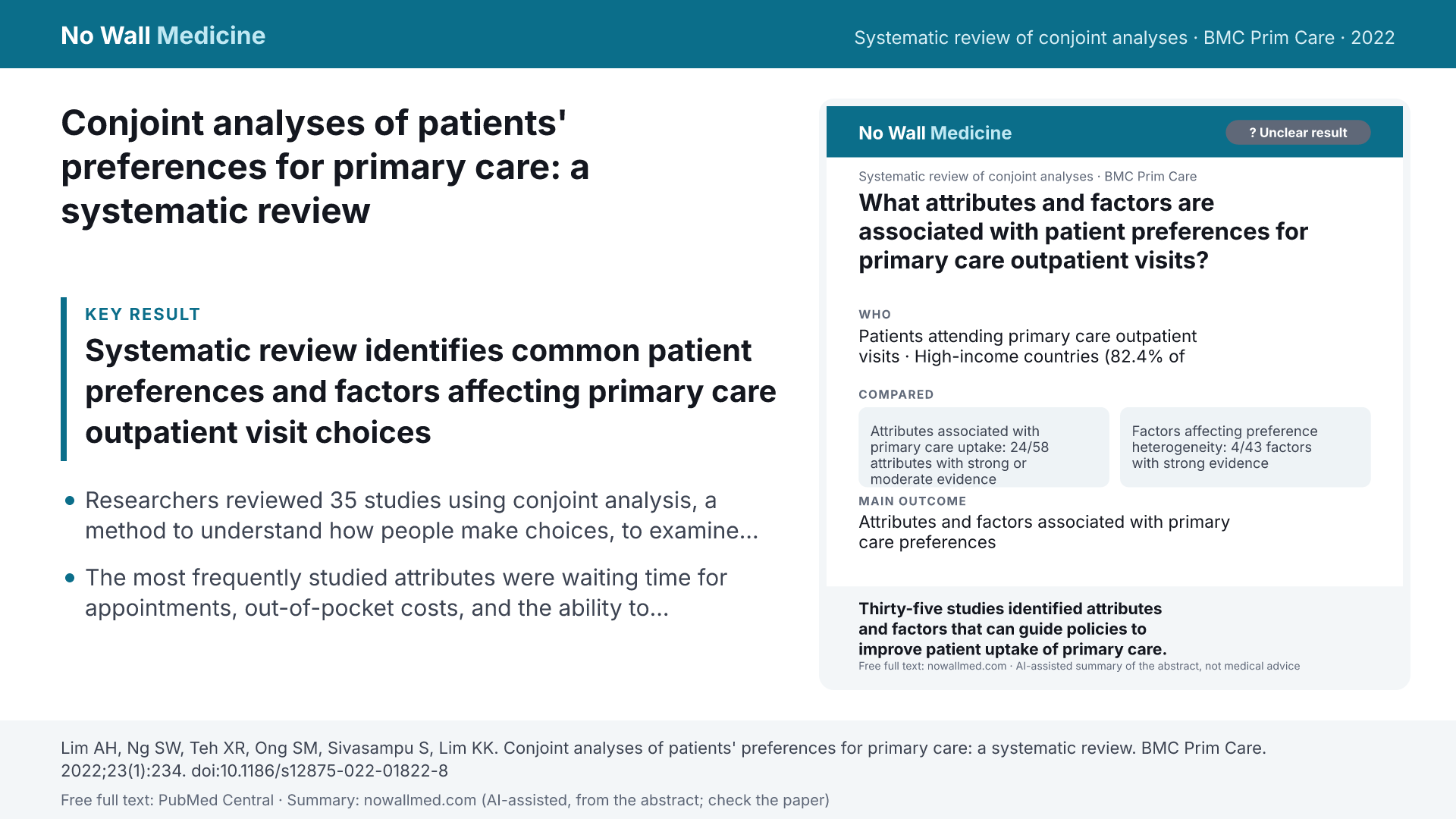
Key result: Systematic review identifies common patient preferences and factors affecting primary care outpatient visit choices
Systematic review of conjoint analysesUnclear result
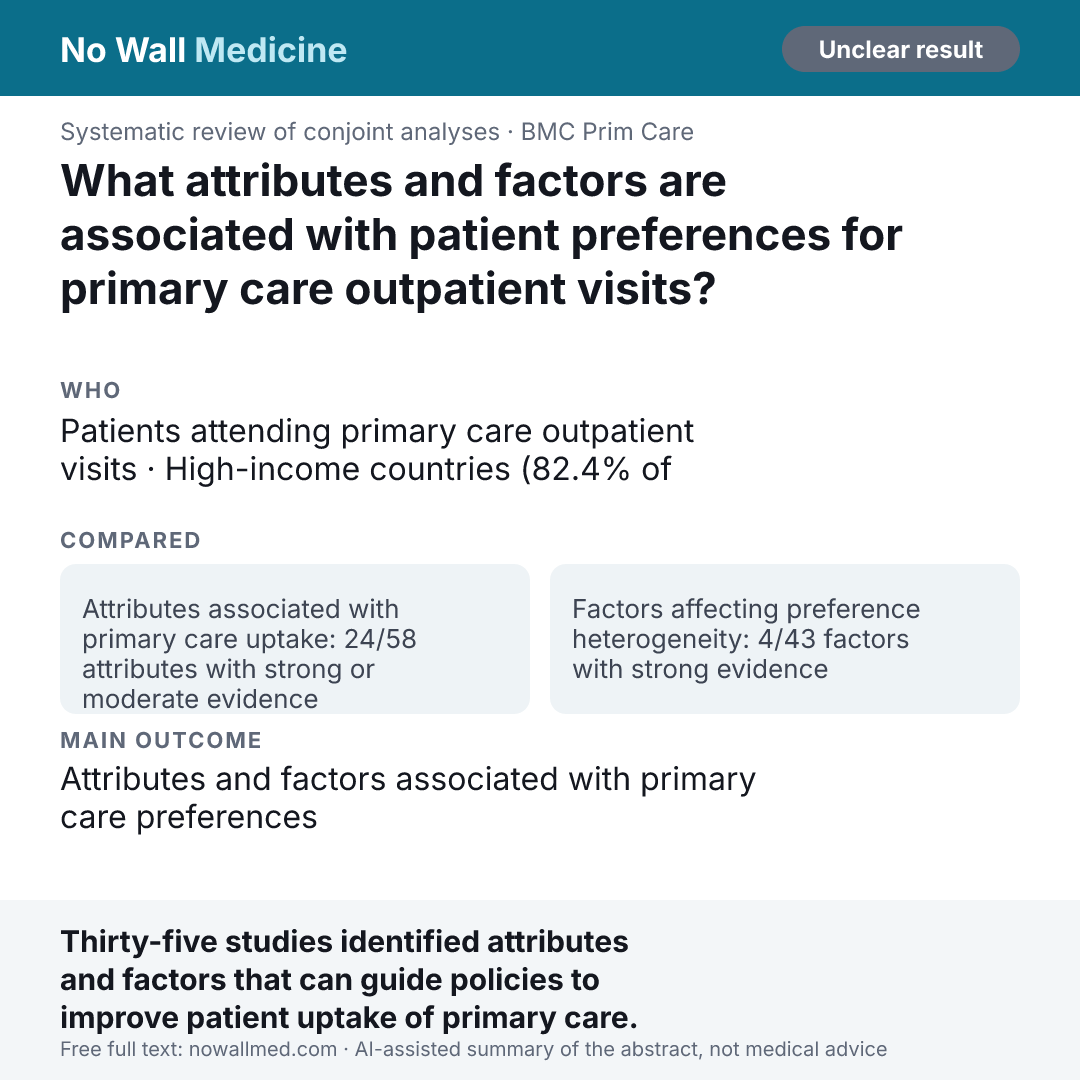
What attributes and factors are associated with patient preferences for primary care outpatient visits?
Who
Patients attending primary care outpatient visits · High-income countries (82.4% of studies)
Compared
Attributes associated with primary care uptake: 24/58 attributes with strong or moderate evidence
Factors affecting preference heterogeneity: 4/43 factors with strong evidence
Main outcome
Attributes and factors associated with primary care preferences
Bottom line: Thirty-five studies identified attributes and factors that can guide policies to improve patient uptake of primary care.
BMC Prim Care · 2022-09-09 · Save PNG
Key points
- Researchers reviewed 35 studies using conjoint analysis, a method to understand how people make choices, to examine 58 attributes and 43 factors related to primary care visits.
- The most frequently studied attributes were waiting time for appointments, out-of-pocket costs, and the ability to choose specific providers.
- The review found 24/58 attributes were associated with primary care uptake and 4/43 factors, such as age and gender, were associated with differences in patient preferences.
Discussion prompts
- Would these patients look like yours? Who was left out?
- Is the main outcome one that matters to patients?
- Is the difference large enough to change what you do?
Cite: Lim AH, Ng SW, Teh XR, Ong SM, Sivasampu S, Lim KK. Conjoint analyses of patients' preferences for primary care: a systematic review. BMC Prim Care. 2022;23(1):234. doi:10.1186/s12875-022-01822-8
Free full text: PubMed Central · Summary and visual abstract: nowallmed.com/a/conjoint-analyses-of-patients-preferences-for-primary-care-a-v7mbch/ (AI-assisted from the abstract; check the paper before relying on it).