Non-invasive brain stimulation and deep brain stimulation show different cognitive outcomes in Alzheimer's disease
Connectomic neuromodulation for Alzheimer's disease: A systematic review and meta-analysis of invasive and non-invasive techniques
Systematic review and meta-analysisMixed results
What are the cognitive outcomes of deep brain stimulation and non-invasive neuromodulation in Alzheimer's disease?
Who
242
Patients with Alzheimer's disease
Compared
Non-invasive neuromodulation: effect size -0.40(95% [CI], -0.73, -0.06, p = 0.02)
0.11Deep brain stimulation (95% [CI] -0.34, 0.56, p = 0.63)
Main outcome
cognitive outcome
Result: effect size -0.40(95% [CI], -0.73, -0.06, p = 0.02) for non-invasive neuromodulation
Bottom line: Non-invasive neuromodulation favored baseline, while deep brain stimulation improved cognitive outcomes in patients aged 65 years or older.
Transl Psychiatry · 2022-11-21Download image
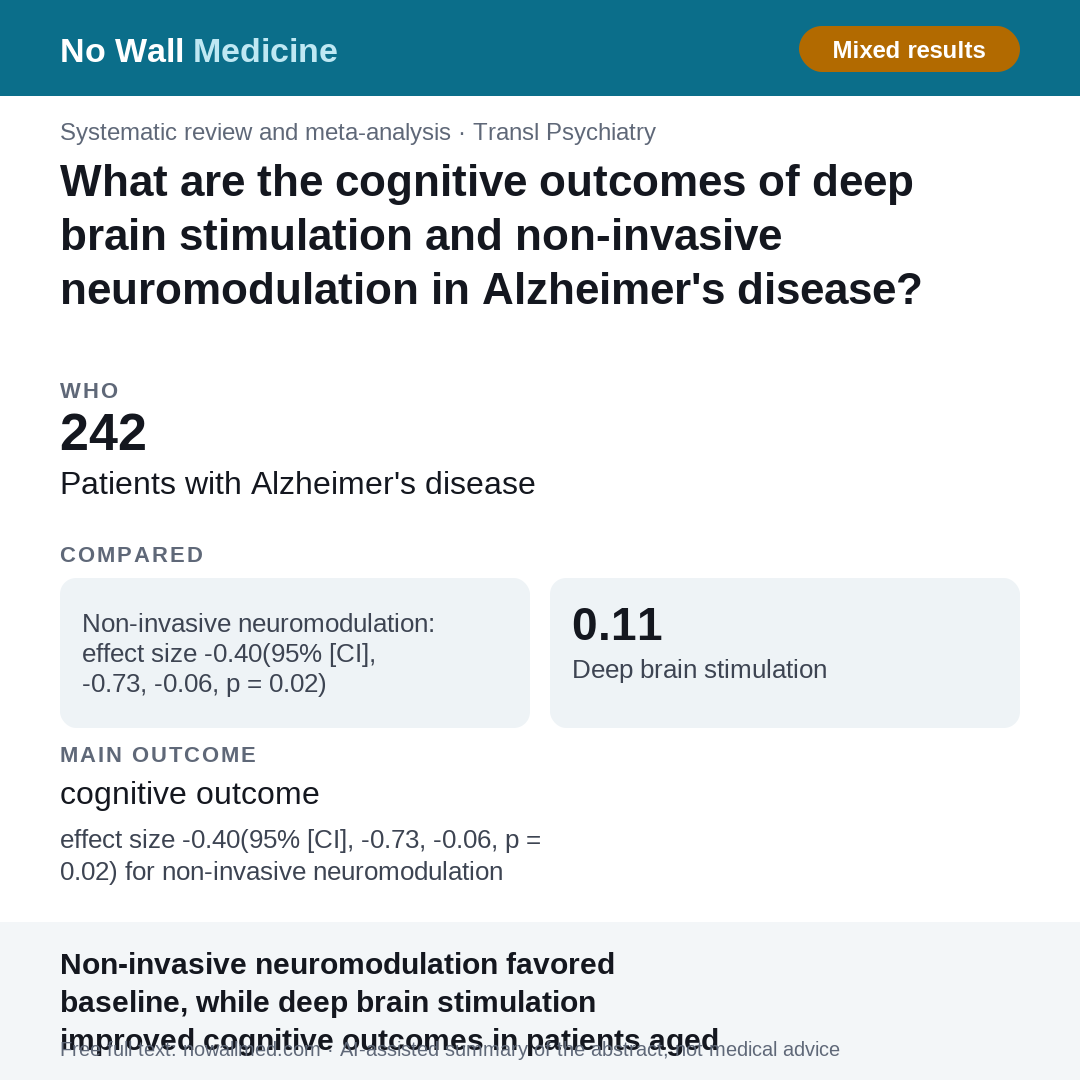
Clinical question: What are the cognitive outcomes of deep brain stimulation and non-invasive neuromodulation in Alzheimer's disease?
Why it matters: The cognitive outcomes and specific brain network connectivity changes resulting from different neuromodulation techniques in Alzheimer's disease remain unknown.
Key points
- Researchers analyzed six studies involving 242 patients with Alzheimer's disease to compare non-invasive neuromodulation and deep brain stimulation, which involves implanted electrodes.
- Non-invasive neuromodulation was associated with a cognitive effect size of -0.40 (95% [CI], -0.73, -0.06, p = 0.02), while deep brain stimulation was 0.11 (95% [CI] -0.34, 0.56, p = 0.63).
- In patients aged 65 years or older, deep brain stimulation was associated with a cognitive outcome of 0.95 (95% [CI] 0.31, 1.58, p = 0.004).
Headline and key points written with AI from the paper’s abstract, with every number checked against it. Read the paper before relying on them.
Was this summary helpful?
Subject terms
Cite this article
Cheyuo C, Germann J, Yamamoto K, Vetkas A, Loh A, Sarica C. Connectomic neuromodulation for Alzheimer's disease: A systematic review and meta-analysis of invasive and non-invasive techniques. Transl Psychiatry. 2022. doi:10.1038/s41398-022-02246-9
Spotted a mistake? Suggest a correction
Top studies every Monday
The week’s key trials and guidelines in your specialties, plus any topics you follow. By email, free.
Get the weekly digest