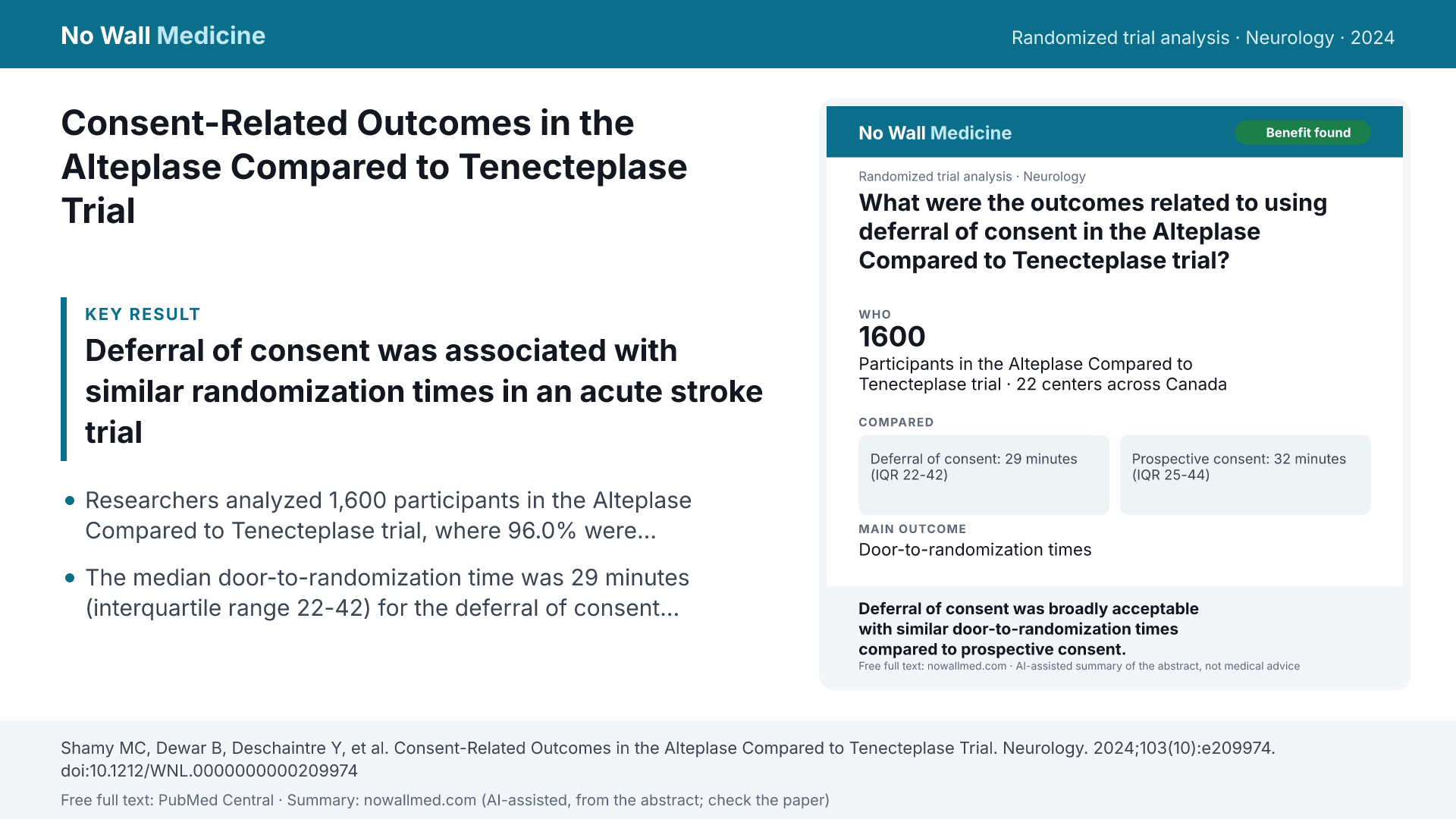
Deferral of consent was associated with similar randomization times in an acute stroke trial
Consent-Related Outcomes in the Alteplase Compared to Tenecteplase Trial
Randomized trial analysisBenefit found
What were the outcomes related to using deferral of consent in the Alteplase Compared to Tenecteplase trial?
Who
1600
Participants in the Alteplase Compared to Tenecteplase trial · 22 centers across Canada
Compared
Deferral of consent: 29 minutes (IQR 22-42)
Prospective consent: 32 minutes (IQR 25-44)
Main outcome
Door-to-randomization times
Bottom line: Deferral of consent was broadly acceptable with similar door-to-randomization times compared to prospective consent.
Neurology · 2024-11-07 · Save PNG
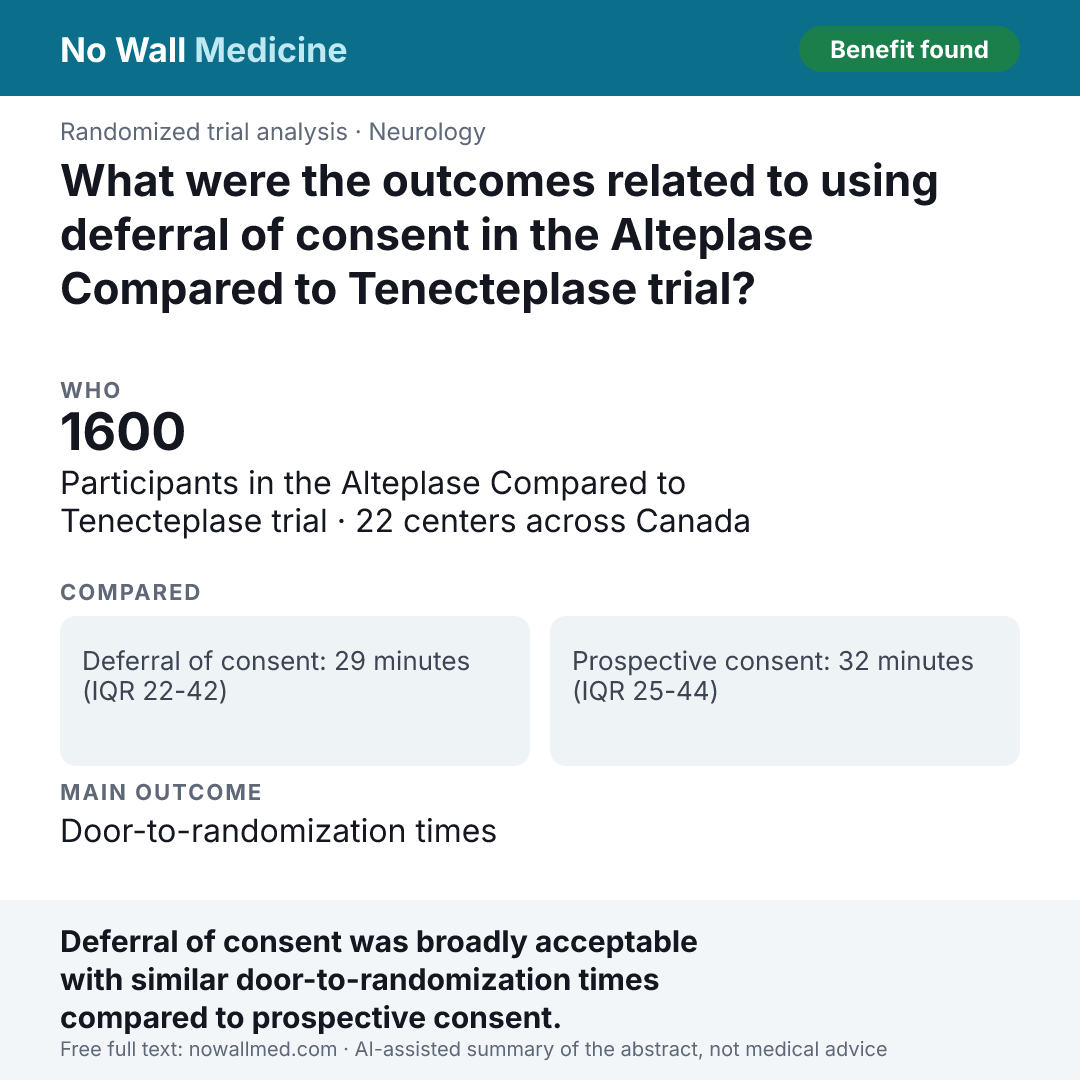
Clinical question: What were the outcomes related to using deferral of consent in the Alteplase Compared to Tenecteplase trial?
Key points
- Researchers analyzed 1,600 participants in the Alteplase Compared to Tenecteplase trial, where 96.0% were enrolled through deferral of consent and 4.0% through prospective consent.
- The median door-to-randomization time was 29 minutes (interquartile range 22-42) for the deferral of consent group compared to 32 minutes (interquartile range 25-44) for the prospective consent group.
- Among those enrolled via deferral of consent, 95% (1,454/1,537) consented to ongoing participation, and 86% of survey respondents agreed with the use of deferral of consent in this trial.
Headline and key points written with AI from the paper’s abstract, with every number checked against it. Read the paper before relying on them.
Was this summary helpful?
Subject terms
Headline, design, result, key points, caveat and citation as plain text.
Cite this article
Shamy MC, Dewar B, Deschaintre Y, et al. Consent-Related Outcomes in the Alteplase Compared to Tenecteplase Trial. Neurology. 2024;103(10):e209974. doi:10.1212/WNL.0000000000209974
Spotted a mistake? Suggest a correction