Immediate tonsillectomy resulted in fewer sore throat days than conservative management in adults
Conservative management versus tonsillectomy in adults with recurrent acute tonsillitis in the UK (NATTINA): a multicentre, open-label, randomised controlled trial
Multicentre, open-label, randomised controlled trialBenefit found
Is tonsillectomy more effective than conservative management for recurrent acute tonsillitis in adults?
Who
429
Adults aged 16 years or older with recurrent acute tonsillitis · 27 hospitals in the UK
Compared
Immediate tonsillectomy: median 23 days [IQR 11-46]
Conservative management: median 30 days [14-65]
Main outcome
Number of sore throat days during 24 months
Result: incident rate ratio 0·53 (95% CI 0·43 to 0·65)
Bottom line: Immediate tonsillectomy is clinically effective and cost-effective compared to conservative management for adults with recurrent acute tonsillitis.
Funded by: National Institute for Health Research
Lancet · 2023-05-17Download image
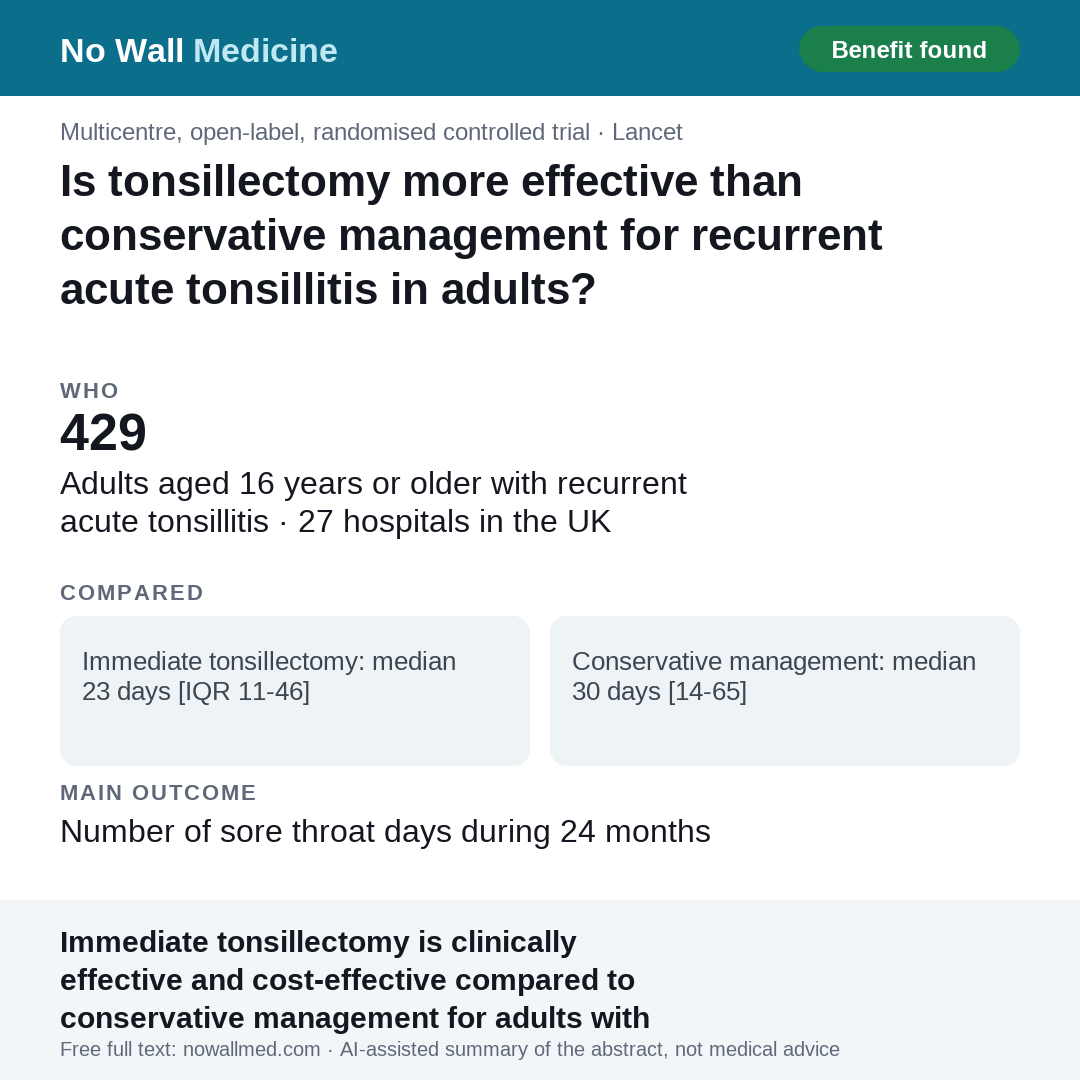
Clinical question: Is tonsillectomy more effective than conservative management for recurrent acute tonsillitis in adults?
Why it matters: Evidence is scarce regarding whether tonsillectomy or conservative management is more effective for adults with recurrent acute tonsillitis.
Key points
- Researchers conducted a randomized trial of 429 adults with recurrent acute tonsillitis across 27 UK hospitals, comparing surgery to standard non-surgical care.
- The tonsillectomy group had a median of 23 sore throat days over 24 months compared to 30 days in the conservative management group.
- Adverse events related to surgery occurred in 39% of participants, with bleeding being the most common event in 19% of participants.
Headline and key points written with AI from the paper’s abstract, with every number checked against it. Read the paper before relying on them.
Abstract
Background
Tonsillectomy is regularly performed in adults with acute tonsillitis, but with scarce evidence. A reduction in tonsillectomies has coincided with an increase in acute adult hospitalisation for tonsillitis complications. We aimed to assess the clinical effectiveness and cost-effectiveness of conservative management versus tonsillectomy in patients with recurrent acute tonsillitis. Methods
This pragmatic multicentre, open-label, randomised controlled trial was conducted in 27 hospitals in the UK. Participants were adults aged 16 years or older who were newly referred to secondary care otolaryngology clinics with recurrent acute tonsillitis. Patients were randomly assigned (1:1) to receive tonsillectomy or conservative management using random permuted blocks of variable length. Stratification by recruiting centre and baseline symptom severity was assessed using the Tonsil Outcome Inventory-14 score (categories defined as mild 0-35, moderate 36-48, or severe 49-70). Participants in the tonsillectomy group received elective surgery to dissect the palatine tonsils within 8 weeks after random assignment and those in the conservative management group received standard non-surgical care during 24 months. The primary outcome was the number of sore throat days collected during 24 months after random assignment, reported once per week with a text message. The primary analysis was done in the intention-to-treat (ITT) population. This study is registered with the ISRCTN registry, 55284102. Findings
Between May 11, 2015, and April 30, 2018, 4165 participants with recurrent acute tonsillitis were assessed for eligibility and 3712 were excluded. 453 eligible participants were randomly assigned (233 in the immediate tonsillectomy group vs 220 in the conservative management group). 429 (95%) patients were included in the primary ITT analysis (224 vs 205). The median age of participants was 23 years (IQR 19-30), with 355 (78%) females and 97 (21%) males. Most participants were White (407 [90%]). Participants in the immediate tonsillectomy group had fewer days of sore throat during 24 months than those in the conservative management group (median 23 days [IQR 11-46] vs 30 days [14-65]). After adjustment for site and baseline severity, the incident rate ratio of total sore throat days in the immediate tonsillectomy group (n=224) compared with the conservative management group (n=205) was 0·53 (95% CI 0·43 to 0·65; <0·0001). 191 adverse events in 90 (39%) of 231 participants were deemed related to tonsillectomy. The most common adverse event was bleeding (54 events in 44 [19%] participants). No deaths occurred during the study. Interpretation
Compared with conservative management, immediate tonsillectomy is clinically effective and cost-effective in adults with recurrent acute tonsillitis. Funding
National Institute for Health Research.
Abstract reproduced under the article’s CC BY licence.
Topics
Cite this article
Wilson JA, O'Hara J, Fouweather T, Homer T, Stocken DD, Vale L. Conservative management versus tonsillectomy in adults with recurrent acute tonsillitis in the UK (NATTINA): a multicentre, open-label, randomised controlled trial. Lancet. 2023. doi:10.1016/S0140-6736(23)00519-6
Spotted a mistake? Suggest a correction