Non-surgical treatments for chronic back pain show short-term benefits but lack long-term clinical significance
Conservative treatments for chronic non-specific low back pain: time course network meta-analysis
Time course network meta-analysisMixed results
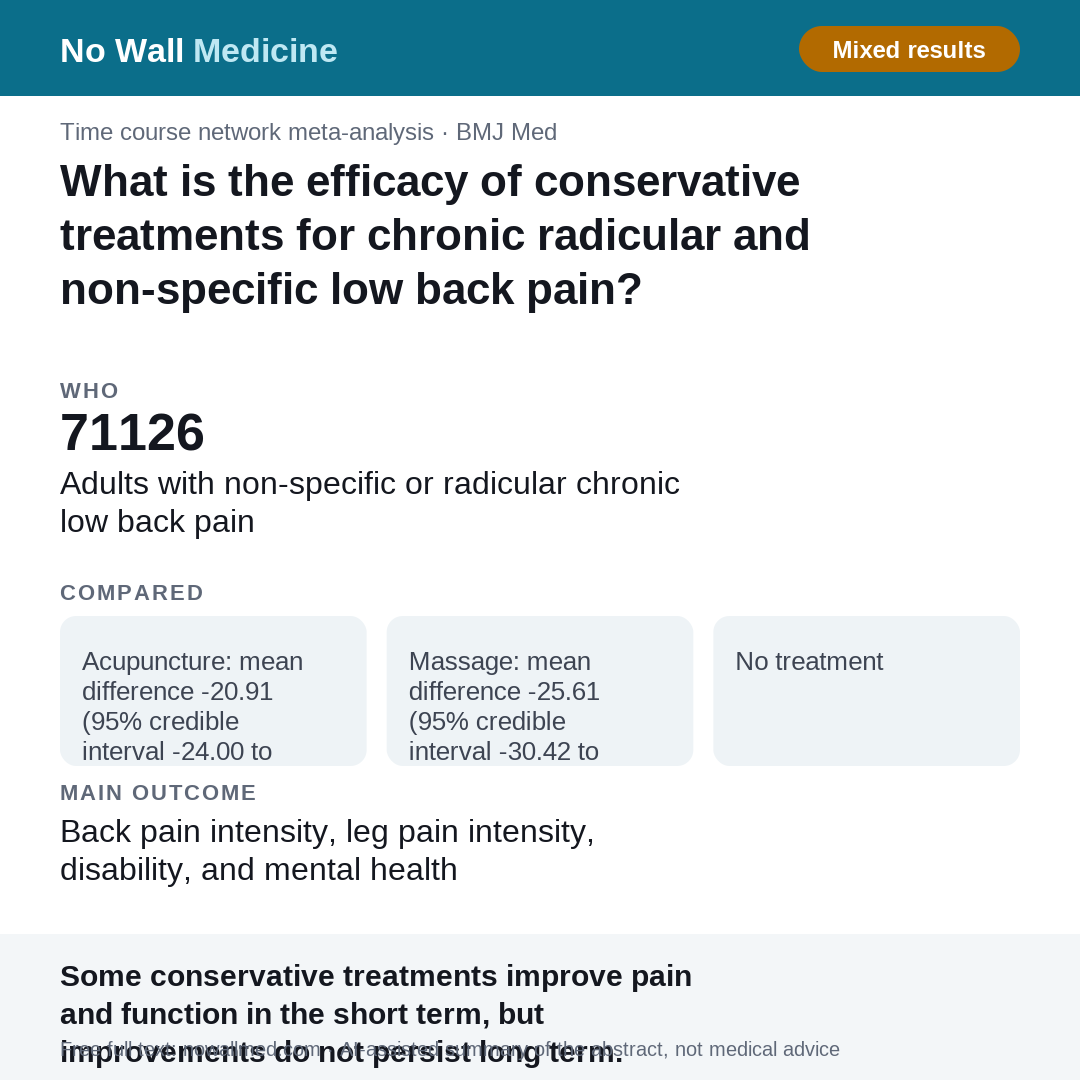
What is the efficacy of conservative treatments for chronic radicular and non-specific low back pain?
Who
71126
Adults with non-specific or radicular chronic low back pain
Compared
Acupuncture: mean difference -20.91 (95% credible interval -24.00 to -11.95)
Massage: mean difference -25.61 (95% credible interval -30.42 to -10.91)
No treatment
Main outcome
Back pain intensity, leg pain intensity, disability, and mental health
Bottom line: Some conservative treatments improve pain and function in the short term, but improvements do not persist long term.
Limitation: The certainty of the evidence was low to very low across interventions and time points.
BMJ Med · 2026-06-30Download image
Clinical question: What is the efficacy of conservative treatments for chronic radicular and non-specific low back pain?
Why it matters: There is a need to understand how different non-surgical treatments affect back pain and disability over various time periods.
Key points
- Researchers analyzed 551 studies involving 71,126 patients to compare various non-surgical treatments for chronic non-specific and radicular back pain.
- In the short term, massage, acupuncture, exercise, and multidisciplinary pain management reduced back pain intensity and disability more than no treatment.
- While some treatments showed statistically significant benefits in the long term, these effects did not meet the threshold for clinical significance.
Limitation the authors note: The certainty of the evidence was low (1.4%) to very low (98.6%) across interventions and time points.
Headline and key points written with AI from the paper’s abstract, with every number checked against it. Read the paper before relying on them.
Abstract
Objective
To examine the efficacy of conservative (non-surgical) treatments, usual care, and no treatment for chronic radicular and non-specific back pain. Design
Time course network meta-analysis. Data sources
Six electronic databases (Medline, SPORTDiscus, CINAHL, PsycINFO, Embase, and CENTRAL), searched from inception to 24 July 2020, and 302 previous systematic reviews. Eligibility criteria for selecting studies
Full peer reviewed publications in English or German of randomised controlled trials, randomised clinical trials, randomised controlled cluster trials, or randomised crossover trials in adults (aged ≥18 years) receiving common conservative treatments for non-specific and radicular chronic low back pain. Treatments examined were acupuncture, education or advice, electrotherapy (including heat and ice electrotherapeutic modalities applied non-invasively), exercise training, manual treatments or manipulation, massage, the McKenzie method, pharmacotherapy, psychological treatments, traction, physical therapy (otherwise not falling into specific treatment combinations), placebo, multidisciplinary pain management, usual care (eg, management by a doctor), and no treatment (true control). Results
Back pain intensity, leg pain intensity, disability, and mental health outcomes were reported immediately (<1 day), and at short term (≥1 day and ≤3 months), intermediate term (>3 and <12 months), and long term (≥12 months) time points. 581 reports of 551 studies (71 126 patients) were included. 510 trials included people with non-specific chronic low back pain and 41 trials included those with radicular chronic low back pain. For back pain (0-100 scale), acupuncture (mean difference -20.91, 95% credible interval -24.00 to -11.95), electrotherapy (-18.98, -21.84 to-10.95), exercise (-15.59, -17.51 to -10.05), manual treatment (-19.48, -22.17 to -11.74), massage (-25.61, -30.42 to -10.91), and multidisciplinary pain management (-18.96, -22.26 to -9.58) exceeded the minimal clinically important difference (set at 0.5 standard deviation) in the short term. For disability (0-100 scale), acupuncture (mean difference -10.52, 95% credible intervals -11.84 to -6.59), massage (-9.95, -11.45 to -5.50), and multidisciplinary pain management (-12.56, -13.91 to -8.55) were clinically effective in the short term. In the immediate and intermediate term only, the McKenzie method and massage, respectively, exceeded the minimal clinically important difference. In the long term, although two of the 14 treatments for back pain and nine of 14 treatments for disability had statistically significant benefits compared with no treatment, the effects were not clinically significant. The certainty of the evidence based on the GRADE (Grading of Recommendations, Assessment, Development, and Evaluation) framework was low (1.4%) to very low (98.6%) across interventions and time points. Findings for massage and the McKenzie method were not stable in the sensitivity analyses. Treatment effects for radicular chronic low back pain did not seem to differ from those for non-specific chronic low back pain. Conclusions
Some treatments were effective for pain and function in non-specific chronic low back pain, but improvements did not persist long term. Most of the evidence was for non-specific chronic low back pain; the evidence base for radicular chronic low back pain was limited. Although sensitivity analyses did not provide evidence for a different response in radicular chronic low back pain, an evidence gap remains for this subpopulation. Future work should explore strategies to establish the long term efficacy of modifications to lifestyle and behaviour. Systematic review registration
PROSPERO CRD42020182039.
Abstract reproduced under the article’s CC BY NC licence.
Cite this article
Belavý DL, Saueressig T, Arora NK, Balasundaram AP, Chen X, Diwan AD. Conservative treatments for chronic non-specific low back pain: time course network meta-analysis. BMJ Med. 2026. doi:10.1136/bmjmed-2025-001908
Spotted a mistake? Suggest a correction