Six months of financial incentives increased smoking cessation rates among adults experiencing homelessness
Contingency Management for Smoking Cessation Among Adults Experiencing Homelessness: A Pilot Randomized Clinical Trial
Pilot parallel 2-group randomized clinical trialBenefit found
Is an extended 6-month contingency management intervention effective for smoking cessation among adults experiencing homelessness?
Who
83
Adults experiencing homelessness who smoked cigarettes and intended to quit · 3 safety-net clinics in San Francisco, California
Compared
31.0%extended contingency management
12.2%control
Main outcome
7-day point prevalence abstinence
Result: adjusted odds ratio 3.24 (95% CI 1.03-10.19)
Bottom line: Extended contingency management was feasible and associated with higher odds of smoking abstinence among adults experiencing homelessness.
JAMA Netw Open · 2026-08-03Download image
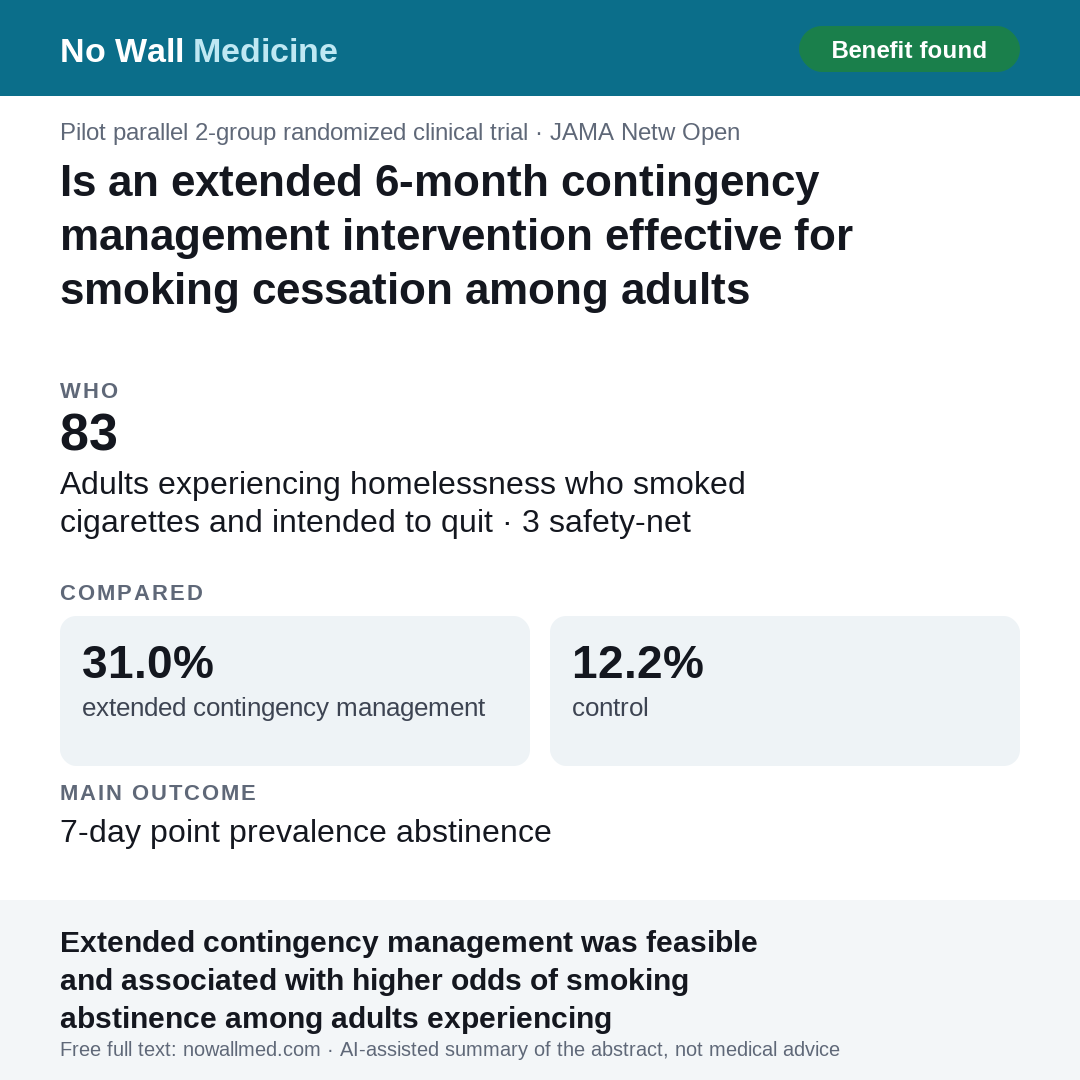
Clinical question: Is an extended 6-month contingency management intervention effective for smoking cessation among adults experiencing homelessness?
Why it matters: Extended contingency management interventions, which provide financial rewards for quitting, have not been well studied in people experiencing homelessness.
Key points
- Researchers studied 83 adults experiencing homelessness in San Francisco, comparing a six-month incentive program to a control group.
- At 6 months, 31.0% of the incentive group achieved smoking abstinence compared to 12.2% in the control group.
- The group receiving escalating gift cards for verified abstinence had higher odds of quitting than the control group.
Limitation the authors note: The authors state that larger trials are needed to confirm efficacy.
Headline and key points written with AI from the paper’s abstract, with every number checked against it. Read the paper before relying on them.
Topics
Spotted a mistake? Suggest a correction