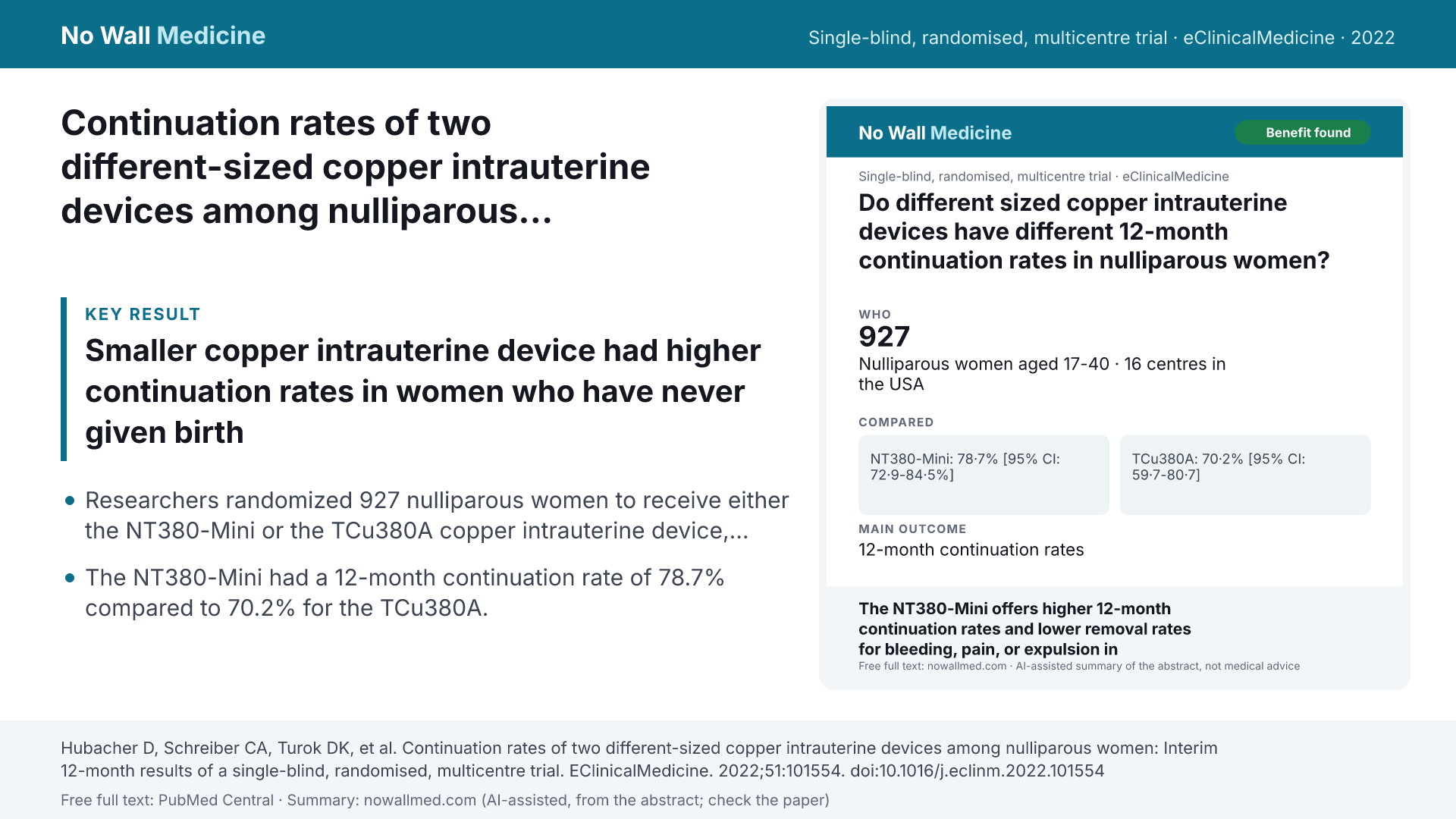
Continuation rates of two different-sized copper intrauterine devices among nulliparous women: Interim 12-month results of a single-blind, randomised, multicentre trial
Key result: Smaller copper intrauterine device had higher continuation rates in women who have never given birth
Key points
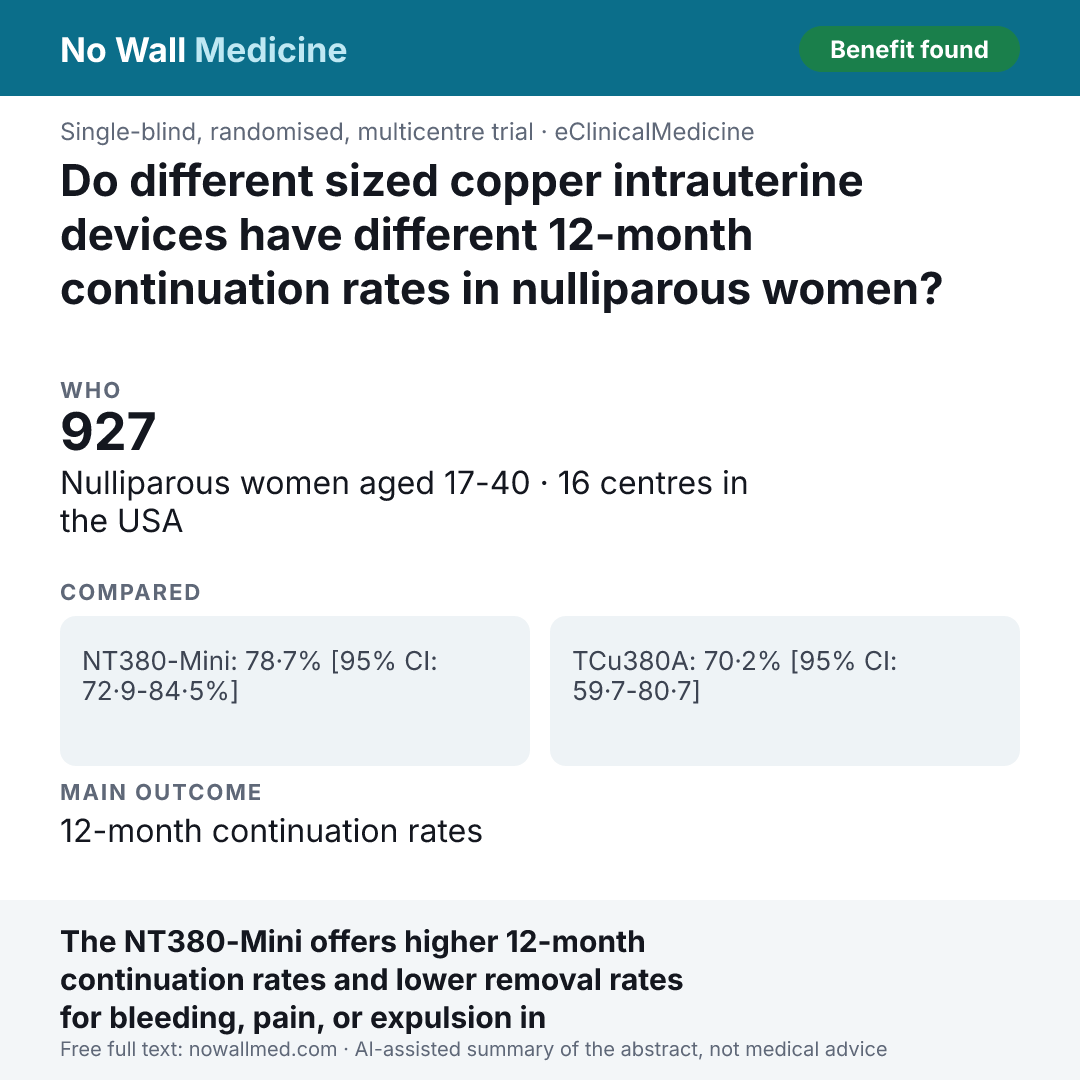
- Researchers randomized 927 nulliparous women to receive either the NT380-Mini or the TCu380A copper intrauterine device, a small device placed in the uterus for birth control.
- The NT380-Mini had a 12-month continuation rate of 78.7% compared to 70.2% for the TCu380A.
- Users of the NT380-Mini had lower rates of removal for bleeding or pain at 8.1% versus 16.2% and lower expulsion rates at 4.8% versus 8.9%.
Why it matters: The TCu380A copper intrauterine device causes side effects and early removals that may be worse for women with smaller uterine cavities who have never given birth.
Discussion prompts
- Would these patients look like yours? Who was left out?
- Is the main outcome one that matters to patients?
- Is the difference large enough to change what you do?
Cite: Hubacher D, Schreiber CA, Turok DK, et al. Continuation rates of two different-sized copper intrauterine devices among nulliparous women: Interim 12-month results of a single-blind, randomised, multicentre trial. EClinicalMedicine. 2022;51:101554. doi:10.1016/j.eclinm.2022.101554
Free full text: PubMed Central · Summary and visual abstract: nowallmed.com/a/continuation-rates-of-two-different-sized-copper-intrauterine-devices-7tp31v/ (AI-assisted from the abstract; check the paper before relying on it).