Continuous ketamine infusion reduced opioid use and nausea in surgical intensive care patients
Continuous ketamine infusion for surgical patients in the intensive care unit: a systematic review and meta-analysis of randomized controlled trials with GRADE assessment
Systematic review and meta-analysis of randomized controlled trialsMixed results
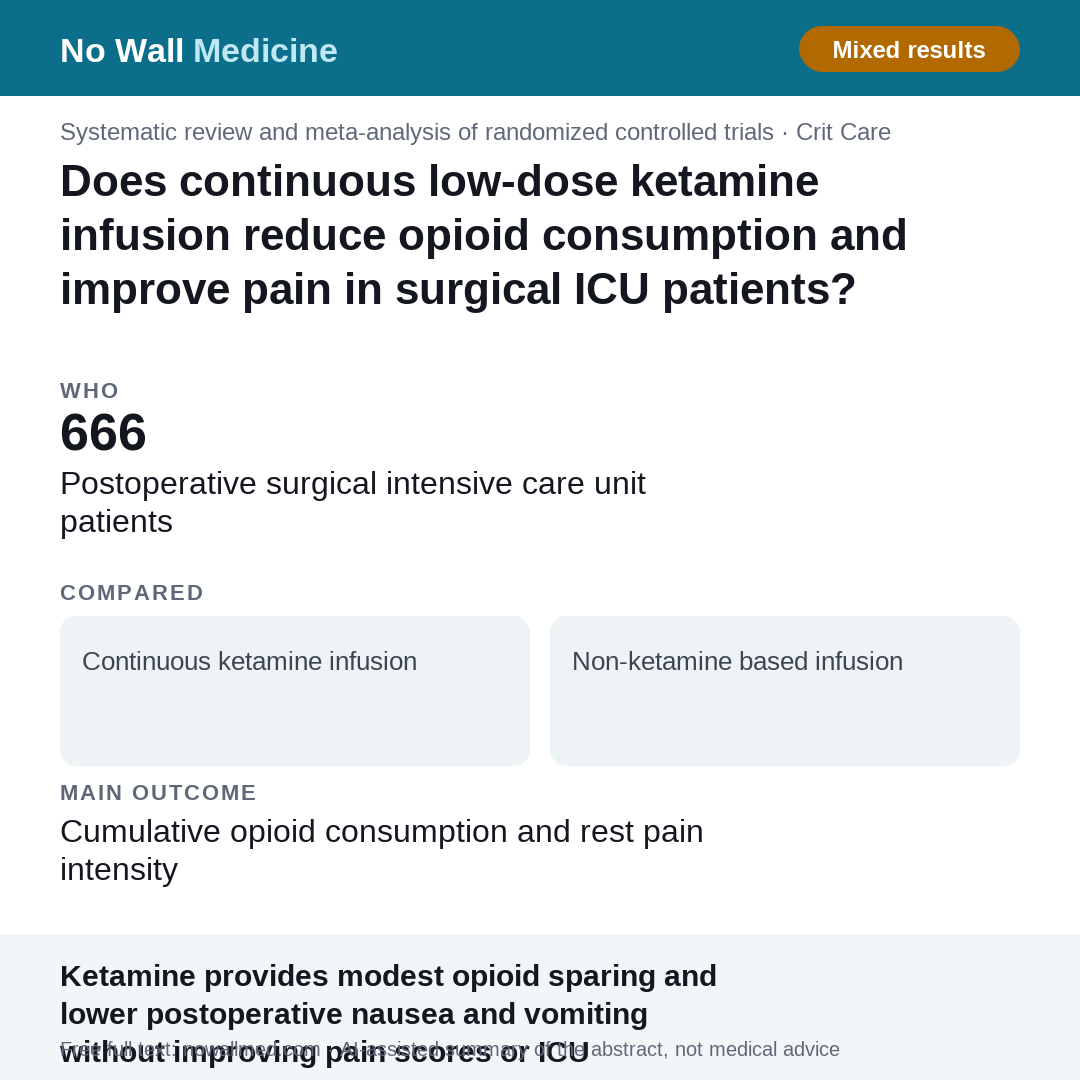
Does continuous low-dose ketamine infusion reduce opioid consumption and improve pain in surgical ICU patients?
Who
666
Postoperative surgical intensive care unit patients
Compared
Continuous ketamine infusion
Non-ketamine based infusion
Main outcome
Cumulative opioid consumption and rest pain intensity
Result: mean difference -5.77 mg morphine equivalents (95% CI -6.32 to -5.23)
Bottom line: Ketamine provides modest opioid sparing and lower postoperative nausea and vomiting without improving pain scores or ICU recovery outcomes.
Limitation: GRADE evidence was low to very low for most outcomes.
Crit Care · 2026-01-23Download image
Clinical question: Does continuous low-dose ketamine infusion reduce opioid consumption and improve pain in surgical ICU patients?
Why it matters: Doctors need to know if adding ketamine to sedation can reduce opioid use and side effects for patients in surgical intensive care units.
Key points
- Researchers analyzed nine randomized controlled trials involving 666 patients to compare continuous ketamine infusion against non-ketamine infusions for pain and sedation.
- Ketamine reduced opioid consumption in adults at 24 hours by a mean difference of -5.77 mg morphine equivalents, but also lowered postoperative nausea and vomiting.
- The treatment did not significantly change pain scores, mechanical ventilation time, or the length of stay in the intensive care unit.
Headline and key points written with AI from the paper’s abstract, with every number checked against it. Read the paper before relying on them.
Topics
Cite this article
Alzmmam AI, Alghanem RF, Alshahrani A, Aljawaied R, Alolayqi FS, Alanazi SK. Continuous ketamine infusion for surgical patients in the intensive care unit: a systematic review and meta-analysis of randomized controlled trials with GRADE assessment. Crit Care. 2026. doi:10.1186/s13054-026-05858-5
Spotted a mistake? Suggest a correction