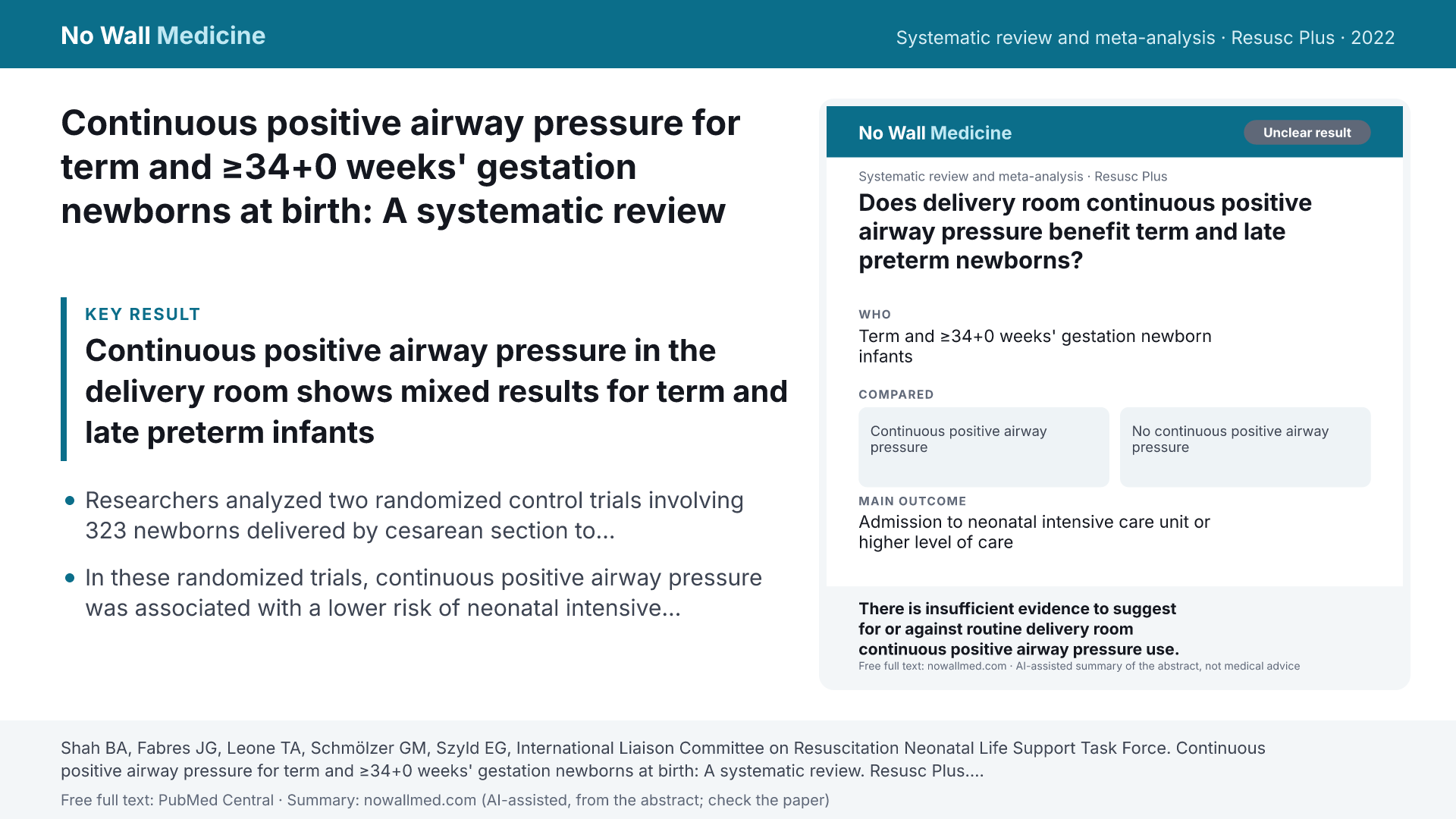
Continuous positive airway pressure for term and ≥34+0 weeks' gestation newborns at birth: A systematic review
Key result: Continuous positive airway pressure in the delivery room shows mixed results for term and late preterm infants
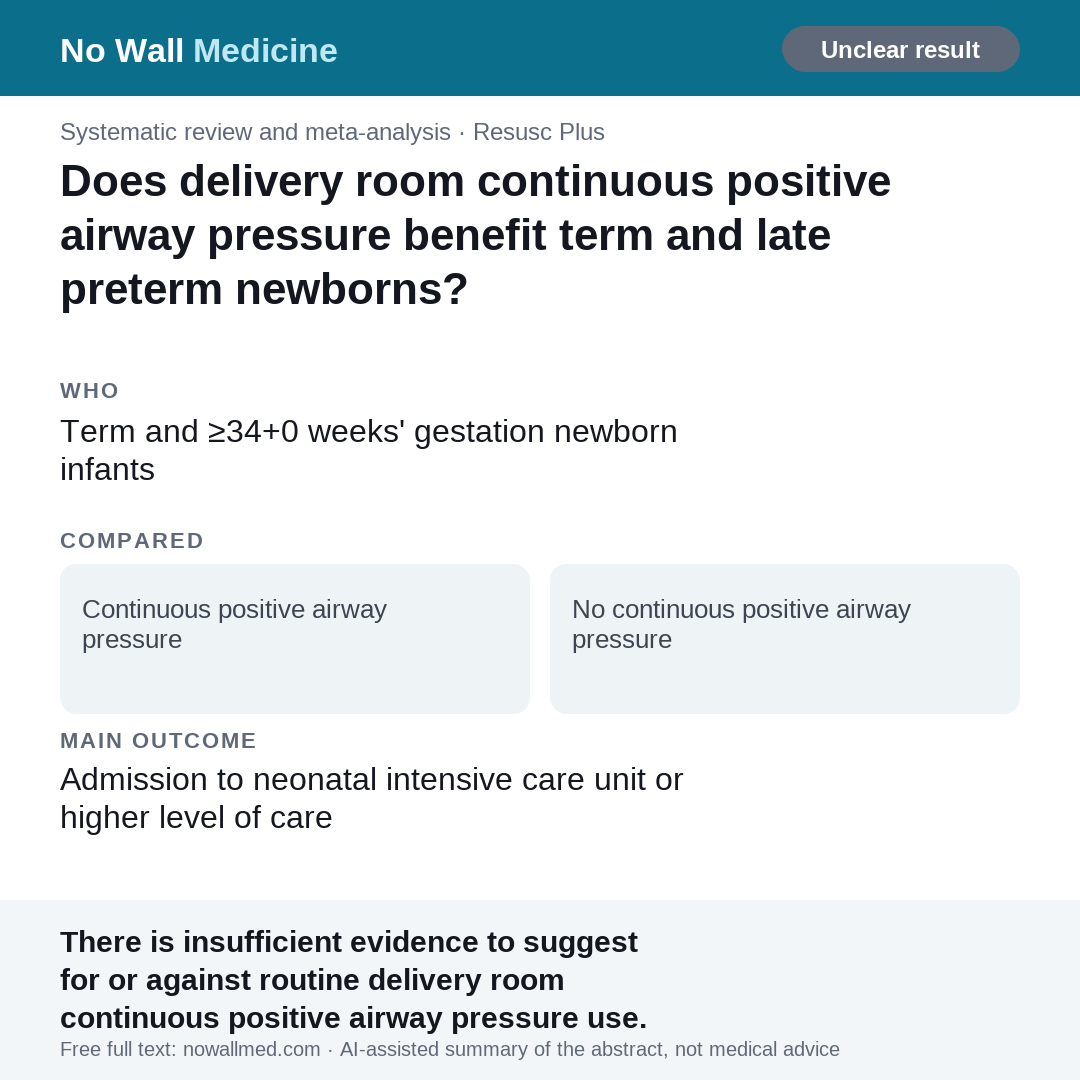
Key points
- Researchers analyzed two randomized control trials involving 323 newborns delivered by cesarean section to compare continuous positive airway pressure with no pressure support.
- In these randomized trials, continuous positive airway pressure was associated with a lower risk of neonatal intensive care unit admission (RR 0.27, 95% CI 0.11-0.66) and respiratory support (RR 0.18, 95% CI 0.05-0.60).
- Two before-after studies involving 8,476 newborns showed that continuous positive airway pressure was associated with an increased risk of air leak syndrome.
Why it matters: The effect of applying continuous positive airway pressure in the delivery room for spontaneously breathing term and late preterm infants has not been systematically evaluated.
Limitation the authors note: The certainty of evidence was very low for all outcomes.
Discussion prompts
- Would these patients look like yours? Who was left out?
- Is the main outcome one that matters to patients?
- Is the difference large enough to change what you do?
Cite: Shah BA, Fabres JG, Leone TA, Schmölzer GM, Szyld EG, International Liaison Committee on Resuscitation Neonatal Life Support Task Force. Continuous positive airway pressure for term and ≥34+0 weeks' gestation newborns at birth: A systematic review. Resusc Plus. 2022. doi:10.1016/j.resplu.2022.100320
Free full text: PubMed Central · Summary and visual abstract: nowallmed.com/a/continuous-positive-airway-pressure-for-term-and-34-0-weeks-gestation-19f2km8/ (AI-assisted from the abstract; check the paper before relying on it).