Continuous positive airway pressure is unsafe for radiofrequency ablation of lung cancer under sedation: a randomised controlled trial
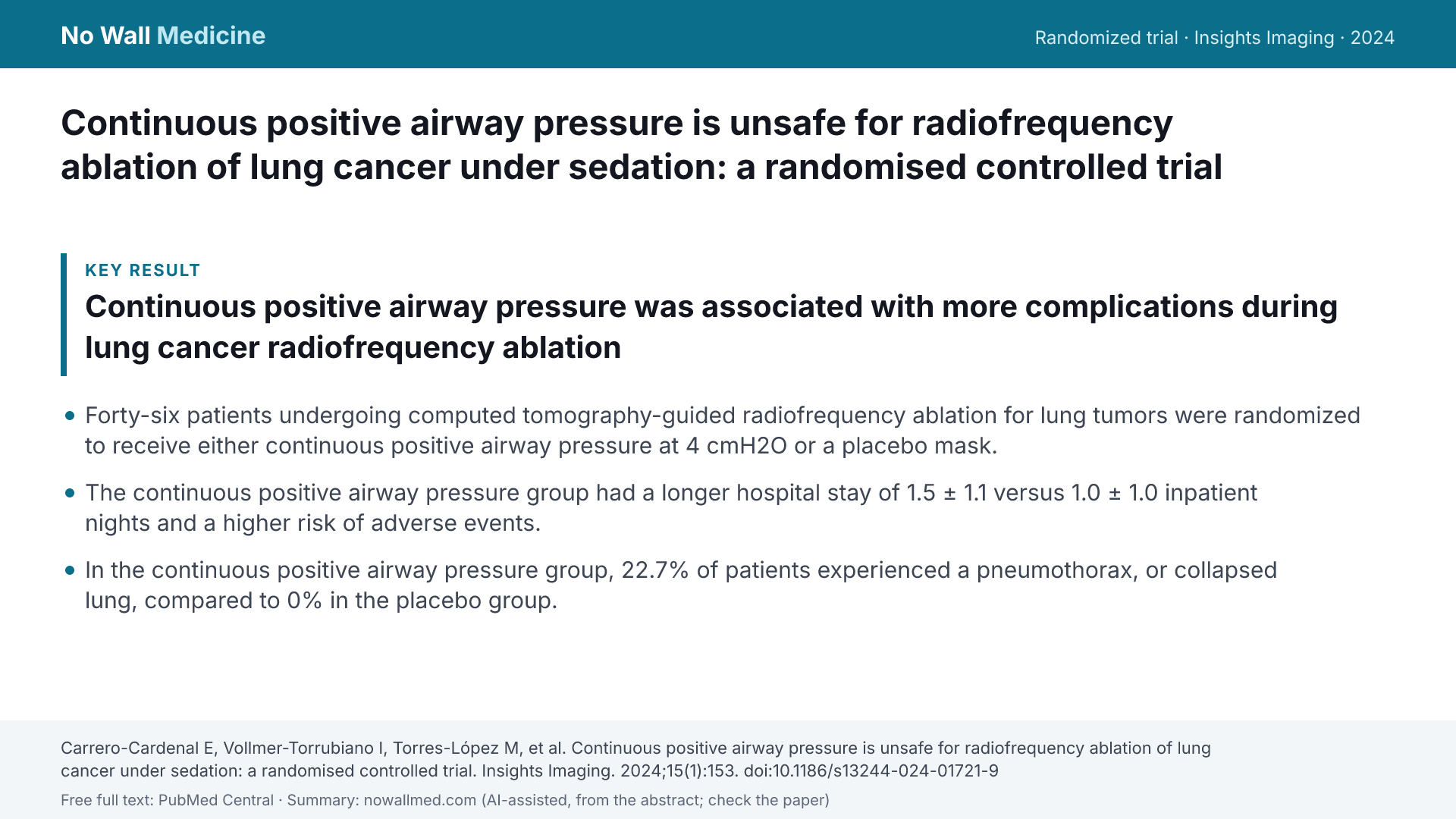
Key result: Continuous positive airway pressure was associated with more complications during lung cancer radiofrequency ablation
Key points
- Forty-six patients undergoing computed tomography-guided radiofrequency ablation for lung tumors were randomized to receive either continuous positive airway pressure at 4 cmH2O or a placebo mask.
- The continuous positive airway pressure group had a longer hospital stay of 1.5 ± 1.1 versus 1.0 ± 1.0 inpatient nights and a higher risk of adverse events.
- In the continuous positive airway pressure group, 22.7% of patients experienced a pneumothorax, or collapsed lung, compared to 0% in the placebo group.
Discussion prompts
- Would these patients look like yours? Who was left out?
- Is the main outcome one that matters to patients?
- Is the difference large enough to change what you do?
Cite: Carrero-Cardenal E, Vollmer-Torrubiano I, Torres-López M, et al. Continuous positive airway pressure is unsafe for radiofrequency ablation of lung cancer under sedation: a randomised controlled trial. Insights Imaging. 2024;15(1):153. doi:10.1186/s13244-024-01721-9
Free full text: PubMed Central · Summary and visual abstract: nowallmed.com/a/continuous-positive-airway-pressure-is-unsafe-for-radiofrequency-umheqf/ (AI-assisted from the abstract; check the paper before relying on it).