Continuous Positive Airway Pressure Treatment and Hypertensive Adverse Outcomes in Pregnancy: A Systematic Review and Meta-Analysis
Systematic review and meta-analysisBenefit found
Does continuous positive airway pressure reduce adverse hypertensive outcomes during pregnancy in women with obstructive sleep apnea?
Who
809
Pregnant women with obstructive sleep apnea
Compared
Continuous positive airway pressure use
Non-continuous positive airway pressure use
Main outcome
Gestational hypertension and preeclampsia
Result: risk ratio 0.65 (95% CI 0.47-0.89) for gestational hypertension and 0.70 (95% CI 0.50-0.98) for preeclampsia
Bottom line: Continuous positive airway pressure treatment may reduce the risk of gestational hypertension and preeclampsia in pregnant women with obstructive sleep apnea.
JAMA Netw Open · 2024-08-01Download image
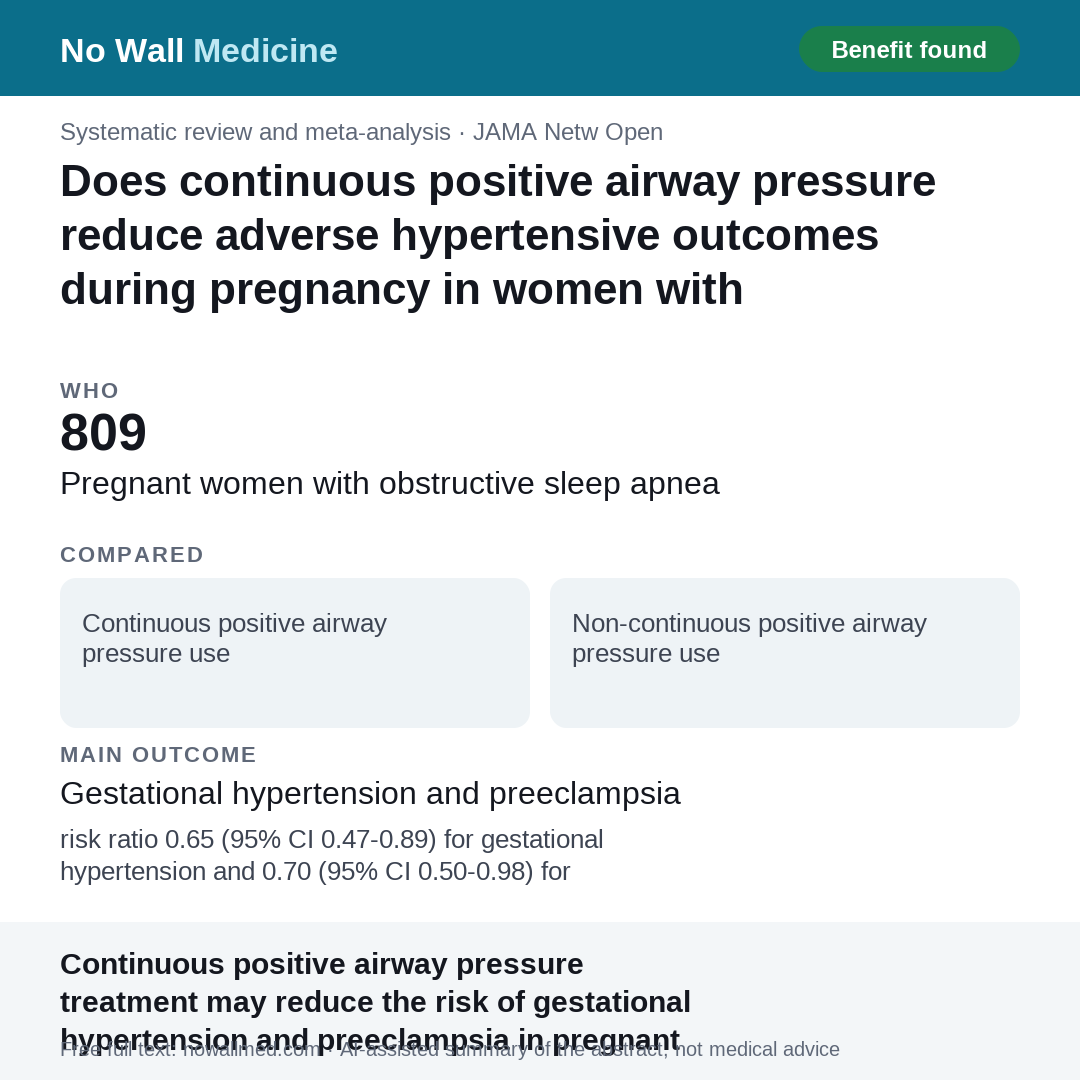
Clinical question: Does continuous positive airway pressure reduce adverse hypertensive outcomes during pregnancy in women with obstructive sleep apnea?
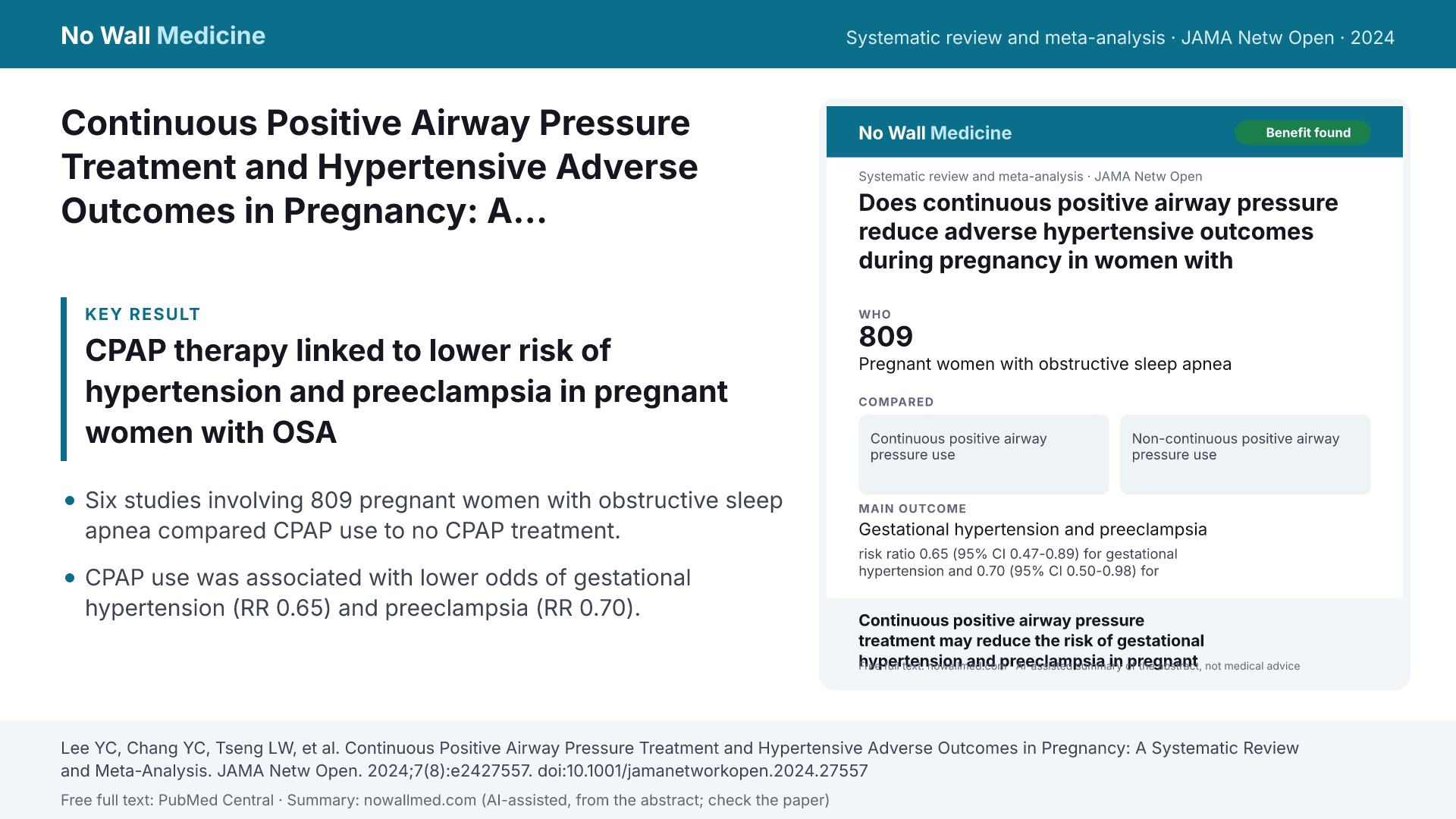
Abstract
Importance
Pregnancy may contribute to the development or exacerbation of obstructive sleep apnea (OSA) and increase the risk of gestational complications. Continuous positive airway pressure (CPAP) is the first-line and criterion standard treatment for OSA and is regarded as the most feasible choice during pregnancy. However, the association between CPAP therapy in pregnant women with OSA and reduced gestational complications remains inconclusive. Objective
To investigate the association between CPAP therapy in pregnant women with OSA and the reduction of adverse hypertensive outcomes during gestation. Data sources
Keyword searches of PubMed, Embase, and the Cochrane Database of Systematic Reviews and Clinical Trials were conducted from inception to November 5, 2023. Study selection
Original studies reporting the treatment effect of CPAP use on lowering hypertension and preeclampsia risks in pregnant women with OSA were selected. Data extraction and synthesis
The Preferred Reporting Items for Systematic Reviews and Meta-Analyses (PRISMA) guideline was followed in the reporting of reviews. Data were independently extracted by 2 authors. Random-effects model meta-analyses were performed and risk ratios (RRs) reported. Subgroup analysis, meta-regression based on age and body mass index (BMI; calculated as weight in kilograms divided by height in meters squared), and publication bias assessment were also conducted. Main outcome and measures
The primary outcome was the RR of gestational hypertension and preeclampsia between pregnant women with OSA receiving CPAP treatment and those who did not receive CPAP treatment. Results
Six original studies in 809 participants (mean age, 31.4 years; mean BMI, 34.0) were identified and systematically reviewed for meta-analysis. The pooled results showed significant differences between the intervention (CPAP use) and the control (non-CPAP use) groups in reducing the risk of gestational hypertension (RR, 0.65; 95% CI, 0.47-0.89; P = .008) and preeclampsia (RR, 0.70; 95% CI, 0.50-0.98; P = .04). Meta-regression revealed that patients' age (coefficient, -0.0190; P = .83) and BMI (coefficient, -0.0042; P = .87) were not correlated with reduction of risk of hypertension and preeclampsia. Conclusions and relevance
These findings suggest that implementing CPAP treatment in pregnant women with OSA may reduce the risk of gestational hypertension and preeclampsia.
Subject terms
Cite this article
Lee YC, Chang YC, Tseng LW, et al. Continuous Positive Airway Pressure Treatment and Hypertensive Adverse Outcomes in Pregnancy: A Systematic Review and Meta-Analysis. JAMA Netw Open. 2024. doi:10.1001/jamanetworkopen.2024.27557
Spotted a mistake? Suggest a correction