Continuous norepinephrine infusion provided more stable blood pressure than manual boluses during anesthesia induction
Continuous versus bolus norepinephrine administration and arterial blood pressure stability during induction of general anaesthesia in high-risk noncardiac surgery patients: a randomised trial
Randomised trialBenefit found
Does continuous versus bolus norepinephrine administration improve blood pressure stability during induction?
Who
71
High-risk noncardiac surgery patients · Single-centre trial
Compared
Continuous norepinephrine infusion: 19 (6) mm Hg min-1
Manual bolus norepinephrine administration: 25 (7) mm Hg min-1
Main outcome
Generalised average real variability of mean arterial pressure
Bottom line: Continuous norepinephrine infusion improved blood pressure stability compared to manual boluses during induction of general anaesthesia.
Br J Anaesth · 2025-07-30Download image
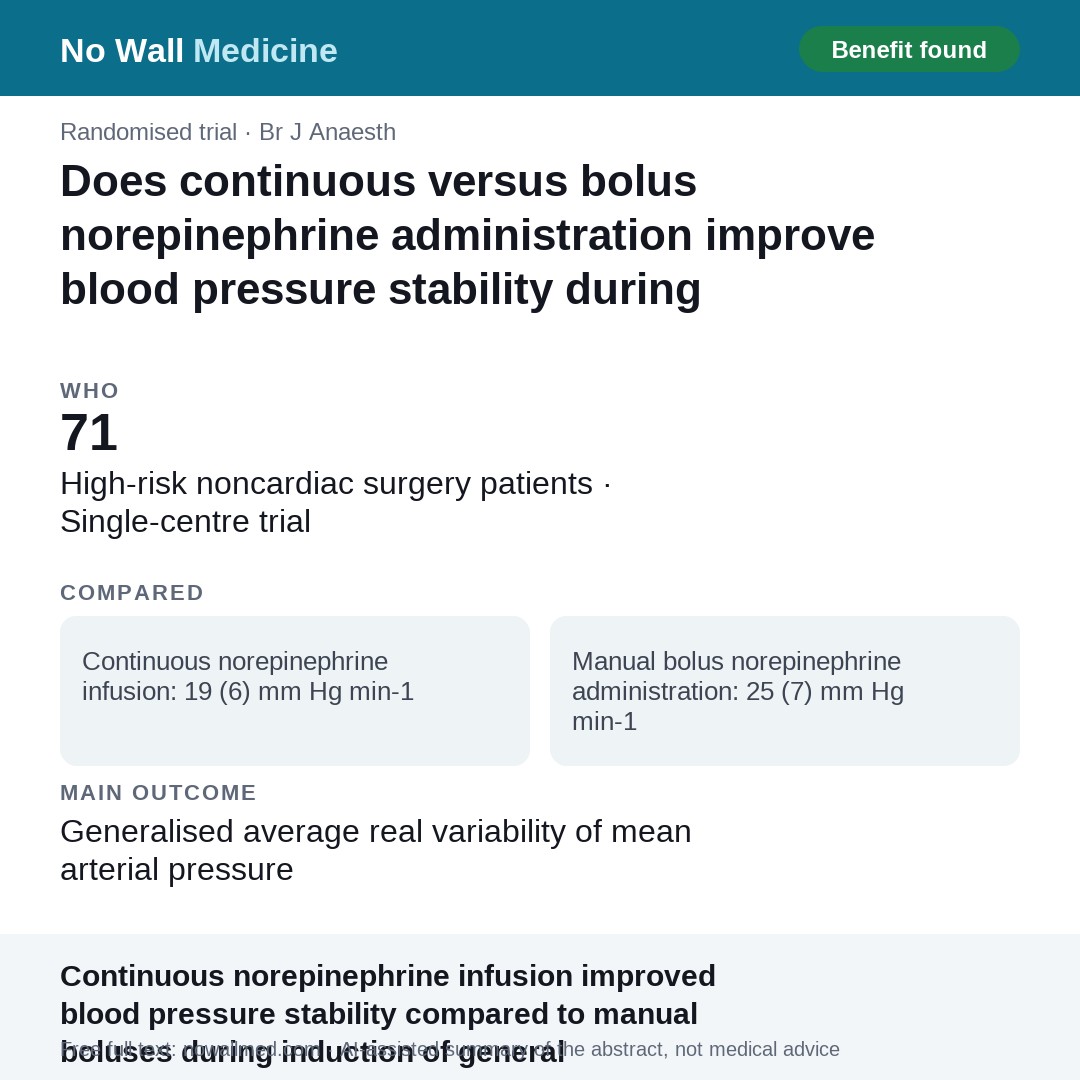
Clinical question: Does continuous versus bolus norepinephrine administration improve blood pressure stability during induction?
Why it matters: Anesthesiologists often use repeated manual boluses of norepinephrine to maintain blood pressure, but it is unclear if continuous infusion provides better stability during anesthesia induction.
Key points
- The study randomized 72 high-risk noncardiac surgery patients to receive either continuous norepinephrine infusion or repeated manual boluses of the medication.
- Continuous infusion resulted in a mean generalized average real variability of mean arterial pressure of 19 (6) mm Hg min-1 compared to 25 (7) mm Hg min-1 for manual boluses.
- The study included 71 participants who completed the trial, with a mean age of 66 years and 48% female.
Headline and key points written with AI from the paper’s abstract, with every number checked against it. Read the paper before relying on them.
Topics
Cite this article
Vokuhl C, Kouz K, Flick M, Krause L, Kröker A, Moll-Khosrawi P. Continuous versus bolus norepinephrine administration and arterial blood pressure stability during induction of general anaesthesia in high-risk noncardiac surgery patients: a randomised trial. Br J Anaesth. 2025. doi:10.1016/j.bja.2025.06.025
Spotted a mistake? Suggest a correction
Top studies every Monday
The week’s key trials and guidelines in your specialties, by email. Free.
Get the weekly digest