Continuous vs Intermittent Postoperative Vital Sign Monitoring: A Cluster Randomized Crossover Trial
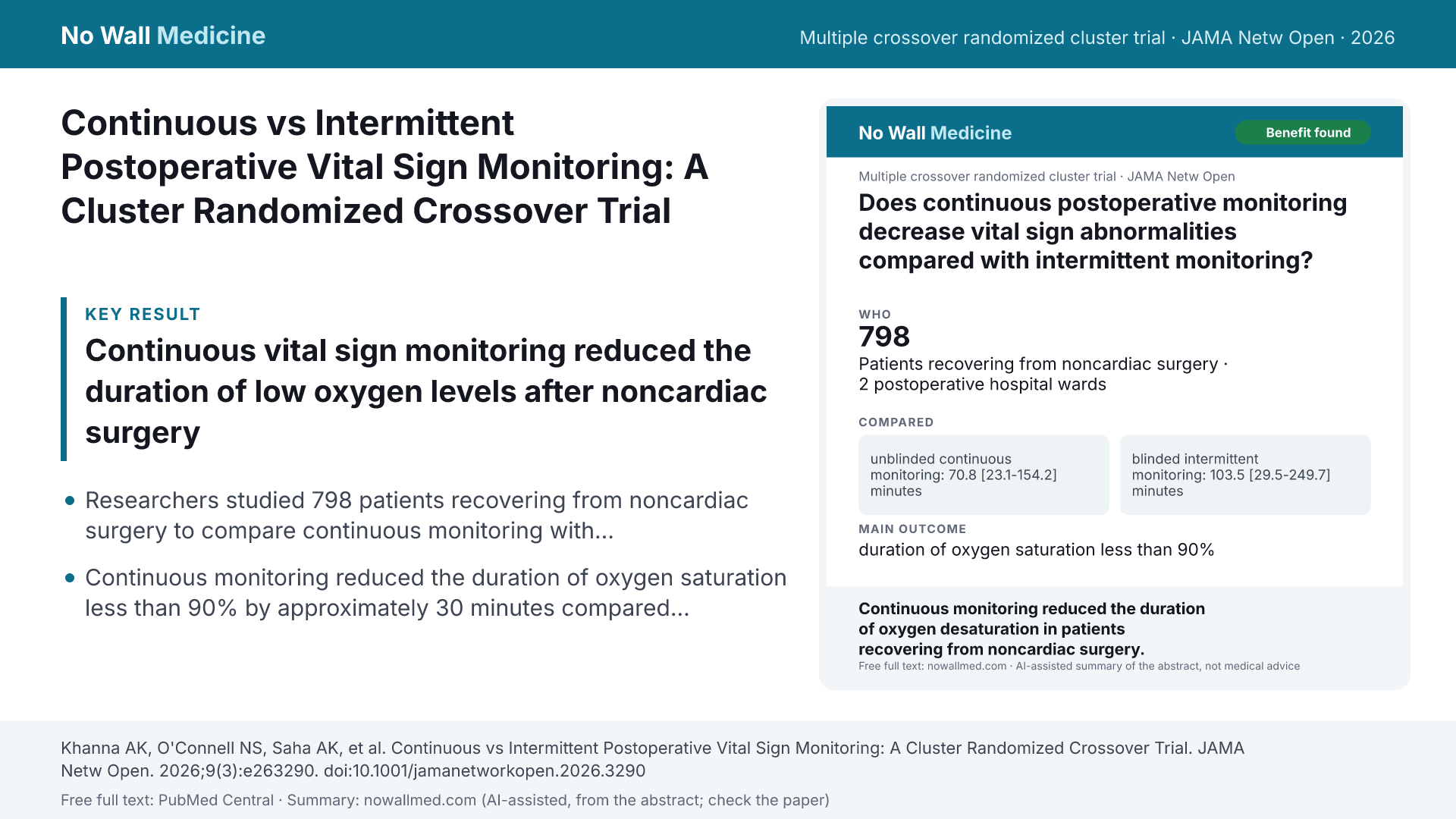
Key result: Continuous vital sign monitoring reduced the duration of low oxygen levels after noncardiac surgery
Multiple crossover randomized cluster trialBenefit found
Does continuous postoperative monitoring decrease vital sign abnormalities compared with intermittent monitoring?
Who
798
Patients recovering from noncardiac surgery · 2 postoperative hospital wards
Compared
unblinded continuous monitoring: 70.8 [23.1-154.2] minutes
blinded intermittent monitoring: 103.5 [29.5-249.7] minutes
Main outcome
duration of oxygen saturation less than 90%
Result: geometric means ratio, 0.86 [95% CI, 0.78-0.95]
Bottom line: Continuous monitoring reduced the duration of oxygen desaturation in patients recovering from noncardiac surgery.
JAMA Netw Open · 2026-03-02
Key points
- Researchers studied 798 patients recovering from noncardiac surgery to compare continuous monitoring with intermittent monitoring.
- Continuous monitoring reduced the duration of oxygen saturation less than 90% by approximately 30 minutes compared to intermittent monitoring.
- The durations of low blood pressure and high heart rate were not significantly reduced by continuous monitoring.
Discussion prompts
- Would these patients look like yours? Who was left out?
- Is the main outcome one that matters to patients?
- Is the difference large enough to change what you do?
Cite: Khanna AK, O'Connell NS, Saha AK, et al. Continuous vs Intermittent Postoperative Vital Sign Monitoring: A Cluster Randomized Crossover Trial. JAMA Netw Open. 2026;9(3):e263290. doi:10.1001/jamanetworkopen.2026.3290
Free full text: PubMed Central · Summary and visual abstract: nowallmed.com/a/continuous-vs-intermittent-postoperative-vital-sign-monitoring-a-j7x2a2/ (AI-assisted from the abstract; check the paper before relying on it).