Contralateral mononostril endoscopic surgery was used to treat a rare cavernous sinus epidermoid cyst
Contralateral mononostril endoscopic chopsticks technique for an intracavernous epidermoid cyst. Technical case report and systematic review of the literature
Case report and systematic reviewBenefit found
Which surgical approach best balances morbidity for pure intracavernous epidermoid cysts?
Who
53
Patients with pure intracavernous epidermoid cysts
Compared
92.5%Transcranial approaches
Extended endonasal and transorbital approaches: 3.8% each
Main outcome
Surgical approach and resection completeness
Bottom line: Contralateral mononostril endoscopic chopsticks technique offers a minimally invasive option for selected pure intracavernous epidermoid cysts.
Brain Spine · 2026-02-17Download image
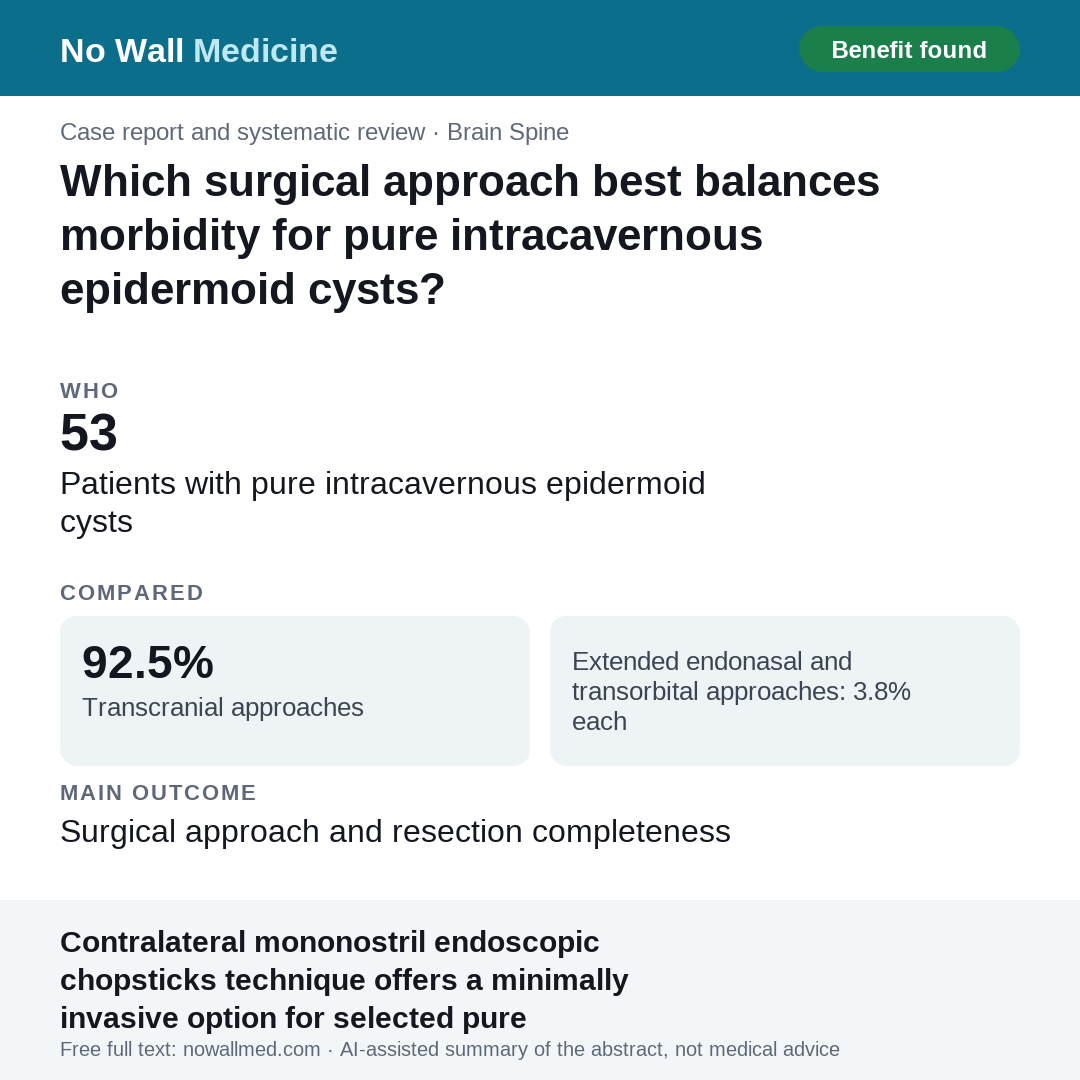
Clinical question: Which surgical approach best balances morbidity for pure intracavernous epidermoid cysts?
Key points
- A 23-year-old man with a left intracavernous epidermoid cyst underwent surgery using the Endoscopic Chopsticks Technique through a single nostril on the opposite side.
- A systematic review of 53 cases from 18 articles showed that transcranial approaches were used in 92.5% of cases, while extended endonasal and transorbital approaches were used in 3.8% each.
- In the reviewed literature, partial capsule resection, which is the removal of only part of the cyst's outer layer, was performed in 58.5% of cases and in 66.6% of pure intracavernous epidermoid cysts.
Headline and key points written with AI from the paper’s abstract, with every number checked against it. Read the paper before relying on them.
Cite this article
Ferlendis L, Fava A, Chainey J, Passeri T, Justo J, Froelich S. Contralateral mononostril endoscopic chopsticks technique for an intracavernous epidermoid cyst. Technical case report and systematic review of the literature. Brain Spine. 2026. doi:10.1016/j.bas.2026.105980
Spotted a mistake? Suggest a correction