Contrast clearance analysis shows high accuracy in distinguishing tumor progression from posttreatment changes
Contrast clearance analysis in neuro-oncology: A systematic review and meta-analysis on differentiating posttreatment changes from tumor progression
Systematic review and meta-analysisKey finding
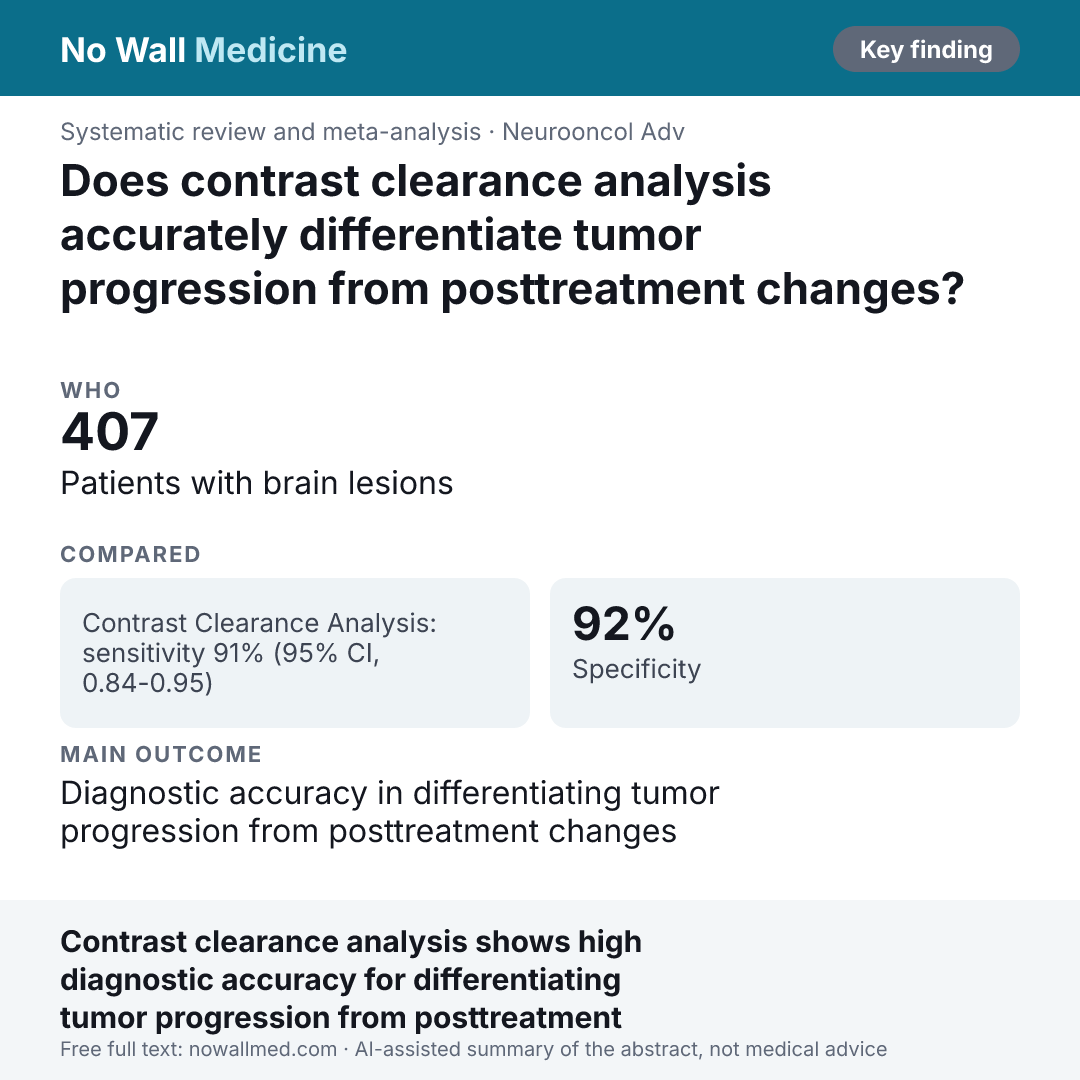
Does contrast clearance analysis accurately differentiate tumor progression from posttreatment changes?
Who
407
Patients with brain lesions
Compared
Contrast Clearance Analysis: sensitivity 91% (95% CI, 0.84-0.95)
92%Specificity (95% CI, 0.87-0.95)
Main outcome
Diagnostic accuracy in differentiating tumor progression from posttreatment changes
Result: AUC 88%
Bottom line: Contrast clearance analysis shows high diagnostic accuracy for differentiating tumor progression from posttreatment changes.
Limitation: Considerable risk of bias in the reference test domain and variability in reference standards.
Neurooncol Adv · 2025-07-19 · Save PNG
Clinical question: Does contrast clearance analysis accurately differentiate tumor progression from posttreatment changes?
Why it matters: Clinicians face challenges in distinguishing between actual tumor growth and changes caused by treatments like radiation necrosis or pseudoprogression.
Key points
- Researchers analyzed nine studies involving 240 patients and 407 brain lesions to evaluate contrast clearance analysis, a tool used to assess treatment response.
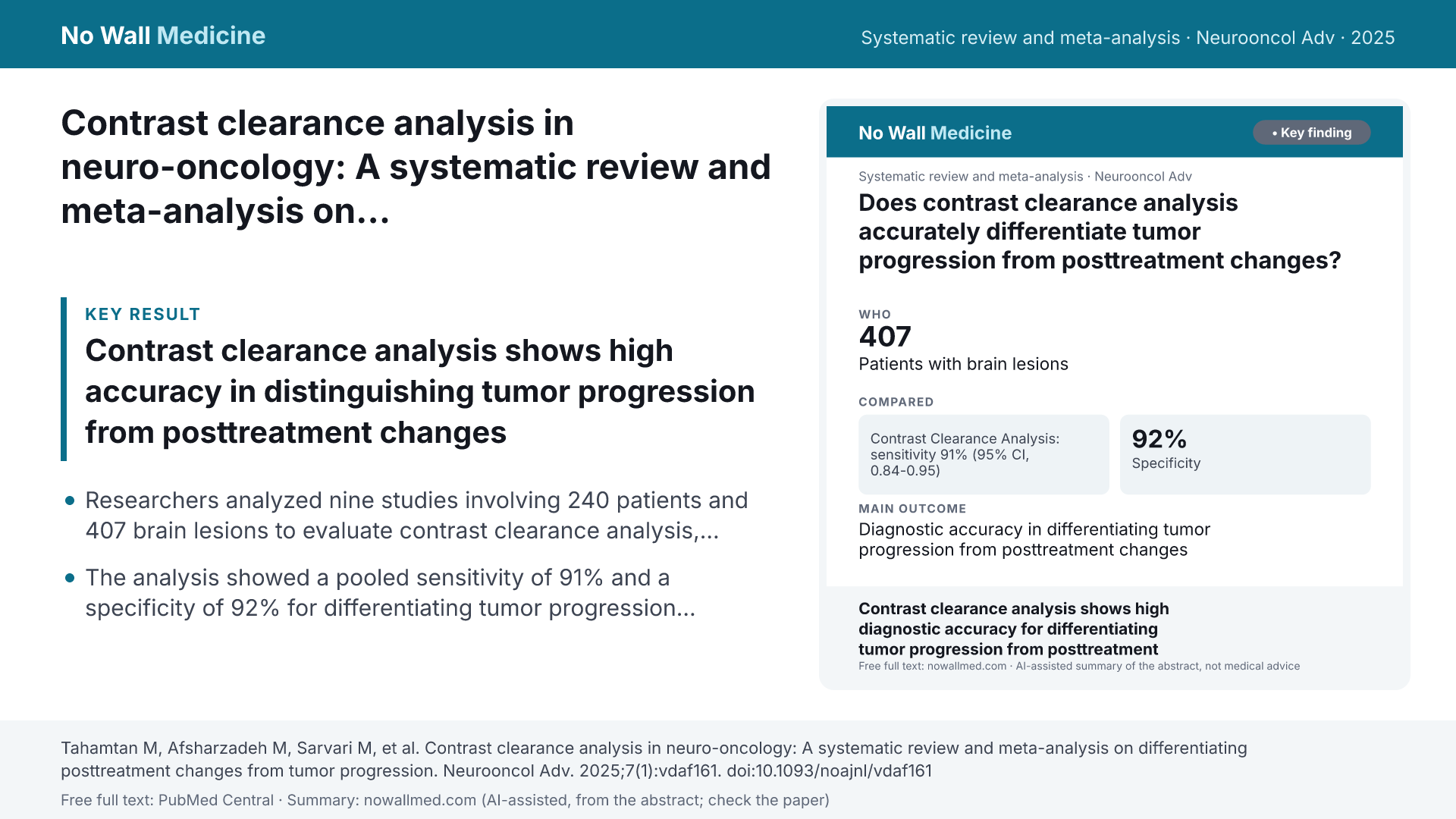
- The analysis showed a pooled sensitivity of 91% and a specificity of 92% for differentiating tumor progression from treatment-induced changes.
- Contrast clearance analysis had an area under the curve of 88% and performed as well as or better than magnetic resonance perfusion or spectroscopy.
Limitation the authors note: The authors noted a considerable risk of bias in the reference test domain and variability in reference standards.
Headline and key points written with AI from the paper’s abstract, with every number checked against it. Read the paper before relying on them.
Was this summary helpful?
Headline, design, result, key points, caveat and citation as plain text.
Cite this article
Tahamtan M, Afsharzadeh M, Sarvari M, et al. Contrast clearance analysis in neuro-oncology: A systematic review and meta-analysis on differentiating posttreatment changes from tumor progression. Neurooncol Adv. 2025;7(1):vdaf161. doi:10.1093/noajnl/vdaf161
Spotted a mistake? Suggest a correction