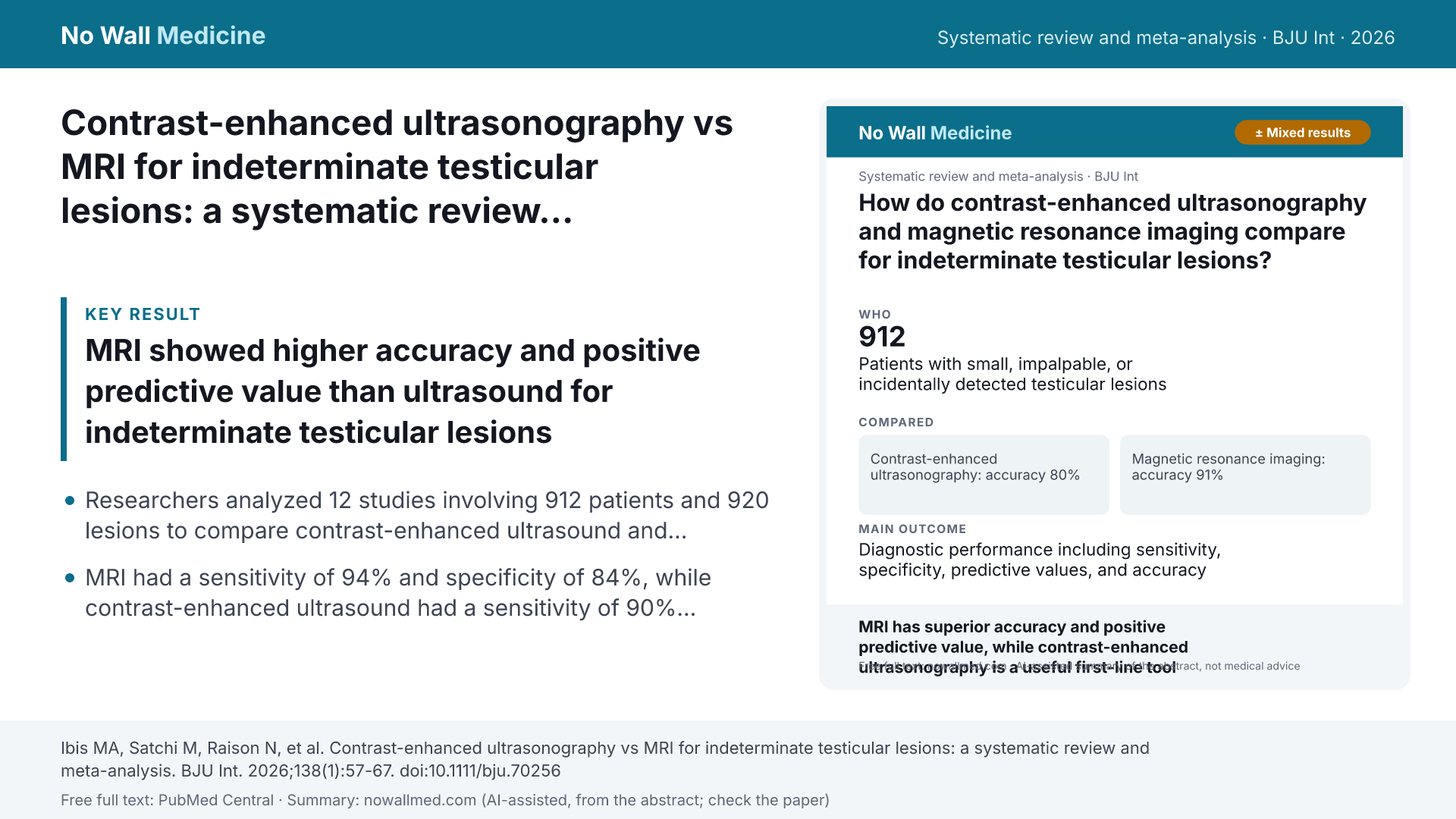
MRI showed higher accuracy and positive predictive value than ultrasound for indeterminate testicular lesions
Contrast-enhanced ultrasonography vs MRI for indeterminate testicular lesions: a systematic review and meta-analysis
Systematic review and meta-analysisMixed results
How do contrast-enhanced ultrasonography and magnetic resonance imaging compare for indeterminate testicular lesions?
Who
912
Patients with small, impalpable, or incidentally detected testicular lesions
Compared
Contrast-enhanced ultrasonography: accuracy 80%
Magnetic resonance imaging: accuracy 91%
Main outcome
Diagnostic performance including sensitivity, specificity, predictive values, and accuracy
Result: Differences in positive predictive value and accuracy significantly favoured MRI (P = 0.025 and P = 0.031)
Bottom line: MRI has superior accuracy and positive predictive value, while contrast-enhanced ultrasonography is a useful first-line tool due to high negative predictive value.
Limitation: Protocol heterogeneity, operator dependence, and small sample sizes.
BJU Int · 2026-03-24 · Save PNG
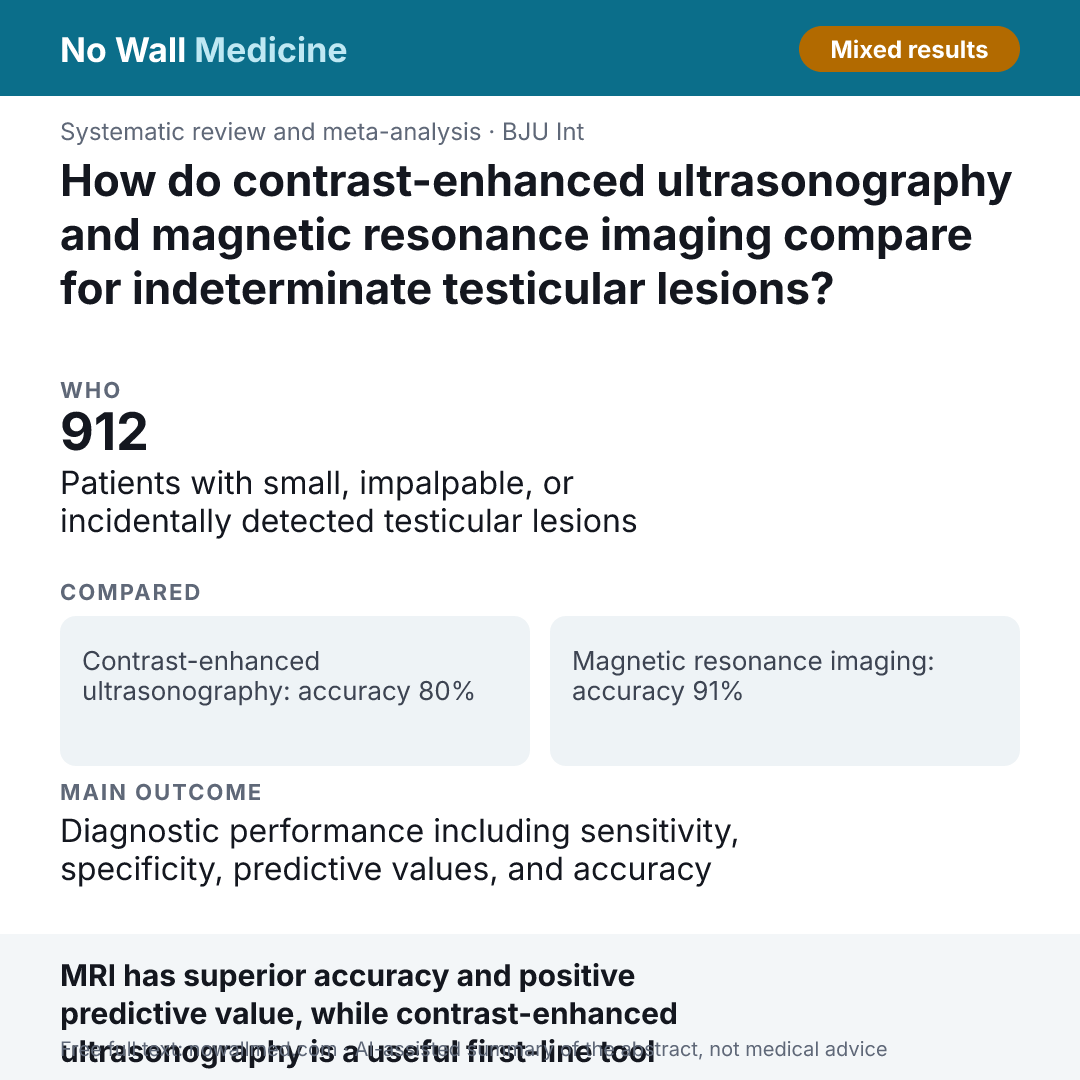
Clinical question: How do contrast-enhanced ultrasonography and magnetic resonance imaging compare for indeterminate testicular lesions?
Key points
- Researchers analyzed 12 studies involving 912 patients and 920 lesions to compare contrast-enhanced ultrasound and magnetic resonance imaging.
- MRI had a sensitivity of 94% and specificity of 84%, while contrast-enhanced ultrasound had a sensitivity of 90% and specificity of 74%.
- MRI was associated with a higher positive predictive value of 83% compared to 65% for ultrasound, and higher accuracy of 91% compared to 80%.
Limitation the authors note: The authors noted protocol heterogeneity, operator dependence, and small sample sizes as limitations.
Headline and key points written with AI from the paper’s abstract, with every number checked against it. Read the paper before relying on them.
Was this summary helpful?
Subject terms
Headline, design, result, key points, caveat and citation as plain text.
Cite this article
Ibis MA, Satchi M, Raison N, et al. Contrast-enhanced ultrasonography vs MRI for indeterminate testicular lesions: a systematic review and meta-analysis. BJU Int. 2026;138(1):57-67. doi:10.1111/bju.70256
Spotted a mistake? Suggest a correction