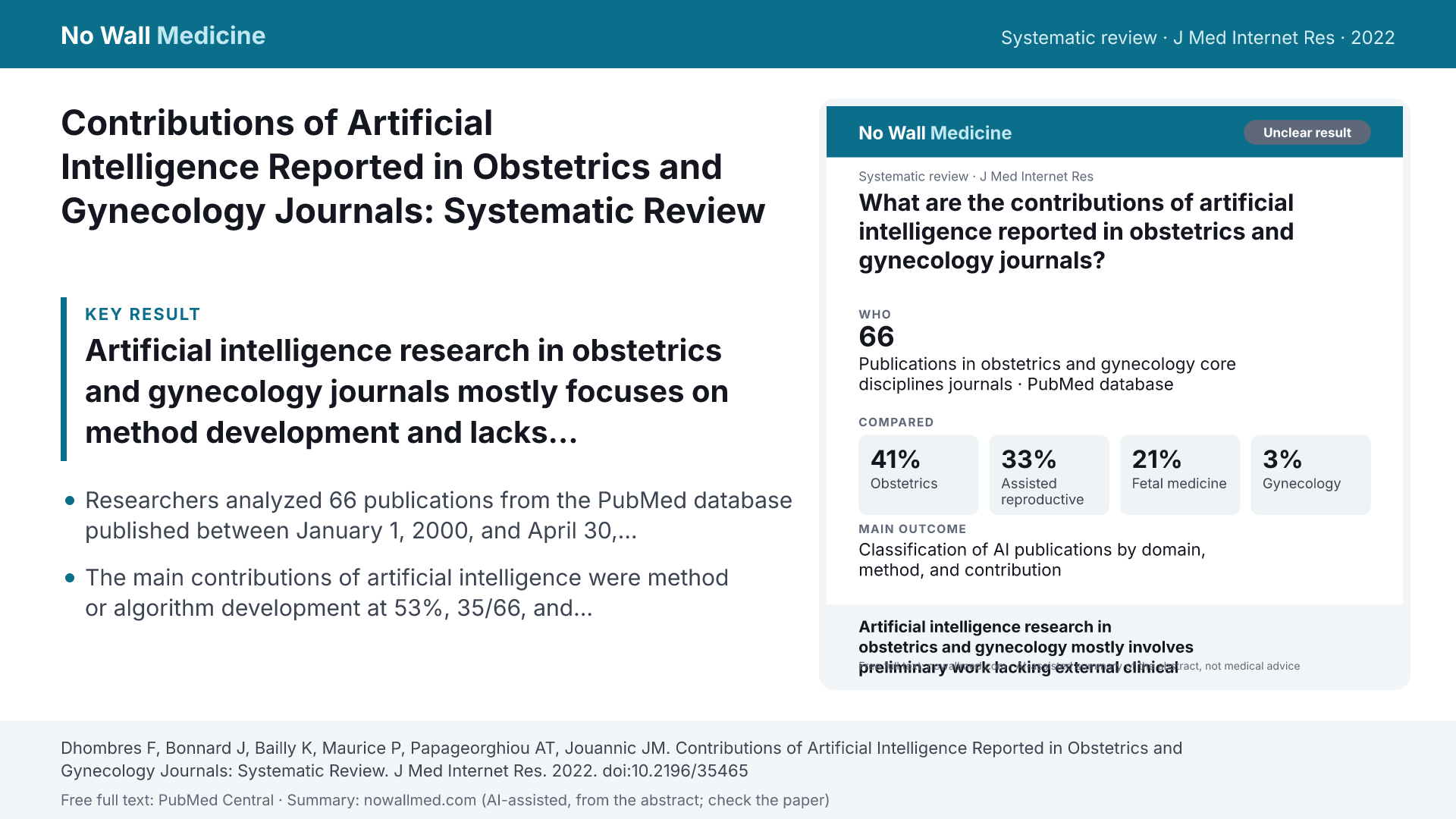
Contributions of Artificial Intelligence Reported in Obstetrics and Gynecology Journals: Systematic Review
Key result: Artificial intelligence research in obstetrics and gynecology journals mostly focuses on method development and lacks external validation
Key points
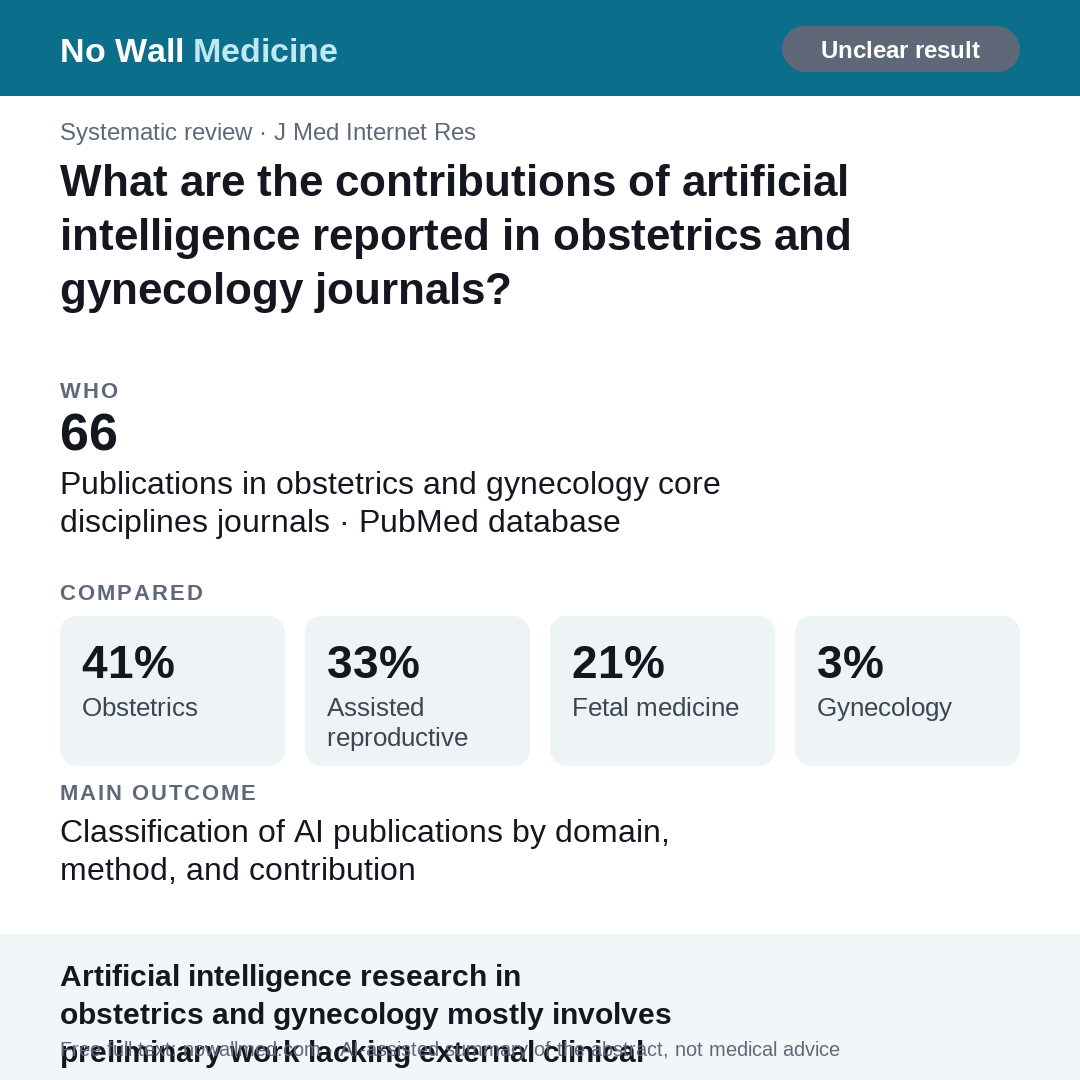
- Researchers analyzed 66 publications from the PubMed database published between January 1, 2000, and April 30, 2020, regarding artificial intelligence in obstetrics and gynecology.
- The main contributions of artificial intelligence were method or algorithm development at 53%, 35/66, and hypothesis generation at 42%, 28/66.
- Validation was performed on only one data set in 86%, 57/66 of the publications, and no external validation was reported.
Why it matters: The actual contributions and the level of clinical validation for artificial intelligence processes in obstetrics and gynecology disciplines were unknown.
Discussion prompts
- Would these patients look like yours? Who was left out?
- Is the main outcome one that matters to patients?
- Is the difference large enough to change what you do?
Cite: Dhombres F, Bonnard J, Bailly K, Maurice P, Papageorghiou AT, Jouannic JM. Contributions of Artificial Intelligence Reported in Obstetrics and Gynecology Journals: Systematic Review. J Med Internet Res. 2022. doi:10.2196/35465
Free full text: PubMed Central · Summary and visual abstract: nowallmed.com/a/contributions-of-artificial-intelligence-reported-in-obstetrics-and-1goe73e/ (AI-assisted from the abstract; check the paper before relying on it).