Novel anal insert did not significantly reduce fecal incontinence severity compared to usual care
Controlling Fecal Incontinence With a Novel Anal Device: A Randomized Clinical Trial
Multicenter, open-label, randomized clinical superiority trialNo clear difference
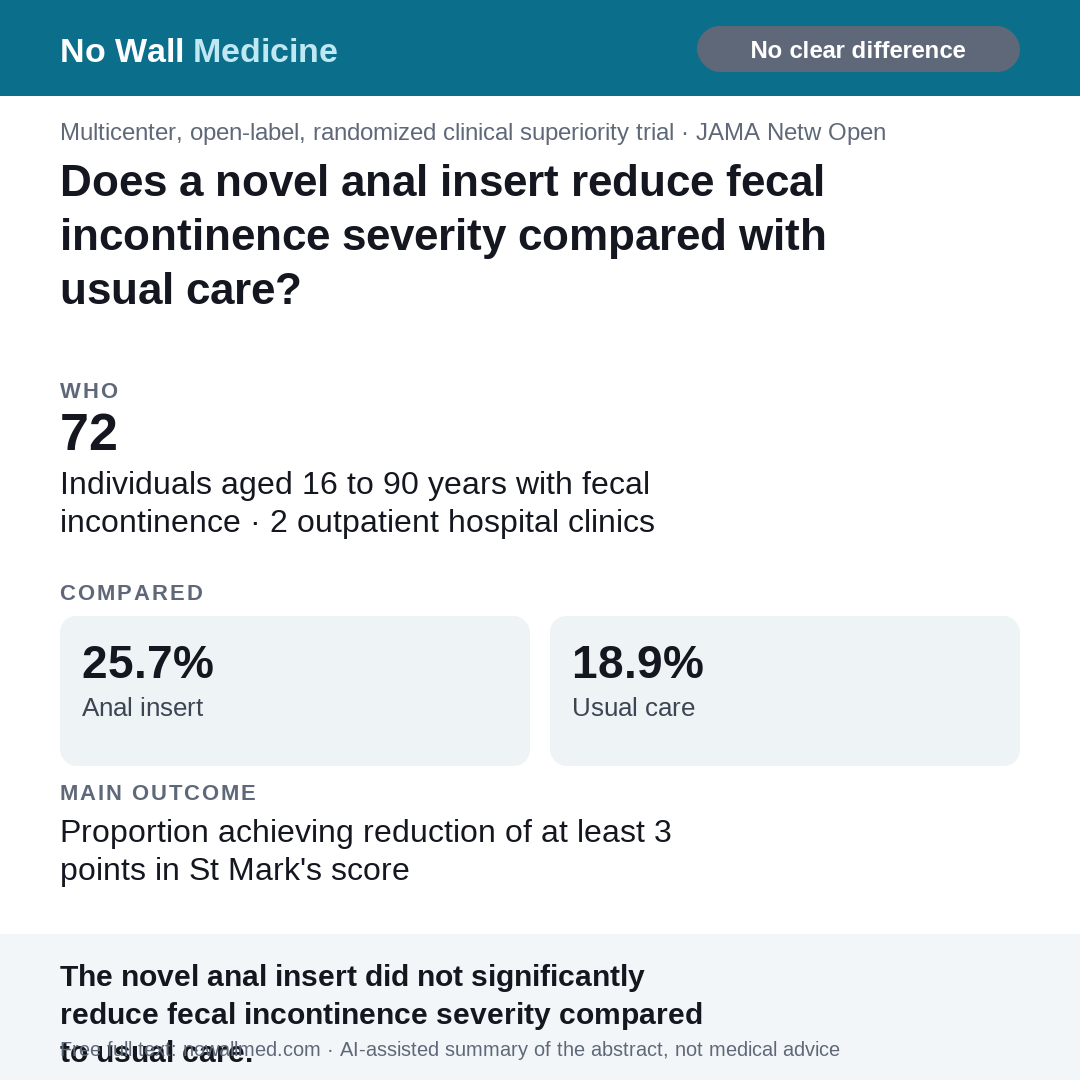
Does a novel anal insert reduce fecal incontinence severity compared with usual care?
Who
72
Individuals aged 16 to 90 years with fecal incontinence · 2 outpatient hospital clinics in the Netherlands
Compared
25.7%Anal insert (9/35)
18.9%Usual care (7/37)
Main outcome
Proportion achieving reduction of at least 3 points in St Mark's score
Result: relative risk 1.36 (95% CI 0.57 to 3.25)
Bottom line: The novel anal insert did not significantly reduce fecal incontinence severity compared to usual care.
JAMA Netw Open · 2026-04-01Download image
Clinical question: Does a novel anal insert reduce fecal incontinence severity compared with usual care?
Why it matters: Evidence is limited regarding the effectiveness of minimally invasive alternatives, such as anal inserts, for treating fecal incontinence.
Key points
- Researchers studied 72 participants, including 35 receiving a single-use anal insert and 37 receiving usual care, to measure changes in fecal incontinence severity.
- The study found no significant difference in the proportion of participants achieving at least a 3-point reduction in the St Mark's incontinence score.
- The anal insert reduced weekly fecal incontinence episodes by an estimated mean difference of -3.09 and improved certain quality-of-life domains like coping and depression.
Headline and key points written with AI from the paper’s abstract, with every number checked against it. Read the paper before relying on them.
Topics
Spotted a mistake? Suggest a correction