Hypofractionated proton radiation therapy showed no significant difference in complication rates compared to conventional treatment
Conventional versus hypofractionated postmastectomy proton radiotherapy in the USA (MC1631): a randomised phase 2 trial
Randomised phase 2 trialUnclear result
Is hypofractionated proton radiotherapy non-inferior to conventional fractionation for postmastectomy patients?
Who
88
Adults with breast cancer resected by mastectomy requiring radiotherapy · Mayo Clinic, USA
Compared
15%Conventional fractionation
20%Hypofractionation
Main outcome
24-month complication rate
Result: absolute difference 4.9% (one-sided 95% CI 18.5)
Bottom line: Hypofractionated proton radiotherapy showed similar tolerability but non-inferiority could not be established for the complication rate.
Limitation: non-inferiority of the hypofractionation group could not be established
Funded by: Mayo Clinic and US National Cancer Institute
Lancet Oncol · 2023-09-08Download image
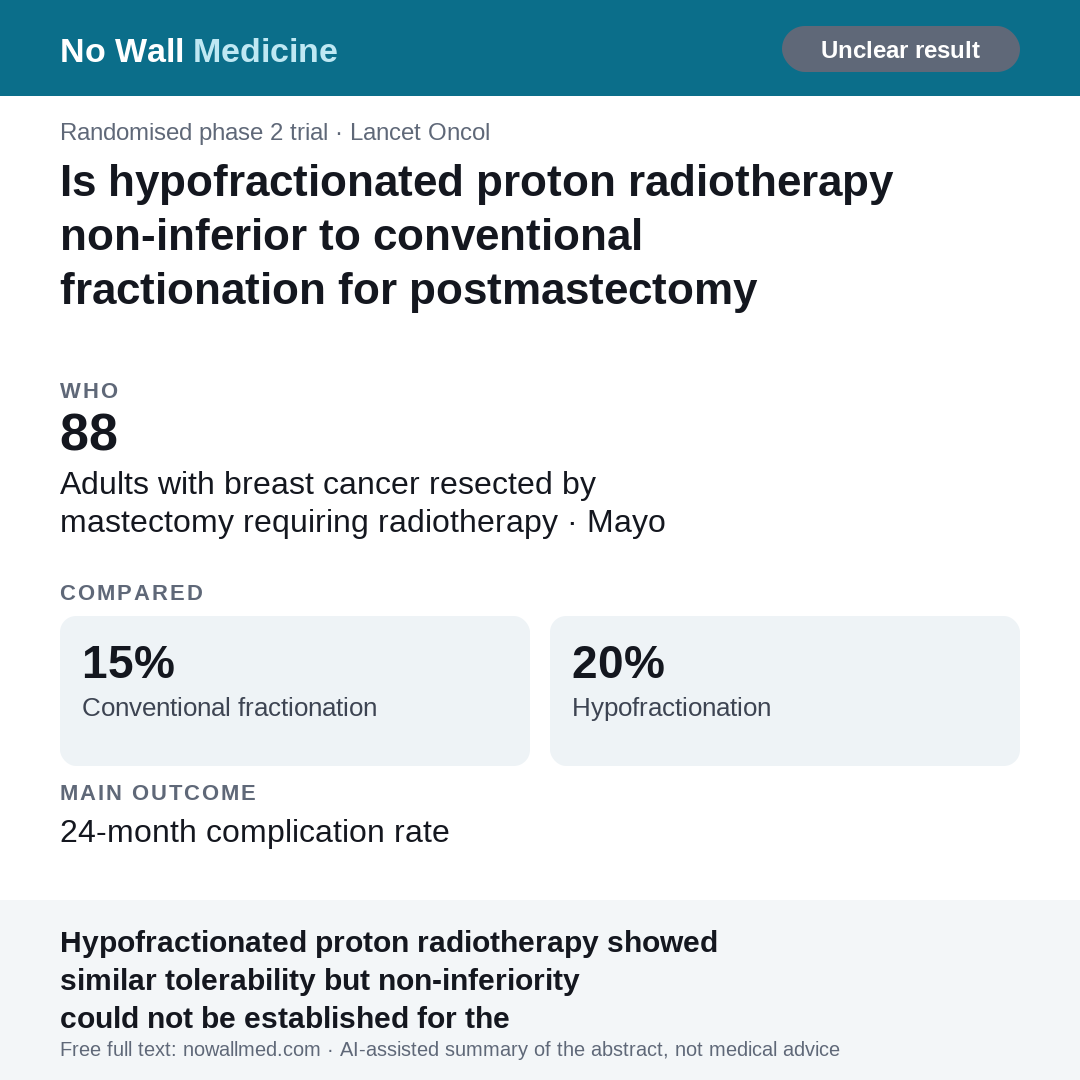
Clinical question: Is hypofractionated proton radiotherapy non-inferior to conventional fractionation for postmastectomy patients?
Why it matters: It is unclear if hypofractionated proton radiation therapy is a feasible alternative to conventional fractionation for patients requiring radiation after a mastectomy.
Key points
- Researchers randomized 88 patients with breast cancer to receive either conventional proton radiation over 25-28 days or hypofractionated proton radiation over fewer sessions.
- Within 24 months, complications occurred in 15% of the conventional group and 20% of the hypofractionated group, an absolute difference of 4.9% (p=0.27).
- All 14 recorded complications occurred in patients who had immediate breast reconstruction using an expander or implant.
Headline and key points written with AI from the paper’s abstract, with every number checked against it. Read the paper before relying on them.
Was this summary helpful?
Subject terms
Cite this article
Mutter RW, Giri S, Fruth BF, Remmes NB, Boughey JC, Harless CA. Conventional versus hypofractionated postmastectomy proton radiotherapy in the USA (MC1631): a randomised phase 2 trial. Lancet Oncol. 2023. doi:10.1016/S1470-2045(23)00388-1
Spotted a mistake? Suggest a correction
Top studies every Monday
The week’s key trials and guidelines in your specialties, plus any topics you follow. By email, free.
Get the weekly digest