Video laryngoscopy improved first-pass success rates compared to direct laryngoscopy for routine tracheal intubations
Conventional vs Video-Assisted Laryngoscopy for Perioperative Endotracheal Intubations: A Randomized Clinical Trial
3-arm randomized clinical trialBenefit found
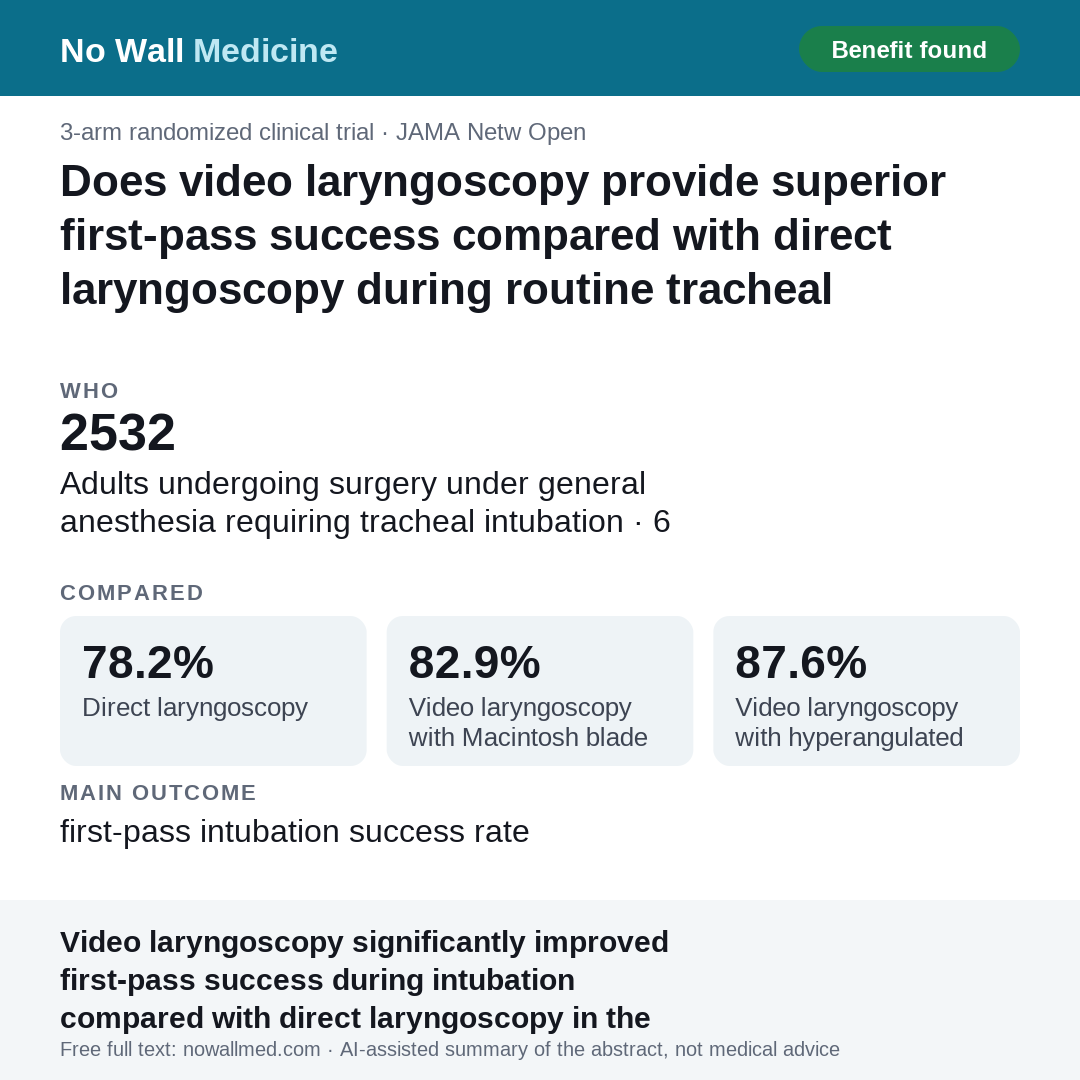
Does video laryngoscopy provide superior first-pass success compared with direct laryngoscopy during routine tracheal intubations?
Who
2532
Adults undergoing surgery under general anesthesia requiring tracheal intubation · 6 academic or intermediate care centers in Germany and Austria
Compared
78.2%Direct laryngoscopy
82.9%Video laryngoscopy with Macintosh blade
87.6%Video laryngoscopy with hyperangulated blade
Main outcome
first-pass intubation success rate
Bottom line: Video laryngoscopy significantly improved first-pass success during intubation compared with direct laryngoscopy in the operating room.
JAMA Netw Open · 2026-08-03Download image
Clinical question: Does video laryngoscopy provide superior first-pass success compared with direct laryngoscopy during routine tracheal intubations?
Why it matters: Evidence regarding the clinical outcomes of using video laryngoscopy for routine tracheal intubation in the operating room remains inconclusive.
Key points
- Researchers studied 2532 adults across six centers in Germany and Austria, comparing direct laryngoscopy to video laryngoscopy with Macintosh blades or hyperangulated blades.
- Both video laryngoscopy methods had higher first-pass success rates than direct laryngoscopy, with rates of 82.9% for Macintosh blades, 87.6% for hyperangulated blades, and 78.2% for direct laryngoscopy.
- Hyperangulated video laryngoscopy resulted in fewer lip or dental injuries or blood on the blade compared to the other two methods.
Headline and key points written with AI from the paper’s abstract, with every number checked against it. Read the paper before relying on them.
Topics
Cite this article
Schmid B, Grüßer L, Müller L, Wittmann M, Delis A, Dinc Dogan T. Conventional vs Video-Assisted Laryngoscopy for Perioperative Endotracheal Intubations: A Randomized Clinical Trial. JAMA Netw Open. 2026. doi:10.1001/jamanetworkopen.2026.25965
Spotted a mistake? Suggest a correction