Switching to belatacept maintenance therapy showed similar graft survival rates compared to continuing calcineurin inhibitors
Conversion from Calcineurin Inhibitor- to Belatacept-Based Maintenance Immunosuppression in Renal Transplant Recipients: A Randomized Phase 3b Trial
Randomized phase 3b trialNo clear difference
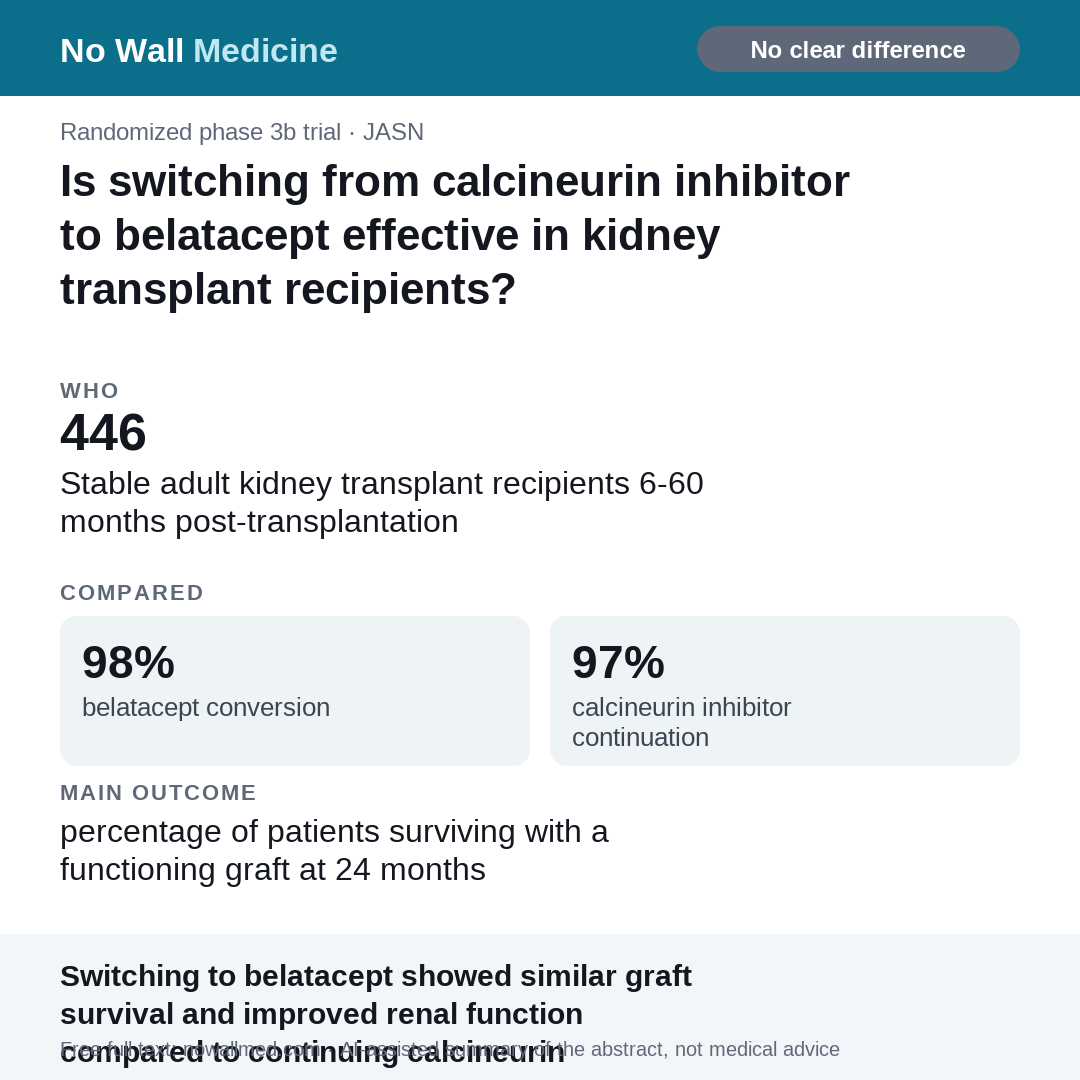
Is switching from calcineurin inhibitor to belatacept effective in kidney transplant recipients?
Who
446
Stable adult kidney transplant recipients 6-60 months post-transplantation
Compared
98%belatacept conversion
97%calcineurin inhibitor continuation
Main outcome
percentage of patients surviving with a functioning graft at 24 months
Result: adjusted difference, 0.8; 95.1% CI, -2.1 to 3.7
Bottom line: Switching to belatacept showed similar graft survival and improved renal function compared to continuing calcineurin inhibitors.
JASN · 2021-12-01Download image
Clinical question: Is switching from calcineurin inhibitor to belatacept effective in kidney transplant recipients?
Why it matters: Calcineurin inhibitors are standard after kidney transplantation but are associated with kidney toxicity and reduced long-term graft survival.
Key points
- Researchers randomized 446 stable adult kidney transplant recipients to either switch to belatacept, a T cell costimulation blocker, or continue their established calcineurin inhibitor treatment.
- At 24 months, graft survival rates were 98% for the belatacept group and 97% for the calcineurin inhibitor group, with an adjusted difference of 0.8.
- The belatacept group had a higher 24-month estimated glomerular filtration rate (a measure of kidney function) of 55.5 ml/min per 1.73 m2 compared to 48.5 ml/min per 1.73 m2.
Headline and key points written with AI from the paper’s abstract, with every number checked against it. Read the paper before relying on them.
Was this summary helpful?
Subject terms
Cite this article
Budde K, Prashar R, Haller H, Rial MC, Kamar N, Agarwal A. Conversion from Calcineurin Inhibitor- to Belatacept-Based Maintenance Immunosuppression in Renal Transplant Recipients: A Randomized Phase 3b Trial. JASN. 2021. doi:10.1681/ASN.2021050628
Spotted a mistake? Suggest a correction
Top studies every Monday
The week’s key trials and guidelines in your specialties, plus any topics you follow. By email, free.
Get the weekly digest