Higher coronary perfusion pressure linked to better survival in pediatric cardiac arrest
Coronary perfusion pressure during cardiopulmonary resuscitation is associated with outcomes from pediatric in-hospital cardiac arrest
Why it matters: Applies to children with in-hospital cardiac arrest; suggests coronary perfusion pressure may be a useful marker for resuscitation quality.
Key points
- 111 children under 18 with invasive blood pressure monitoring during in-hospital cardiac arrest were analyzed.
- Average coronary perfusion pressure of 20 mmHg or higher was associated with higher rates of return of spontaneous circulation.
- Coronary perfusion pressure below 10 mmHg was associated with lower rates of return of spontaneous circulation.
Limitation the authors note: The study was a secondary analysis of a quality improvement trial, not a randomized trial of coronary perfusion pressure.
Study type: Observational study: it can show a link, but not prove that one thing causes another.
Headline and key points written with AI from the paper’s abstract, with every number checked against it. Read the paper before relying on them.
Was this summary helpful?
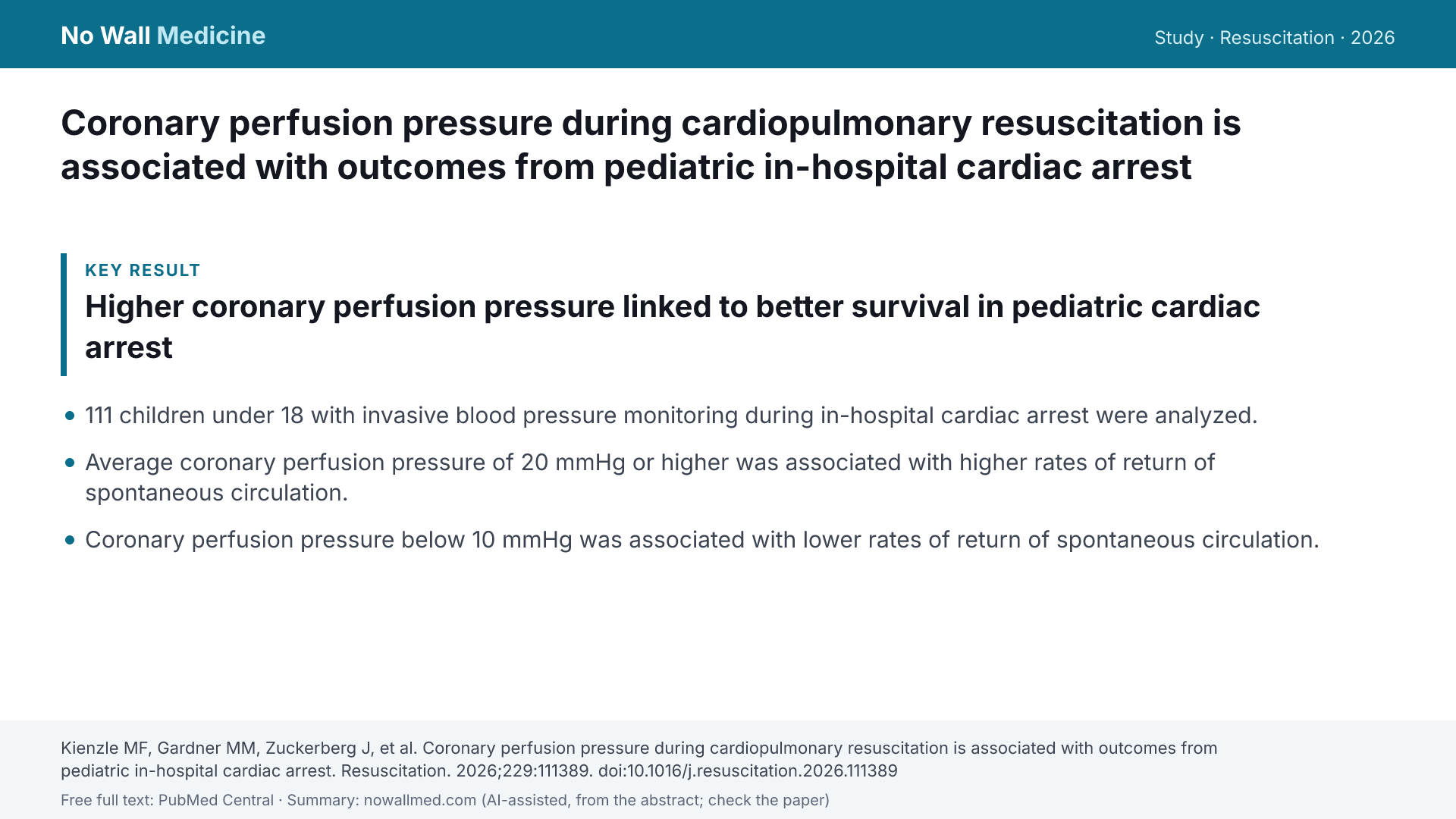
Headline, design, result, key points, caveat and citation as plain text.
Cite this article
Kienzle MF, Gardner MM, Zuckerberg J, et al. Coronary perfusion pressure during cardiopulmonary resuscitation is associated with outcomes from pediatric in-hospital cardiac arrest. Resuscitation. 2026. doi:10.1016/j.resuscitation.2026.111389
Spotted a mistake? Suggest a correction