Coronary revascularization associated with lower mortality in patients with heart failure and coronary artery disease
Coronary revascularization for heart failure with coronary artery disease: A systematic review and meta-analysis of randomized trials
Systematic review and meta-analysis of randomized controlled trialsBenefit found
Does coronary revascularization improve outcomes in heart failure patients with coronary artery disease?
Who
2842
Patients with chronic heart failure due to coronary artery disease
Compared
Coronary revascularization
Medical therapy alone
Main outcome
All-cause mortality
Result: hazard ratio 0.88 (95% CI 0.79-0.99)
Bottom line: Coronary revascularization was associated with a lower risk of all-cause mortality compared to medical therapy alone.
Limitation: Randomized controlled trials were not blinded, which may bias reporting of hospitalization and mortality causes.
Eur J Heart Fail · 2023-06-29Download image
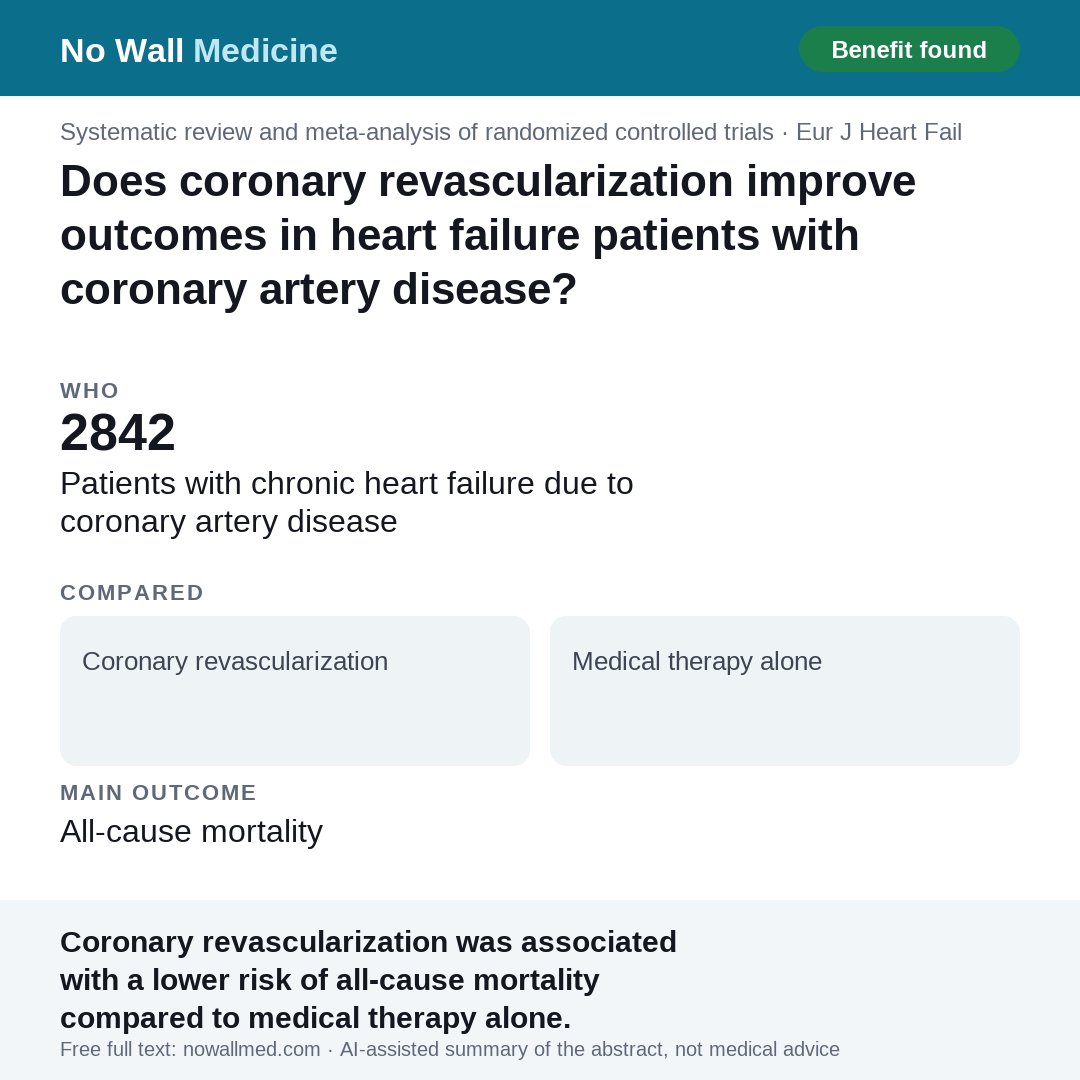
Clinical question: Does coronary revascularization improve outcomes in heart failure patients with coronary artery disease?
Why it matters: It is uncertain whether coronary revascularization improves outcomes for patients with heart failure who are already receiving guideline-recommended pharmacological therapy.
Key points
- Researchers analyzed five randomized controlled trials involving 2842 patients with chronic heart failure caused by coronary artery disease.
- Coronary revascularization was associated with a lower risk of all-cause mortality (hazard ratio 0.88) and cardiovascular mortality (hazard ratio 0.80) compared to medical therapy alone.
- The treatment was not associated with a difference in the composite outcome of all-cause mortality or hospitalization for heart failure (hazard ratio 0.87).
Limitation the authors note: The randomized controlled trials were not blinded, which may bias reporting of the causes for mortality and hospitalization.
Headline and key points written with AI from the paper’s abstract, with every number checked against it. Read the paper before relying on them.
Was this summary helpful?
Subject terms
Cite this article
Iaconelli A, Pellicori P, Dolce P, Busti M, Ruggio A, Aspromonte N. Coronary revascularization for heart failure with coronary artery disease: A systematic review and meta-analysis of randomized trials. Eur J Heart Fail. 2023. doi:10.1002/ejhf.2911
Spotted a mistake? Suggest a correction
Top studies every Monday
The week’s key trials and guidelines in your specialties, plus any topics you follow. By email, free.
Get the weekly digest