Specific nasal biomarkers correlate with smell loss in patients with chronic rhinosinusitis
Correlation of Local Nasal Biomarkers and Olfactory Dysfunction in Chronic Rhinosinusitis: A Systematic Review and Meta-Analysis
Systematic review and meta-analysisMixed results
Are local nasal biomarkers correlated with olfactory dysfunction in chronic rhinosinusitis?
Who
351
Patients with chronic rhinosinusitis with or without nasal polyps
Compared
Chronic rhinosinusitis with nasal polyps: IL-5, IL-6, IL-10, IL-13, IgE, CCL2, and CCL3 r = -0.223 to -0.333
Chronic rhinosinusitis without nasal polyps: IL-8 r = -0.182
Main outcome
Correlation between nasal biomarkers and olfactory function scores
Bottom line: Olfactory dysfunction correlates with specific cytokines in nasal polyp patients but shows weaker correlations in patients without polyps.
Int Forum Allergy Rhinol · 2026-07-21Download image
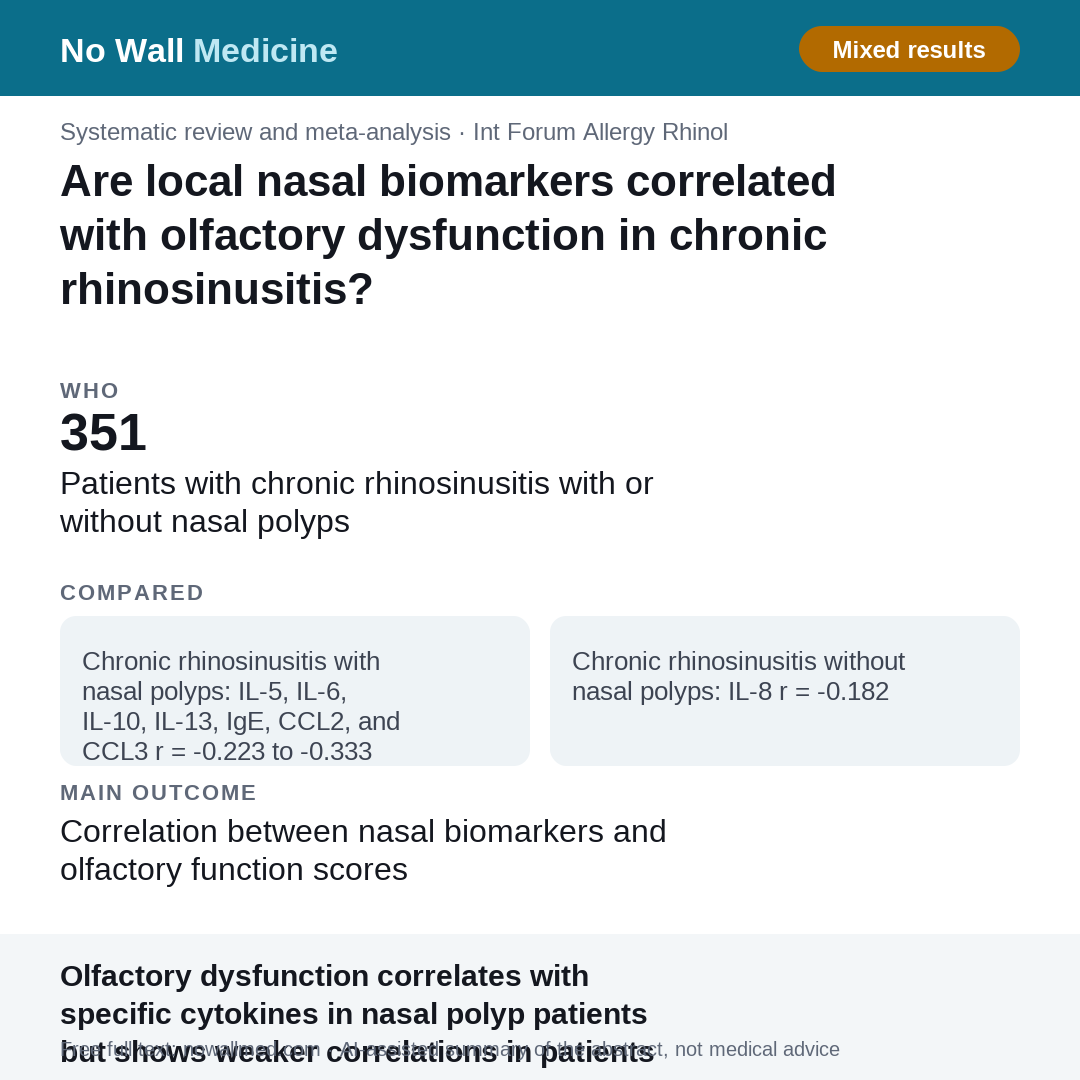
Clinical question: Are local nasal biomarkers correlated with olfactory dysfunction in chronic rhinosinusitis?
Why it matters: Researchers sought to evaluate how local biomarkers found in nasal mucus correlate with olfactory dysfunction, which is the loss of the sense of smell.
Key points
- Researchers analyzed seven prospective studies involving 351 participants with chronic rhinosinusitis, including those with and without nasal polyps.
- In patients with nasal polyps, several proteins like IL-5 and IgE showed inverse correlations with smell scores, while CXCL5 and VEGF-A showed positive correlations.
- In patients without nasal polyps, IL-8 and CXCL5 showed correlations with smell function, but other Type 2 cytokines did not show significant correlations.
Headline and key points written with AI from the paper’s abstract, with every number checked against it. Read the paper before relying on them.
Topics
Spotted a mistake? Suggest a correction