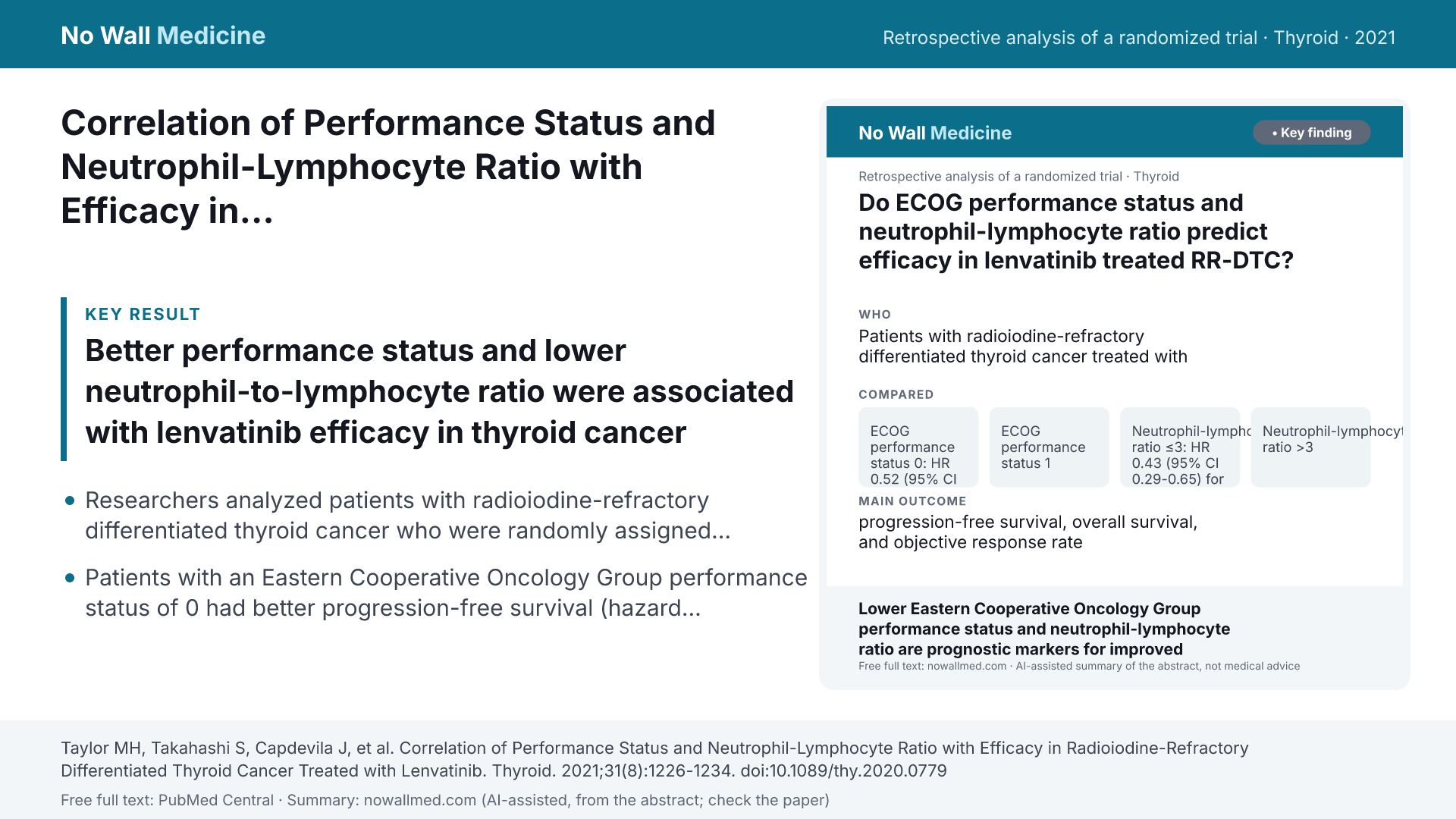
Better performance status and lower neutrophil-to-lymphocyte ratio were associated with lenvatinib efficacy in thyroid cancer
Correlation of Performance Status and Neutrophil-Lymphocyte Ratio with Efficacy in Radioiodine-Refractory Differentiated Thyroid Cancer Treated with Lenvatinib
Retrospective analysis of a randomized trialBenefit found
Do ECOG performance status and neutrophil-lymphocyte ratio predict efficacy in lenvatinib treated RR-DTC?
Who
Patients with radioiodine-refractory differentiated thyroid cancer treated with lenvatinib · SELECT study
Compared
ECOG performance status 0: HR 0.52 (95% CI 0.35-0.77) for PFS
ECOG performance status 1
Neutrophil-lymphocyte ratio ≤3: HR 0.43 (95% CI 0.29-0.65) for PFS
Neutrophil-lymphocyte ratio >3
Main outcome
progression-free survival, overall survival, and objective response rate
Result: hazard ratio 0.52 (95% CI 0.35-0.77) for PFS with ECOG 0
Bottom line: Lower Eastern Cooperative Oncology Group performance status and neutrophil-lymphocyte ratio are prognostic markers for improved efficacy in lenvatinib treated patients.
Thyroid · 2021-04-29Download image
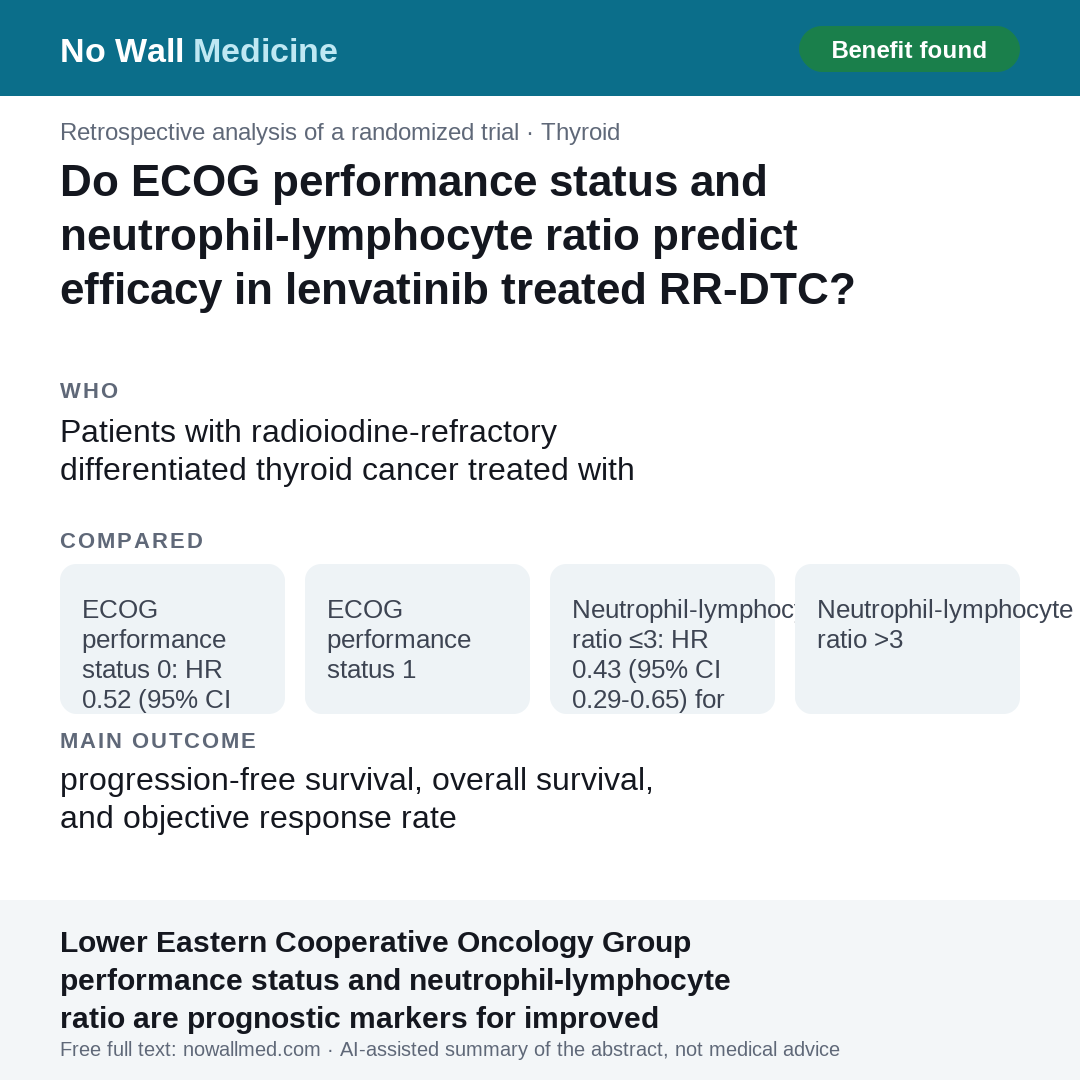
Clinical question: Do ECOG performance status and neutrophil-lymphocyte ratio predict efficacy in lenvatinib treated RR-DTC?
Why it matters: It is unknown if performance status and the neutrophil-to-lymphocyte ratio can serve as prognostic markers for patients with radioiodine-refractory differentiated thyroid cancer treated with lenvatinib.
Key points
- Researchers analyzed patients with radioiodine-refractory differentiated thyroid cancer who were randomly assigned to receive lenvatinib, a multikinase inhibitor.
- Patients with an Eastern Cooperative Oncology Group performance status of 0 had better progression-free survival (hazard ratio 0.52), overall survival (hazard ratio 0.42), and objective response rate (odds ratio 3.51) than those with a status of 1.
- A baseline neutrophil-to-lymphocyte ratio of 3 or less was associated with better progression-free survival (hazard ratio 0.43) and overall survival (hazard ratio 0.48) compared to a ratio greater than 3.
Headline and key points written with AI from the paper’s abstract, with every number checked against it. Read the paper before relying on them.
Was this summary helpful?
Subject terms
Cite this article
Taylor MH, Takahashi S, Capdevila J, et al. Correlation of Performance Status and Neutrophil-Lymphocyte Ratio with Efficacy in Radioiodine-Refractory Differentiated Thyroid Cancer Treated with Lenvatinib. Thyroid. 2021. doi:10.1089/thy.2020.0779
Spotted a mistake? Suggest a correction