Evidence suggests specific immunosuppressive treatments for immune-related adverse events resistant to corticosteroids
Corticosteroid-resistant immune-related adverse events: a systematic review
Systematic reviewBenefit found
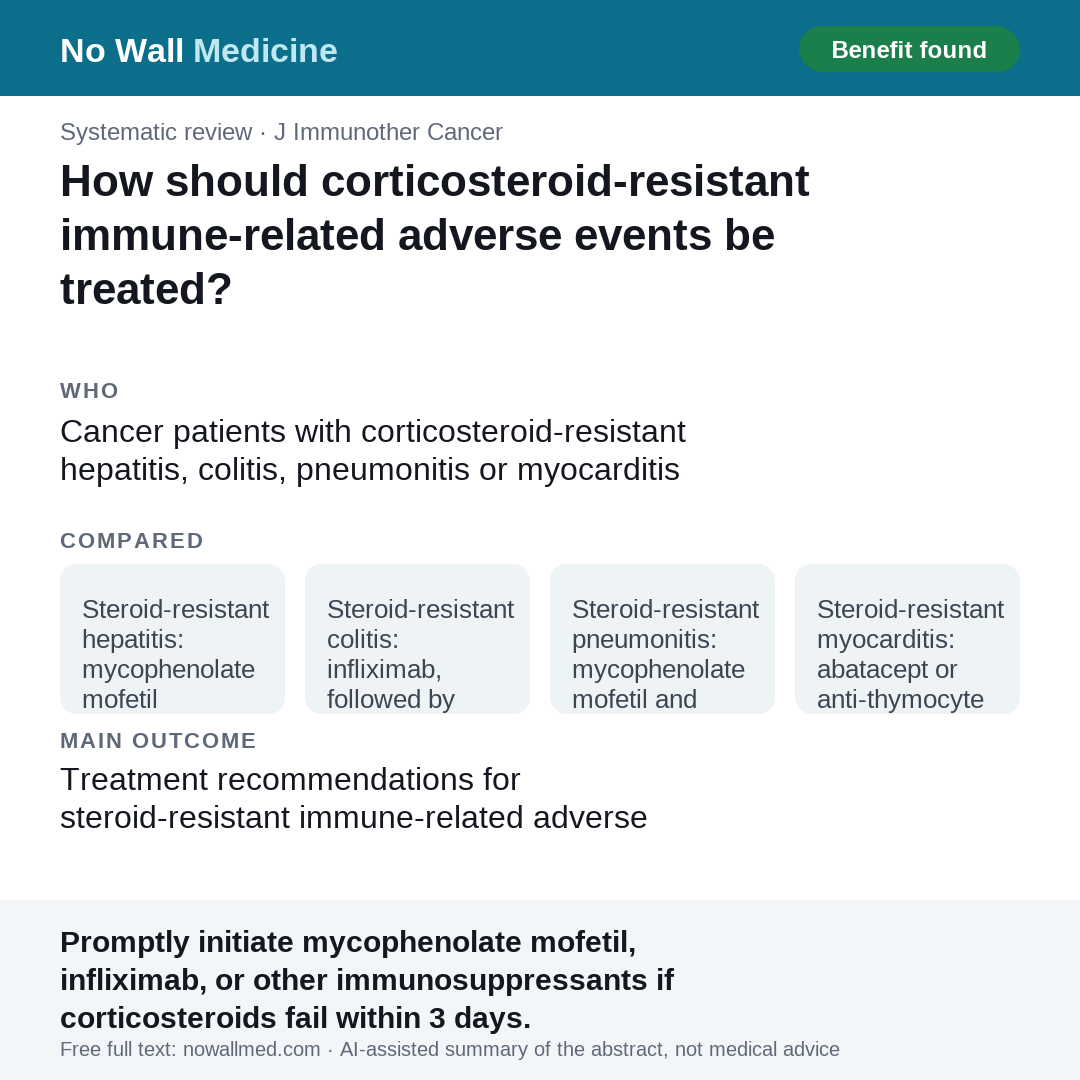
How should corticosteroid-resistant immune-related adverse events be treated?
Who
Cancer patients with corticosteroid-resistant hepatitis, colitis, pneumonitis or myocarditis
Compared
Steroid-resistant hepatitis: mycophenolate mofetil
Steroid-resistant colitis: infliximab, followed by vedolizumab
Steroid-resistant pneumonitis: mycophenolate mofetil and intravenous immunoglobulins
Steroid-resistant myocarditis: abatacept or anti-thymocyte globulin or ruxolitinib with abatacept
Main outcome
Treatment recommendations for steroid-resistant immune-related adverse events
Bottom line: Promptly initiate mycophenolate mofetil, infliximab, or other immunosuppressants if corticosteroids fail within 3 days.
Limitation: Majority of publications are single case reports and data for life-threatening events is limited.
J Immunother Cancer · 2024-01-17Download image
Clinical question: How should corticosteroid-resistant immune-related adverse events be treated?
Why it matters: Clinical guidelines do not precisely define recommendations for managing immune-related adverse events that are resistant to corticosteroid therapy.
Key points
- Researchers reviewed literature and clinical guidelines regarding cancer patients with hepatitis, colitis, pneumonitis, or myocarditis that did not respond to steroid treatment.
- The review identified mycophenolate mofetil for hepatitis, infliximab or vedolizumab for colitis, mycophenolate mofetil and intravenous immunoglobulins for pneumonitis, and abatacept, anti-thymocyte globulin, or ruxolitinib for myocarditis.
- The analysis included 26 cases of colitis, 21 of hepatitis, 17 of pneumonitis, and 15 of myocarditis.
Limitation the authors note: The majority of available publications are single case reports and there is limited data regarding life-threatening resistant adverse events.
Headline and key points written with AI from the paper’s abstract, with every number checked against it. Read the paper before relying on them.
Was this summary helpful?
Abstract
Immune checkpoint inhibitor (ICI) treatment has become an important therapeutic option for various cancer types. Although the treatment is effective, ICI can overstimulate the patient's immune system, leading to potentially severe immune-related adverse events (irAEs), including hepatitis, colitis, pneumonitis and myocarditis. The initial mainstay of treatments includes the administration of corticosteroids. There is little evidence how to treat steroid-resistant (sr) irAEs. It is mainly based on small case series or single case reports. This systematic review summarizes available evidence about sr-irAEs. We conducted a systematic literature search in PubMed. Additionally, we included European Society for Medical Oncology, Society for Immunotherapy of Cancer, National Comprehensive Cancer Network and American Society of Clinical Oncology Guidelines for irAEs in our assessment. The study population of all selected publications had to include patients with cancer who developed hepatitis, colitis, pneumonitis or myocarditis during or after an immunotherapy treatment and for whom corticosteroid therapy was not sufficient. Our literature search was not restricted to any specific cancer diagnosis. Case reports were also included. There is limited data regarding life-threatening sr-irAEs of colon/liver/lung/heart and the majority of publications are single case reports. Most publications investigated sr colitis (n=26), followed by hepatitis (n=21), pneumonitis (n=17) and myocarditis (n=15). There is most data for mycophenolate mofetil (MMF) to treat sr hepatitis and for infliximab, followed by vedolizumab, to treat sr colitis. Regarding sr pneumonitis there is most data for MMF and intravenous immunoglobulins (IVIG) while data regarding infliximab are conflicting. In sr myocarditis, most evidence is available for the use of abatacept or anti-thymocyte globulin (ATG) (both with or without MMF) or ruxolitinib with abatacept. This review highlights the need for prompt recognition and treatment of sr hepatitis, colitis, pneumonitis and myocarditis. Guideline recommendations for sr situations are not defined precisely. Based on our search, we recommend-as first line treatment-(1) MMF for sr hepatitis, (2) infliximab for sr colitis, followed by vedolizumab, (3) MMF and IVIG for sr pneumonitis and (4) abatacept or ATG (both with or without MMF) or ruxolitinib with abatacept for sr myocarditis. These additional immunosuppressive agents should be initiated promptly if there is no sufficient response to corticosteroids within 3 days.
Abstract reproduced under the article’s CC BY NC licence.
Subject terms
Cite this article
Daetwyler E, Wallrabenstein T, König D, Cappelli LC, Naidoo J, Zippelius A. Corticosteroid-resistant immune-related adverse events: a systematic review. J Immunother Cancer. 2024. doi:10.1136/jitc-2023-007409
Spotted a mistake? Suggest a correction
Top studies every Monday
The week’s key trials and guidelines in your specialties, plus any topics you follow. By email, free.
Get the weekly digest