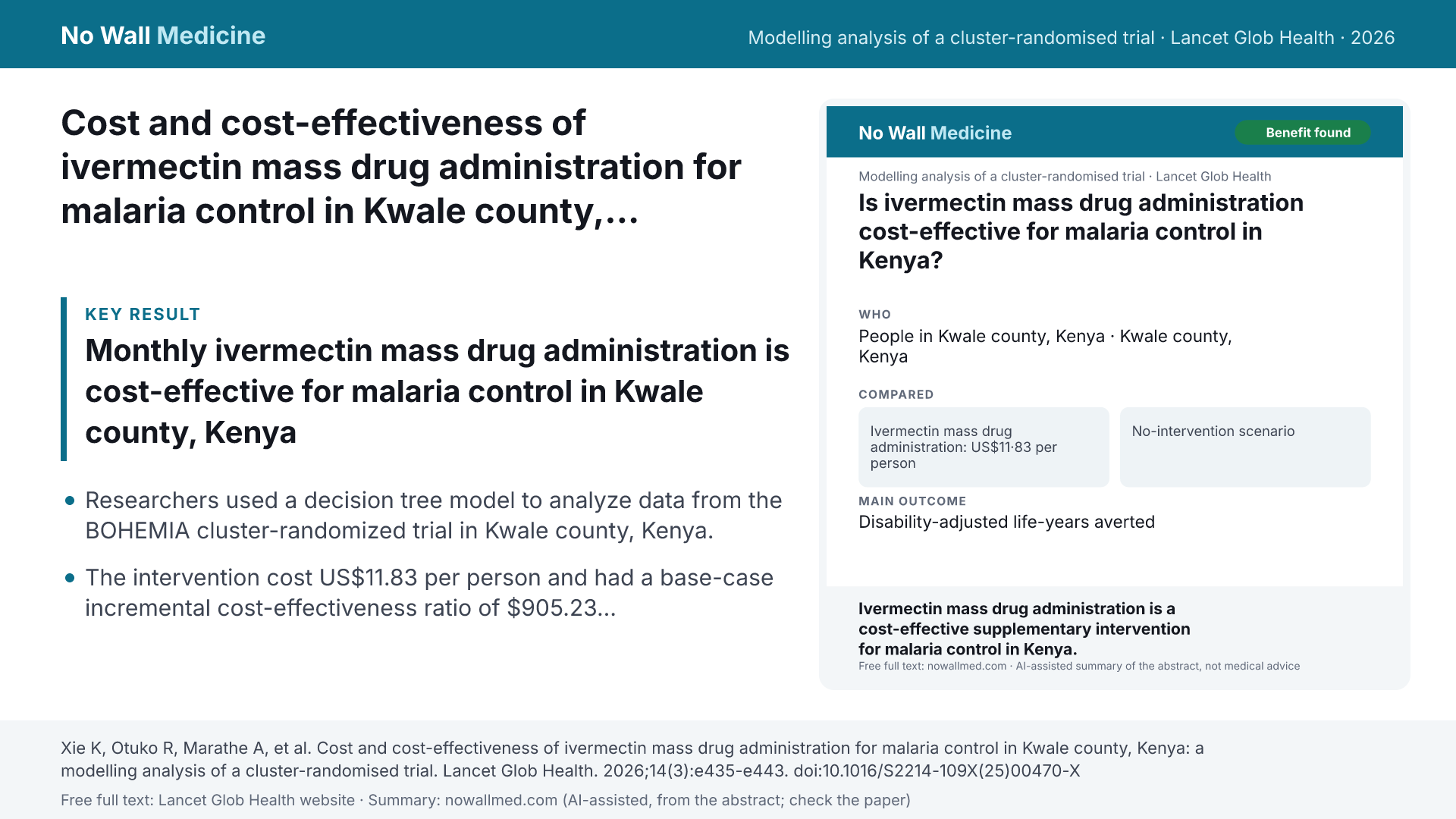
Monthly ivermectin mass drug administration is cost-effective for malaria control in Kwale county, Kenya
Cost and cost-effectiveness of ivermectin mass drug administration for malaria control in Kwale county, Kenya: a modelling analysis of a cluster-randomised trial
Modelling analysis of a cluster-randomised trialBenefit found
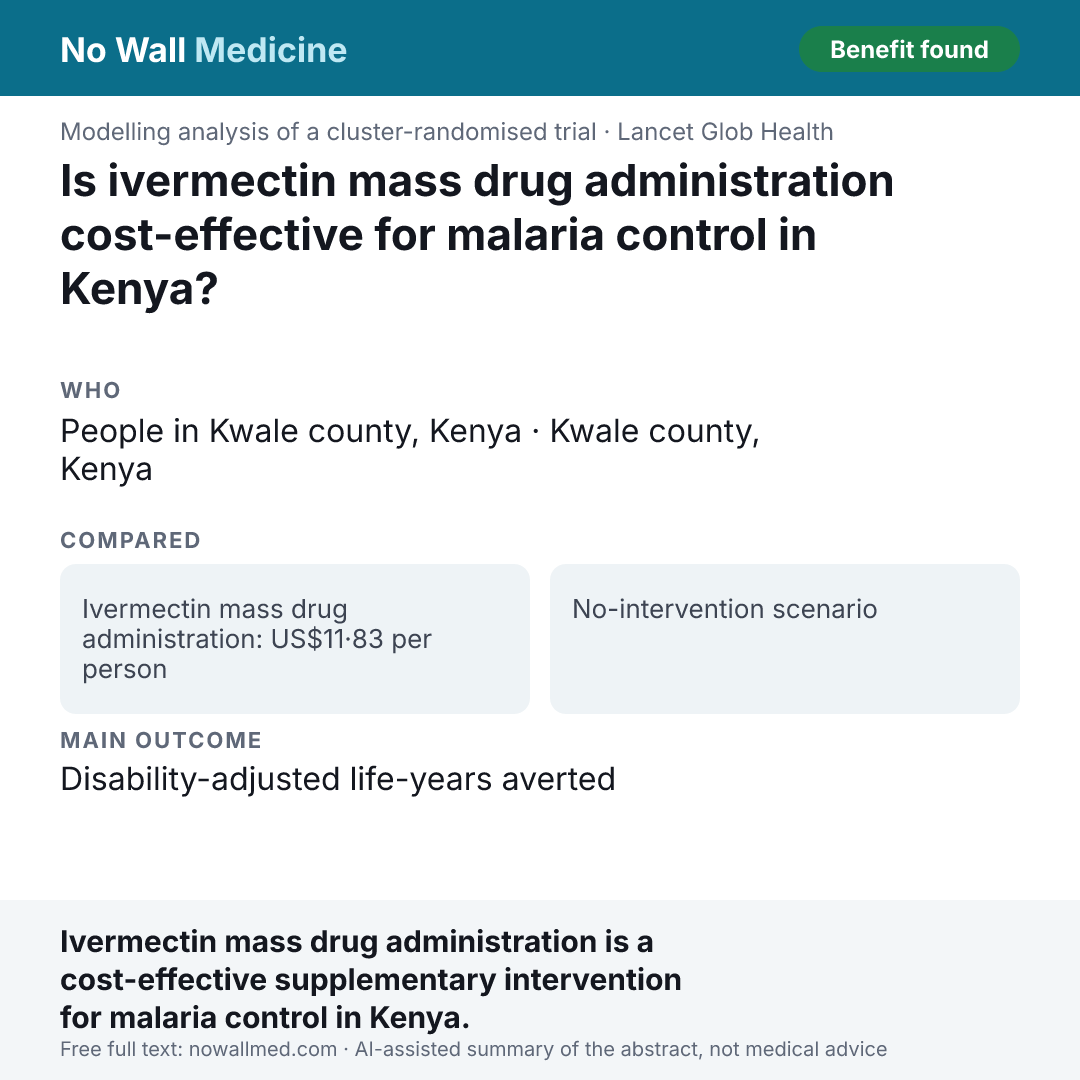
Is ivermectin mass drug administration cost-effective for malaria control in Kenya?
Who
People in Kwale county, Kenya · Kwale county, Kenya
Compared
Ivermectin mass drug administration: US$11·83 per person
No-intervention scenario
Main outcome
Disability-adjusted life-years averted
Bottom line: Ivermectin mass drug administration is a cost-effective supplementary intervention for malaria control in Kenya.
Funded by: Unitaid through the BOHEMIA project
Lancet Glob Health · 2026-02-20 · Save PNG
Clinical question: Is ivermectin mass drug administration cost-effective for malaria control in Kenya?
Why it matters: Traditional mosquito control methods are hindered by insecticide resistance and changing mosquito behavior that causes residual malaria transmission.
Key points
- Researchers used a decision tree model to analyze data from the BOHEMIA cluster-randomized trial in Kwale county, Kenya.
- The intervention cost US$11.83 per person and had a base-case incremental cost-effectiveness ratio of $905.23 per disability-adjusted life-year averted.
- The cost-effectiveness ratio was below the threshold of 0.5 times Kenya's gross domestic product per capita, which was $974.65.
Headline and key points written with AI from the paper’s abstract, with every number checked against it. Read the paper before relying on them.
Was this summary helpful?
Abstract
Background
Malaria remains a major health burden in sub-Saharan Africa, where traditional vector control methods are hindered by insecticide resistance and evolving mosquito behaviour causing residual transmission. In the BOHEMIA cluster-randomised trial in Kenya, ivermectin mass drug administration (iMDA), delivered once a month for 3 months with approximately 64% population coverage, was shown to reduce malaria incidence by 26%. We aimed to assess the cost-effectiveness of iMDA as a supplementary vector control tool using data from the BOHEMIA trial in Kenya. Methods
We did a cost-effectiveness analysis of the BOHEMIA cluster-randomised trial done in Kwale county, Kenya, using a societal perspective to estimate the intervention costs, health system costs, direct household out-of-pocket expenses, and indirect costs from lost wages of iMDA versus a no-intervention scenario. Intervention effectiveness was measured as the number of malaria cases averted and disability-adjusted life-years (DALYs) averted. A decision tree model was developed to simulate the intervention's impact on a broader population. Deterministic and probabilistic sensitivity analyses were performed to assess the robustness of the results, and incremental cost-effectiveness ratios (ICERs) were compared with Kenya's gross domestic product (GDP)-based thresholds. Findings
The intervention cost of iMDA was US$11·83 per person. Household out-of-pocket costs averaged $5·85 for uncomplicated malaria cases and $52·23 for severe cases. Productivity loss amounted to $2·18 for uncomplicated and $8·83 for severe cases. The base-case ICER was $905·23 per DALY averted, which was below the threshold of 0·5 × Kenya's GDP per capita ($974·65). In probabilistic analysis (10 000 iterations), the median ICER was $1107·51 per DALY averted (50% credible interval 770·05-1606·77). Interpretation
This study demonstrates that iMDA can be a cost-effective supplementary intervention for malaria control in settings with moderate malaria transmission and good insecticide-treated net coverage, particularly when malaria reduction is greater than 23·62% for children younger than 5 years and opportunities for reducing intervention costs can be identified. Funding
This work was funded and supported by Unitaid through the BOHEMIA project.
Abstract reproduced under the article’s CC BY licence.
Subject terms
Headline, design, result, key points, caveat and citation as plain text.
Cite this article
Xie K, Otuko R, Marathe A, et al. Cost and cost-effectiveness of ivermectin mass drug administration for malaria control in Kwale county, Kenya: a modelling analysis of a cluster-randomised trial. Lancet Glob Health. 2026;14(3):e435-e443. doi:10.1016/S2214-109X(25)00470-X
Spotted a mistake? Suggest a correction