Physical activity interventions for diabetes prevention were not cost-effective at the £20,000 threshold
Cost-effectiveness analysis of two interventions to promote physical activity in a multiethnic population at high risk of diabetes: an economic evaluation of the 48-month PROPELS randomized controlled trial
Economic evaluation of a randomized controlled trialNo clear difference
Are physical activity interventions cost-effective for preventing type 2 diabetes in high-risk populations?
Who
Multiethnic population at high risk of type 2 diabetes
Compared
Usual care: 9.323 QALYs
Walking Away Plus: 9.330 QALYs
Main outcome
Lifetime costs and quality-adjusted life years
Result: incremental cost-effectiveness ratio £49 273 per quality-adjusted life year gained
Bottom line: Neither Walking Away nor Walking Away Plus was cost-effective at £20 000 per quality-adjusted life year gained.
BMJ Open Diabetes Res Care · 2024-03-12Download image
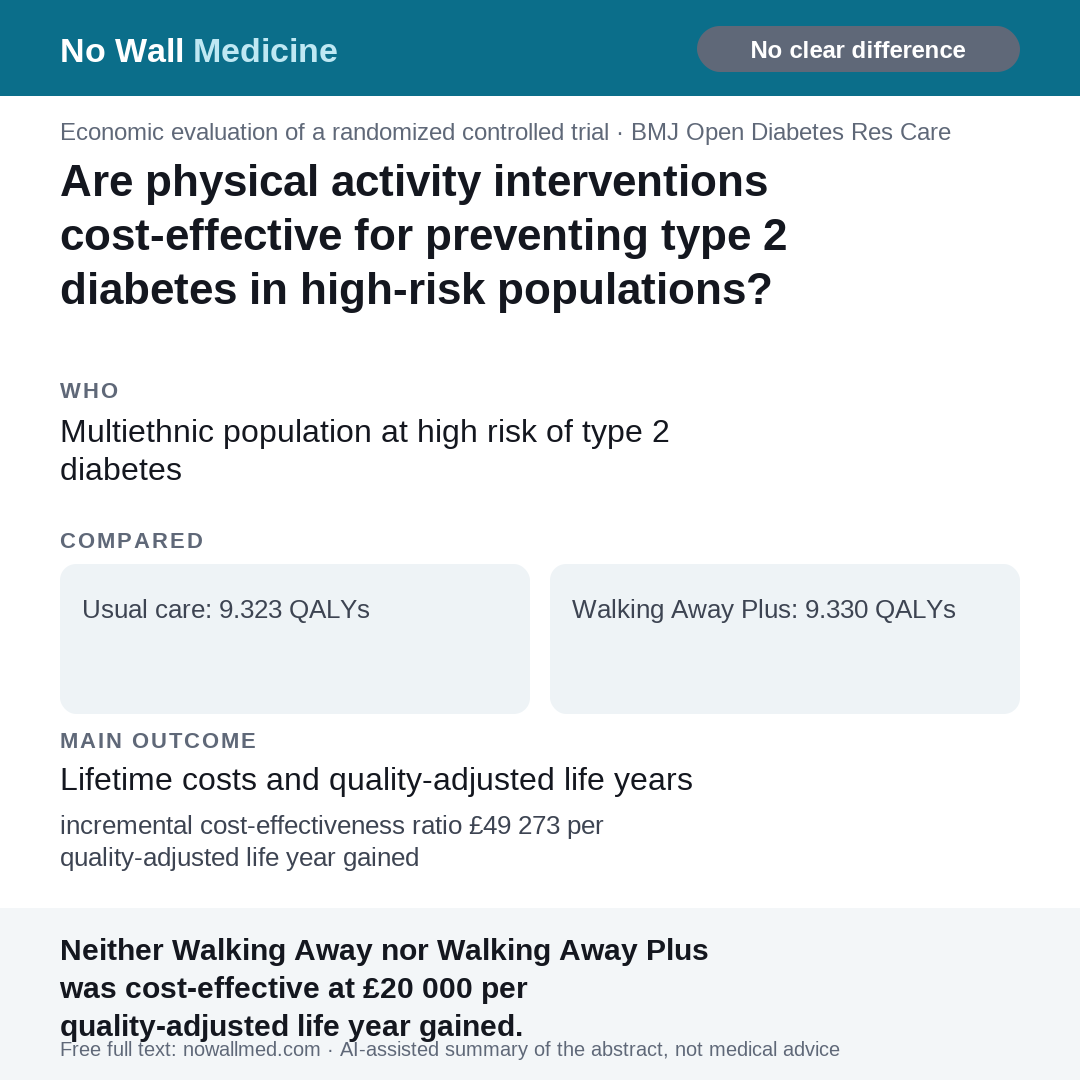
Clinical question: Are physical activity interventions cost-effective for preventing type 2 diabetes in high-risk populations?
Why it matters: Data are lacking regarding the cost-effectiveness of pragmatic, long-term physical activity interventions to reduce the risk of developing type 2 diabetes.
Key points
- Researchers used data from the PROPELS randomized controlled trial to compare two physical activity interventions, Walking Away and Walking Away Plus, against usual care.
- Walking Away Plus was estimated to be more effective and cheaper than Walking Away, but had an incremental cost-effectiveness ratio of £49,273 per quality-adjusted life year gained.
- Neither intervention reached an incremental cost-effectiveness ratio below £20,000 per quality-adjusted life year gained in any scenario analysis.
Headline and key points written with AI from the paper’s abstract, with every number checked against it. Read the paper before relying on them.
Was this summary helpful?
Abstract
Introduction
Physical activity (PA) is protective against type 2 diabetes (T2D). However, data on pragmatic long-term interventions to reduce the risk of developing T2D via increased PA are lacking. This study investigated the cost-effectiveness of a pragmatic PA intervention in a multiethnic population at high risk of T2D. Materials and methods
We adapted the School for Public Health Research diabetes prevention model, using the PROPELS trial data and analyses of the NAVIGATOR trial. Lifetime costs, lifetime quality-adjusted life years (QALYs), and incremental cost-effectiveness ratios (ICERs) were calculated for each intervention (Walking Away (WA) and Walking Away Plus (WA+)) versus usual care and compared with National Institute for Health and Care Excellence's willingness-to-pay of £20 000-£30 000 per QALY gained. We conducted scenario analyses on the outcomes of the PROPELS trial data and a threshold analysis to determine the change in step count that would be needed for the interventions to be cost-effective. Results
Estimated lifetime costs for usual care, WA, and WA+ were £22 598, £23 018, and £22 945, respectively. Estimated QALYs were 9.323, 9.312, and 9.330, respectively. WA+ was estimated to be more effective and cheaper than WA. WA+ had an ICER of £49 273 per QALY gained versus usual care. In none of our scenario analyses did either WA or WA+ have an ICER below £20 000 per QALY gained. Our threshold analysis suggested that a PA intervention costing the same as WA+ would have an ICER below £20 000/QALY if it were to achieve an increase in step count of 500 steps per day which was 100% maintained at 4 years. Conclusions
We found that neither WA nor WA+ was cost-effective at a limit of £20 000 per QALY gained. Our threshold analysis showed that interventions to increase step count can be cost-effective at this limit if they achieve greater long-term maintenance of effect. Trial registration number
ISRCTN registration: ISRCTN83465245: The PRomotion Of Physical activity through structuredEducation with differing Levels of ongoing Support for those with pre-diabetes (PROPELS)https://doi.org/10.1186/ISRCTN83465245.
Abstract reproduced under the article’s CC BY NC licence.
Subject terms
Cite this article
Heathcote LE, Pollard DJ, Brennan A, Davies MJ, Eborall H, Edwardson CL. Cost-effectiveness analysis of two interventions to promote physical activity in a multiethnic population at high risk of diabetes: an economic evaluation of the 48-month PROPELS randomized controlled trial. BMJ Open Diabetes Res Care. 2024. doi:10.1136/bmjdrc-2023-003516
Spotted a mistake? Suggest a correction
Top studies every Monday
The week’s key trials and guidelines in your specialties, plus any topics you follow. By email, free.
Get the weekly digest