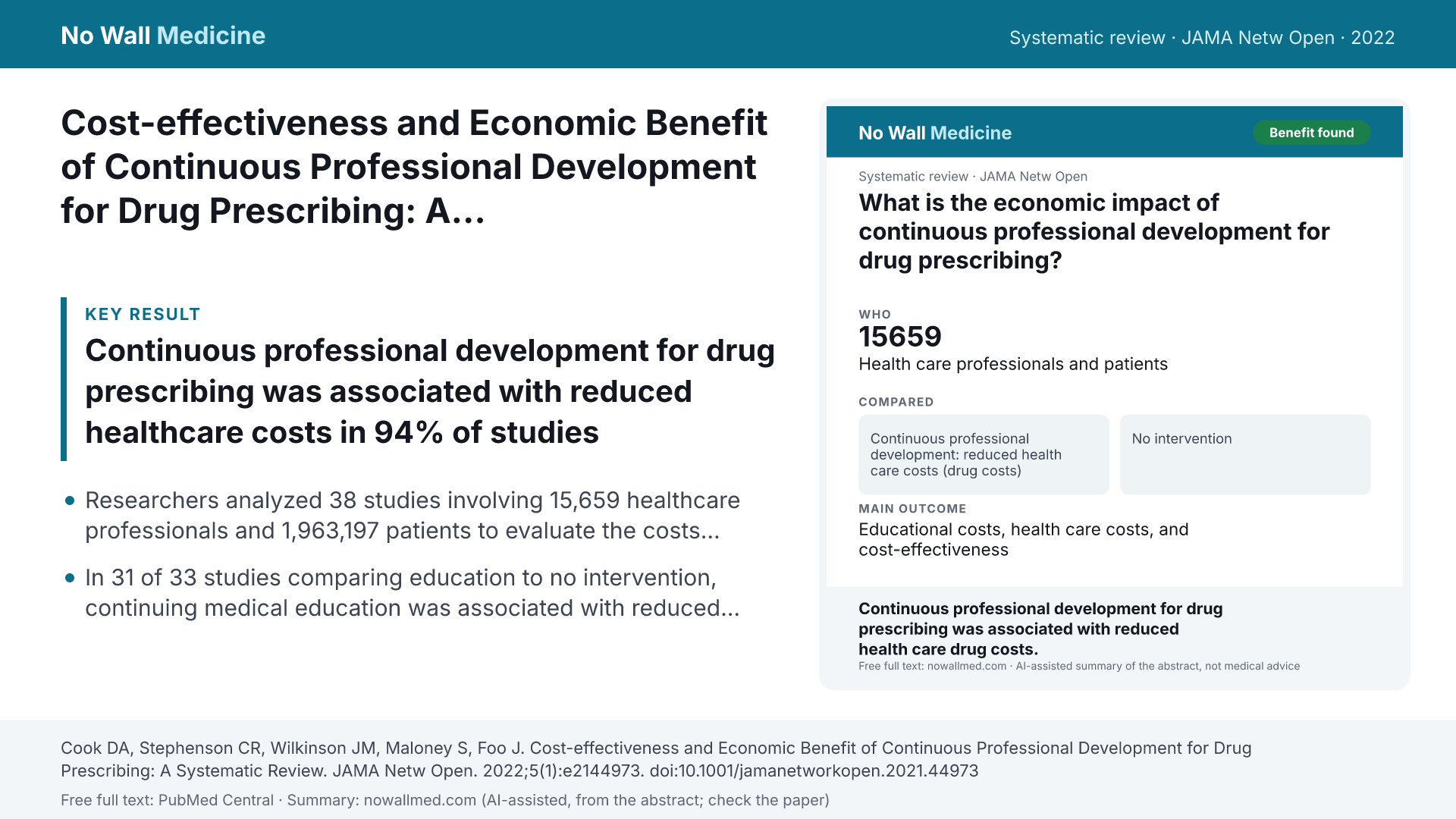
Cost-effectiveness and Economic Benefit of Continuous Professional Development for Drug Prescribing: A Systematic Review
Key result: Continuous professional development for drug prescribing was associated with reduced healthcare costs in 94% of studies
Systematic reviewBenefit found
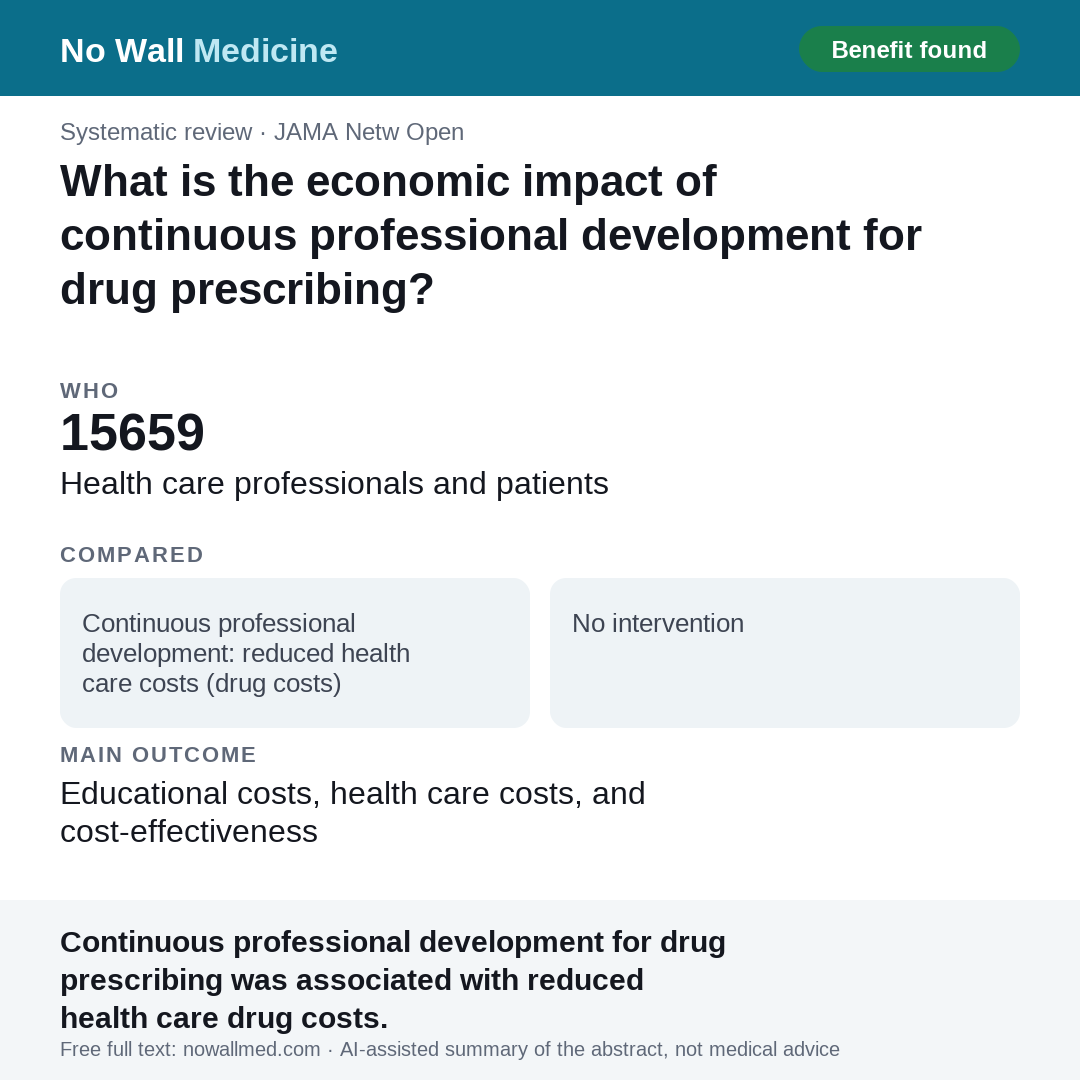
What is the economic impact of continuous professional development for drug prescribing?
Who
15659
Health care professionals and patients
Compared
Continuous professional development: reduced health care costs (drug costs)
No intervention
Main outcome
Educational costs, health care costs, and cost-effectiveness
Bottom line: Continuous professional development for drug prescribing was associated with reduced health care drug costs.
JAMA Netw Open · 2022-01-04Download image
Key points
- Researchers analyzed 38 studies involving 15,659 healthcare professionals and 1,963,197 patients to evaluate the costs of continuing medical education.
- In 31 of 33 studies comparing education to no intervention, continuing medical education was associated with reduced drug costs ranging from $4731 to $6,912,000.
- One-on-one educational outreach was found to be more effective but more expensive than group education or mailed materials.
Why it matters: The economic impact of continuing medical education for physician drug prescribing is incompletely understood.
Discussion prompts
- Would these patients look like yours? Who was left out?
- Is the main outcome one that matters to patients?
- Is the difference large enough to change what you do?
Cite: Cook DA, Stephenson CR, Wilkinson JM, Maloney S, Foo J. Cost-effectiveness and Economic Benefit of Continuous Professional Development for Drug Prescribing: A Systematic Review. JAMA Netw Open. 2022. doi:10.1001/jamanetworkopen.2021.44973
Free full text: PubMed Central · Summary and visual abstract: nowallmed.com/a/cost-effectiveness-and-economic-benefit-of-continuous-professional-10vcfde/ (AI-assisted from the abstract; check the paper before relying on it).