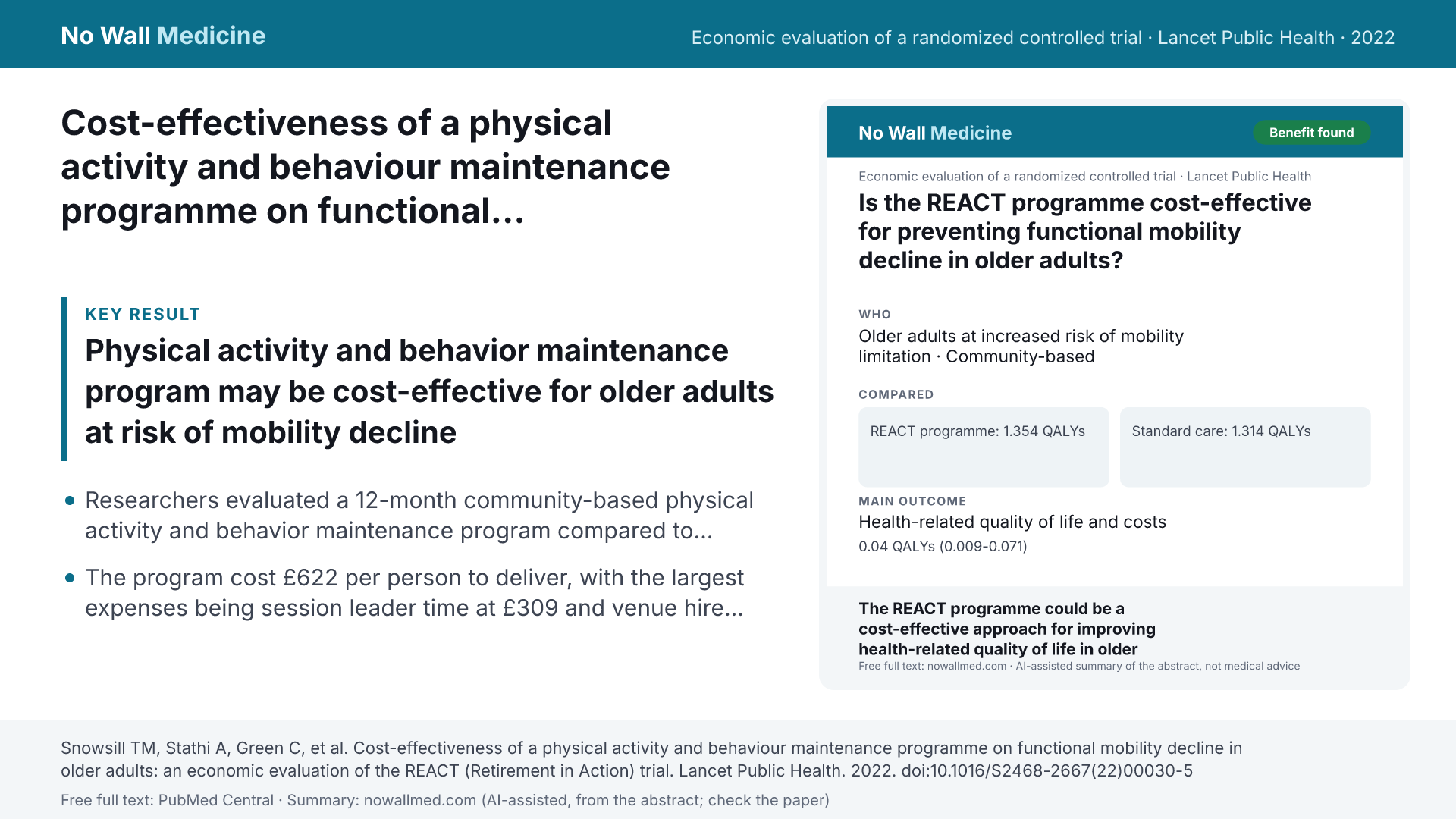
Physical activity and behavior maintenance program may be cost-effective for older adults at risk of mobility decline
Cost-effectiveness of a physical activity and behaviour maintenance programme on functional mobility decline in older adults: an economic evaluation of the REACT (Retirement in Action) trial
Economic evaluation of a randomized controlled trialBenefit found
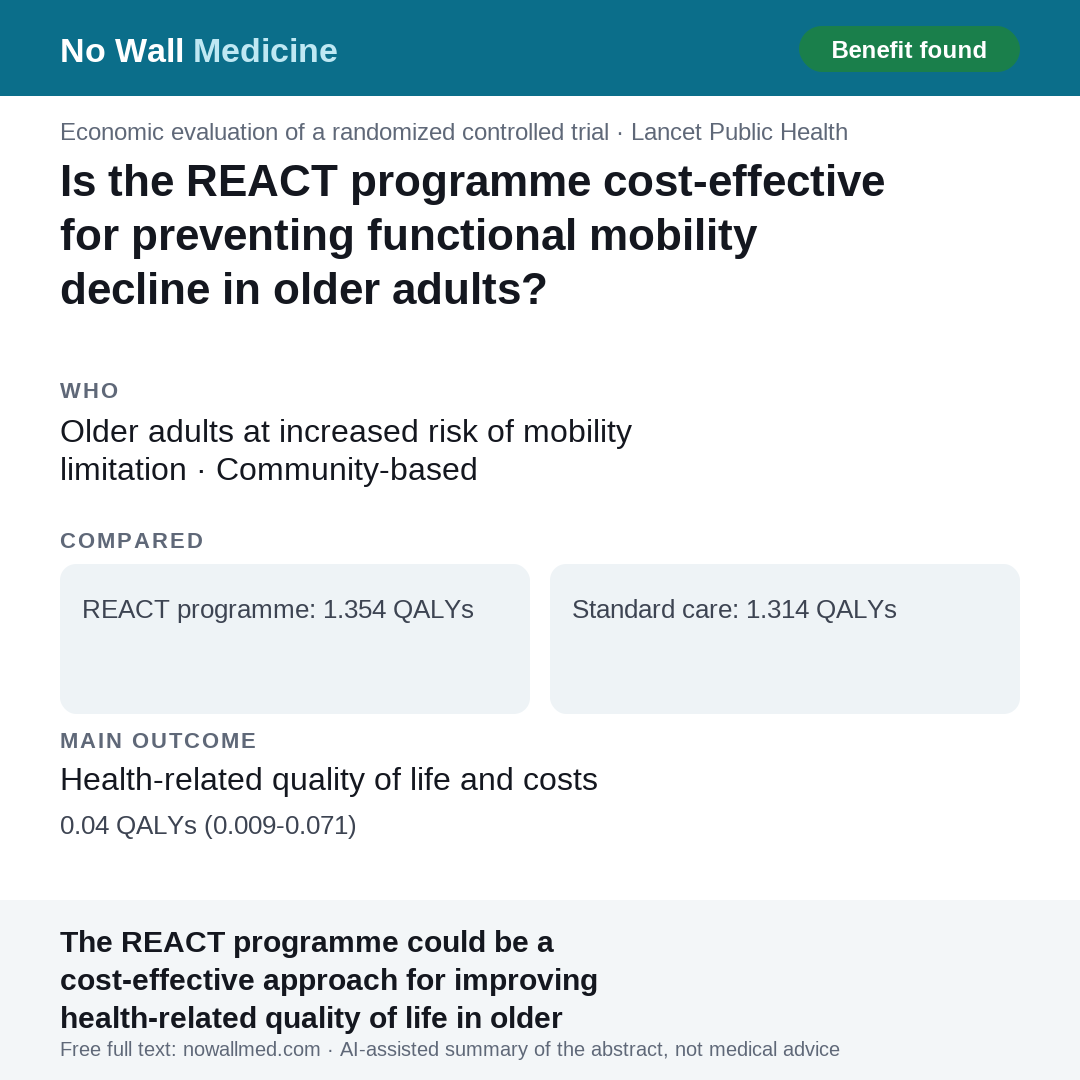
Is the REACT programme cost-effective for preventing functional mobility decline in older adults?
Who
Older adults at increased risk of mobility limitation · Community-based
Compared
REACT programme: 1.354 QALYs
Standard care: 1.314 QALYs
Main outcome
Health-related quality of life and costs
Result: 0.04 QALYs (0.009-0.071)
Bottom line: The REACT programme could be a cost-effective approach for improving health-related quality of life in older adults.
Funded by: National Institute for Health Research Public Health Research Programme
Lancet Public Health · 2022-03-21Download image
Same trial (ISRCTN45627165)
Papers we list that report this registered trial, oldest first. Read a secondary analysis alongside the main results.
- Related analysis Benefit found
This paper Lancet Public Health 2022-03 - Main results Benefit found
A 12-month physical activity programme helped prevent decline in physical function among older adults Lancet Public Health 2022-03
Clinical question: Is the REACT programme cost-effective for preventing functional mobility decline in older adults?
Key points
- Researchers evaluated a 12-month community-based physical activity and behavior maintenance program compared to standard care in older adults at risk of mobility limitations.
- The program cost £622 per person to deliver, with the largest expenses being session leader time at £309 and venue hire at £109.
- The intervention was associated with a health benefit of 0.04 quality-adjusted life-years, representing 1.354 quality-adjusted life-years in the intervention group versus 1.314 in the control group.
Headline and key points written with AI from the paper’s abstract, with every number checked against it. Read the paper before relying on them.
Was this summary helpful?
Abstract
Background
Mobility limitations in older populations have a substantial impact on health outcomes, quality of life, and social care costs. The Retirement in Action (REACT) randomised controlled trial assessed a 12-month community-based group physical activity and behaviour maintenance intervention to help prevent decline in physical functioning in older adults at increased risk of mobility limitation. We aimed to do an economic evaluation of the REACT trial to investigate whether the intervention is cost-effective. Methods
In this health economic evaluation, we did cost-effectiveness and cost-utility analyses of the REACT programme versus standard care on the basis of resource use, primary outcome, and health-related quality-of-life data measured in the REACT trial. We also developed a decision analytic Markov model that forecasts the mobility of recipients beyond the 24-month follow-up of the trial and translated this into future costs and potential benefit to health-related quality of life using the National Health Service and Personal Social Services perspective. Participants completed questionnaire booklets at baseline, and at 6, 12, and 24 months after randomisation, which included a resource use questionnaire and the EQ-5D-5L and 36-item short-form survey (SF-36) health-related quality-of-life instruments. The cost of delivering the intervention was estimated by identifying key resources, such as REACT session leader time, time of an individual to coordinate the programme, and venue hire. EQ-5D-5L and SF-36 responses were converted to preference-based utility values, which were used to estimate quality-adjusted life-years (QALYs) over the 24-month trial follow-up using the area-under-the-curve method. We used generalised linear models to examine the effect of the REACT programme on costs and QALYs and adjust for baseline covariates. Costs and QALYs beyond 12 months were discounted at 3·5% per year. This is a pre-planned analysis of the REACT trial; the trial itself is registered with ISRCTN (ISRCTN45627165). Findings
The 12-month REACT programme was estimated to cost £622 per recipient to deliver. The most substantial cost components are the REACT session leader time (£309 per participant), venue hire (£109), and the REACT coordinator time (£80). The base-case analysis of the trial-based economic evaluation showed that reductions in health and social care usage due to the REACT programme could offset the REACT delivery costs (£3943 in the intervention group vs £4043 in the control group; difference: -£103 [95% CI -£695 to £489]) with a health benefit of 0·04 QALYs (0·009-0·071; 1·354 QALYs in the intervention group vs 1·314 QALYs in the control group) within the 24-month timeframe of the trial. Interpretation
The REACT programme could be considered a cost-effective approach for improving the health-related quality of life of older adults at risk of mobility limitations. Funding
National Institute for Health Research Public Health Research Programme.
Abstract reproduced under the article’s CC BY licence.
Subject terms
Headline, design, result, key points, caveat and citation as plain text.
Cite this article
Snowsill TM, Stathi A, Green C, et al. Cost-effectiveness of a physical activity and behaviour maintenance programme on functional mobility decline in older adults: an economic evaluation of the REACT (Retirement in Action) trial. Lancet Public Health. 2022. doi:10.1016/S2468-2667(22)00030-5
Spotted a mistake? Suggest a correction