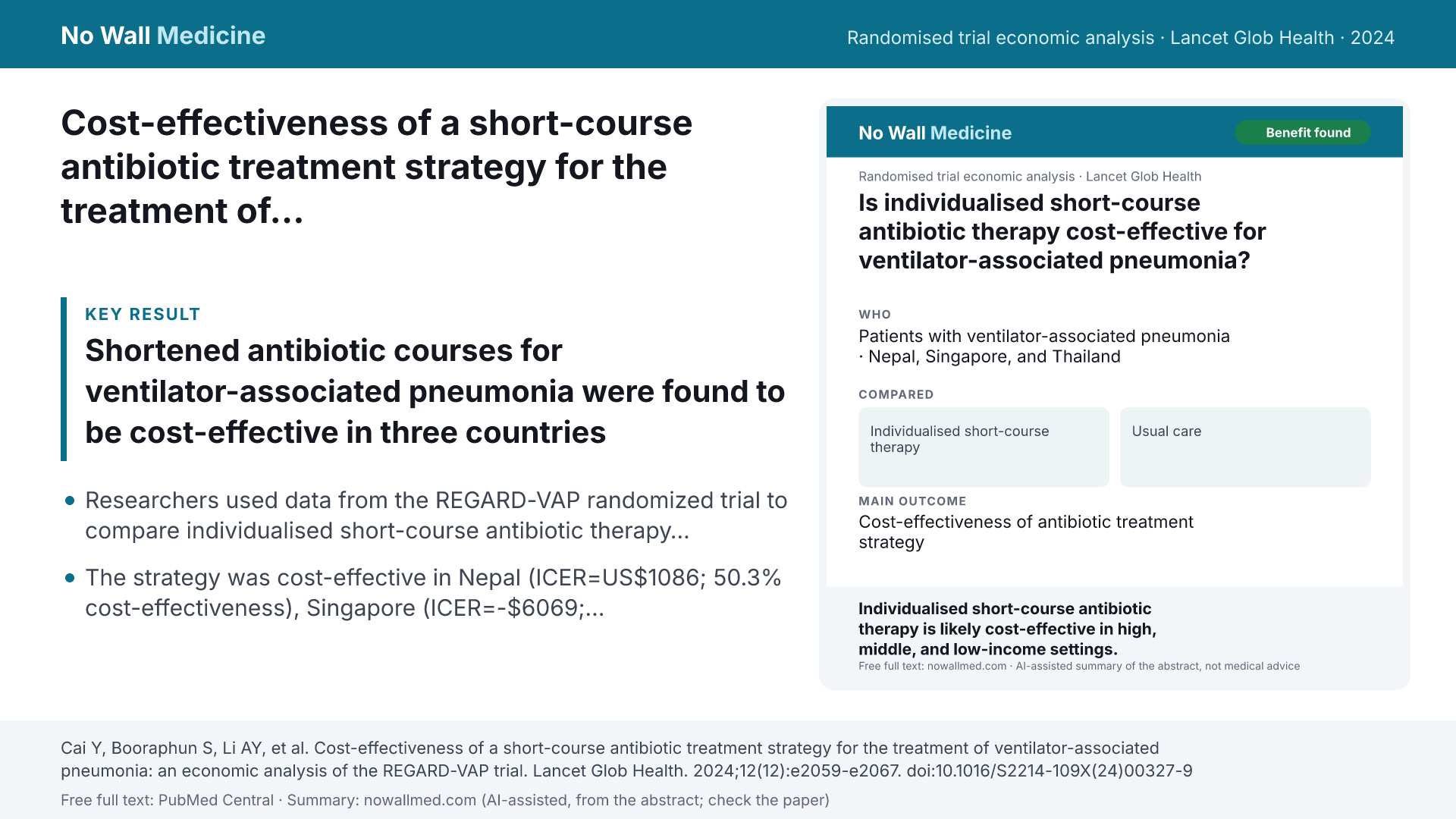
Shortened antibiotic courses for ventilator-associated pneumonia were found to be cost-effective in three countries
Cost-effectiveness of a short-course antibiotic treatment strategy for the treatment of ventilator-associated pneumonia: an economic analysis of the REGARD-VAP trial
Randomised trial economic analysisBenefit found
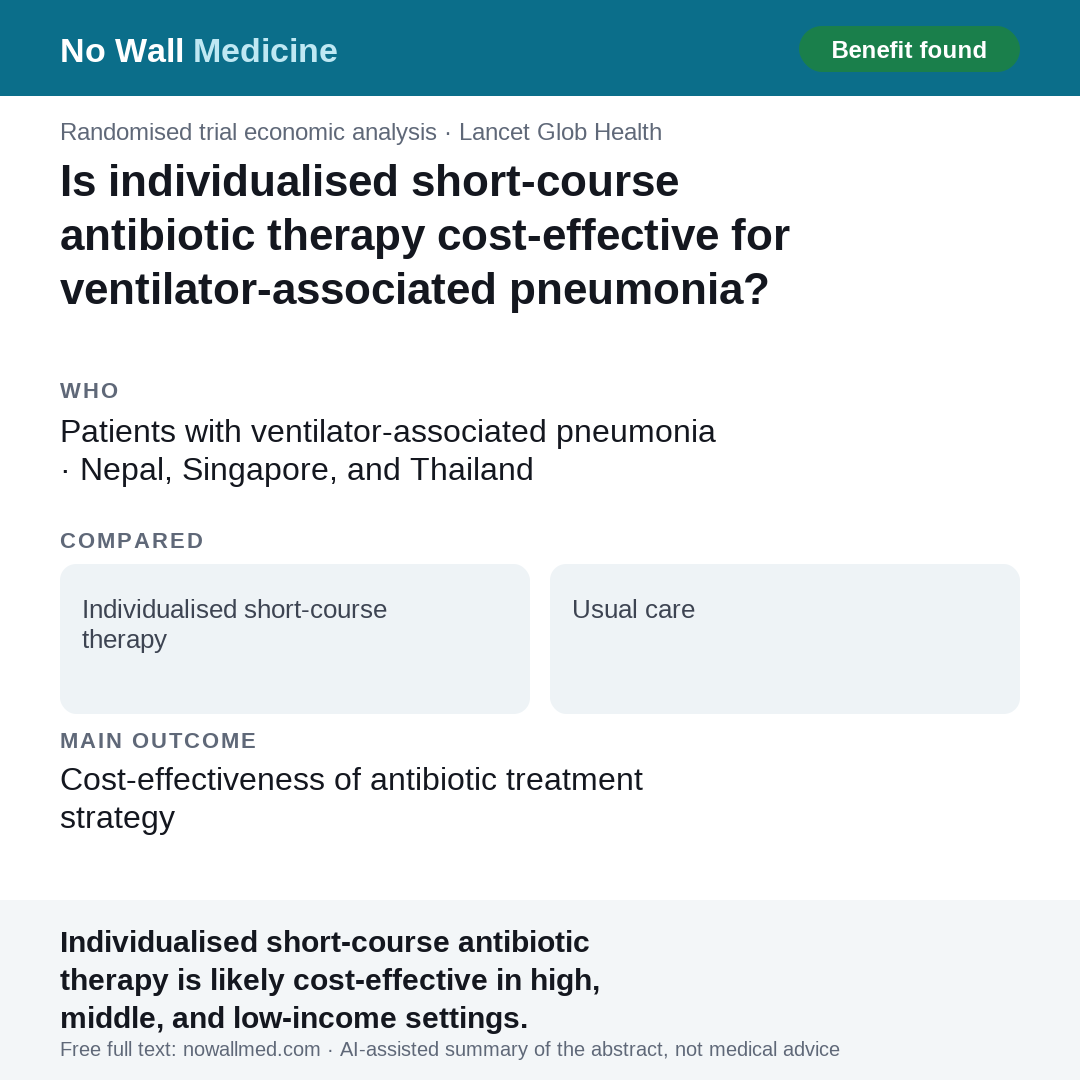
Is individualised short-course antibiotic therapy cost-effective for ventilator-associated pneumonia?
Who
Patients with ventilator-associated pneumonia · Nepal, Singapore, and Thailand
Compared
Individualised short-course therapy
Usual care
Main outcome
Cost-effectiveness of antibiotic treatment strategy
Bottom line: Individualised short-course antibiotic therapy is likely cost-effective in high, middle, and low-income settings.
Funded by: UK Medical Research Council, Singapore National Medical Research Council, and Wellcome Trust
Lancet Glob Health · 2024-11-04Download image
Clinical question: Is individualised short-course antibiotic therapy cost-effective for ventilator-associated pneumonia?
Why it matters: It was unknown if individualised shortened antibiotic therapy for ventilator-associated pneumonia is cost-effective across different economic settings.
Key points
- Researchers used data from the REGARD-VAP randomized trial to compare individualised short-course antibiotic therapy against usual care for ventilator-associated pneumonia in Nepal, Singapore, and Thailand.
- The strategy was cost-effective in Nepal (ICER=US$1086; 50.3% cost-effectiveness), Singapore (ICER=-$6069; 55.2% cost-effectiveness), and Thailand (ICER=$263; 60.5% cost-effectiveness).
- Incremental net monetary benefits were $41 (95% UI -2308 to 2390) in Nepal, $5156 (-45 805 to 56 117) in Singapore, and $804 (-6245 to 7852) in Thailand.
Limitation the authors note: The analysis showed evident uncertainty regarding the results.
Headline and key points written with AI from the paper’s abstract, with every number checked against it. Read the paper before relying on them.
Was this summary helpful?
Abstract
Background
The REGARD-VAP trial showed that individualised shortened antibiotic therapy was non-inferior to usual care for mortality and pneumonia recurrence in patients with ventilator-associated pneumonia (VAP). We aimed to assess the cost-effectiveness of an individualised shortened antibiotic therapy approach in this planned economic analysis. Methods
REGARD-VAP was a phase 4, multicentre, open-label, randomised trial to assess a short-course antibiotic treatment strategy for treatment of VAP. In this planned economic analysis, we fitted a decision tree with data from the REGARD-VAP trial to estimate the cost-effectiveness of individualised short-course therapy for VAP, compared to usual care from the health system perspective, in Nepal, Singapore, and Thailand. Incremental cost-effectiveness ratios (ICERs) and incremental net monetary benefits with 95% uncertainty intervals (UIs) were reported against relevant willingness-to-pay thresholds. Parameter uncertainties were evaluated using scenario analyses. A value of information analysis was conducted. Findings
Adopting individualised short-course therapy was cost-effective for Nepal (ICER=US$1086; percentage cost-effectiveness=50·3%), Singapore (ICER=-$6069; percentage cost-effectiveness=55·2%), and Thailand (ICER=$263; percentage cost-effectiveness=60·5%). The associated incremental net monetary benefits were $41 (95% UI -2308 to 2390) in Nepal, $5156 (-45 805 to 56 117) in Singapore, and $804 (-6245 to 7852) in Thailand. Value of information analysis showed that reducing uncertainties for mortality probabilities, bed-day costs, and variable costs were valuable for decision making. Interpretation
We found that an individualised short-course antibiotics strategy in patients with VAP is likely to be cost-effective in high-income, middle-income, and low-income settings, although with evident uncertainty. Considered alongside the positive externalities of reduced antimicrobial use, our findings foster confidence in policy makers contemplating adoption of short-course antibiotics. Funding
UK Medical Research Council, Singapore National Medical Research Council, and Wellcome Trust.
Abstract reproduced under the article’s CC BY licence.
Subject terms
Cite this article
Cai Y, Booraphun S, Li AY, et al. Cost-effectiveness of a short-course antibiotic treatment strategy for the treatment of ventilator-associated pneumonia: an economic analysis of the REGARD-VAP trial. Lancet Glob Health. 2024. doi:10.1016/S2214-109X(24)00327-9
Spotted a mistake? Suggest a correction