Clinician-supported computer-assisted therapy was cost-effective for treating depression in primary care patients
Cost-Effectiveness of Computer-Assisted Cognitive Behavioral Therapy for Depression Among Adults in Primary Care
Randomized clinical trial-based cost-effectiveness analysisBenefit found
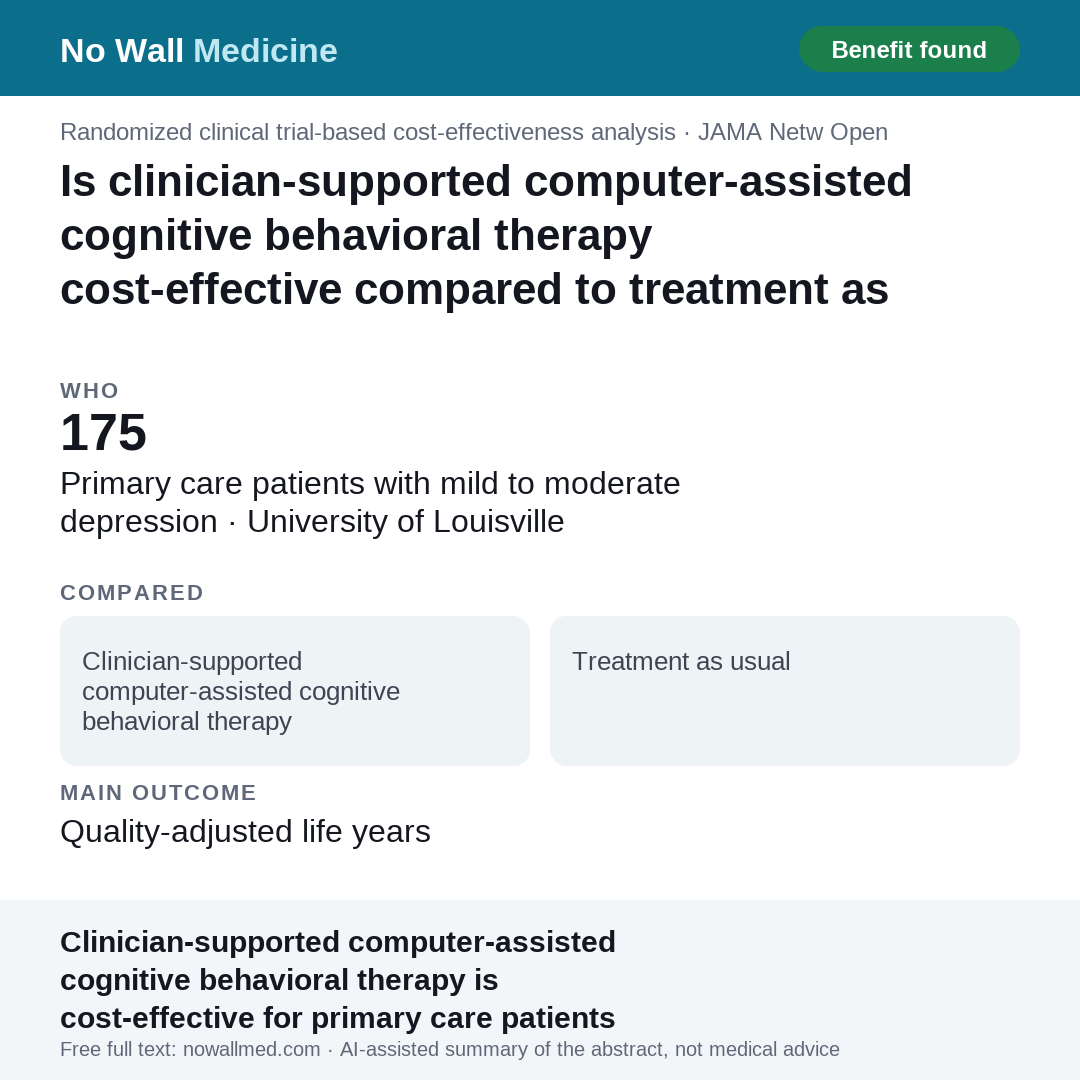
Is clinician-supported computer-assisted cognitive behavioral therapy cost-effective compared to treatment as usual for depression?
Who
175
Primary care patients with mild to moderate depression · University of Louisville
Compared
Clinician-supported computer-assisted cognitive behavioral therapy
Treatment as usual
Main outcome
Quality-adjusted life years
Result: $37 295 (95% CI, $22 724-$66 546) per QALY
Bottom line: Clinician-supported computer-assisted cognitive behavioral therapy is cost-effective for primary care patients with depression.
JAMA Netw Open · 2024-11-04Download image
Clinical question: Is clinician-supported computer-assisted cognitive behavioral therapy cost-effective compared to treatment as usual for depression?
Why it matters: The cost-effectiveness of computer-assisted cognitive behavioral therapy in sociodemographically diverse populations with low income and limited technology access remains unknown.
Key points
- The study analyzed 175 primary care patients with mild to moderate depression, including many with low income and limited internet access.
- Computer-assisted cognitive behavioral therapy was associated with better quality of life and a higher chance of treatment response compared to standard clinical management.
- The incremental cost-effectiveness ratio was $37,295 per quality-adjusted life year, with an 89.4% probability of being cost-effective at a $50,000 threshold.
Headline and key points written with AI from the paper’s abstract, with every number checked against it. Read the paper before relying on them.
Topics
Cite this article
Ali S, Alemu FW, Owen J, Eells TD, Antle B, Lee JT. Cost-Effectiveness of Computer-Assisted Cognitive Behavioral Therapy for Depression Among Adults in Primary Care. JAMA Netw Open. 2024. doi:10.1001/jamanetworkopen.2024.44599
Spotted a mistake? Suggest a correction
Top studies every Monday
The week’s key trials and guidelines in your specialties, plus any topics you follow. By email, free.
Get the weekly digest