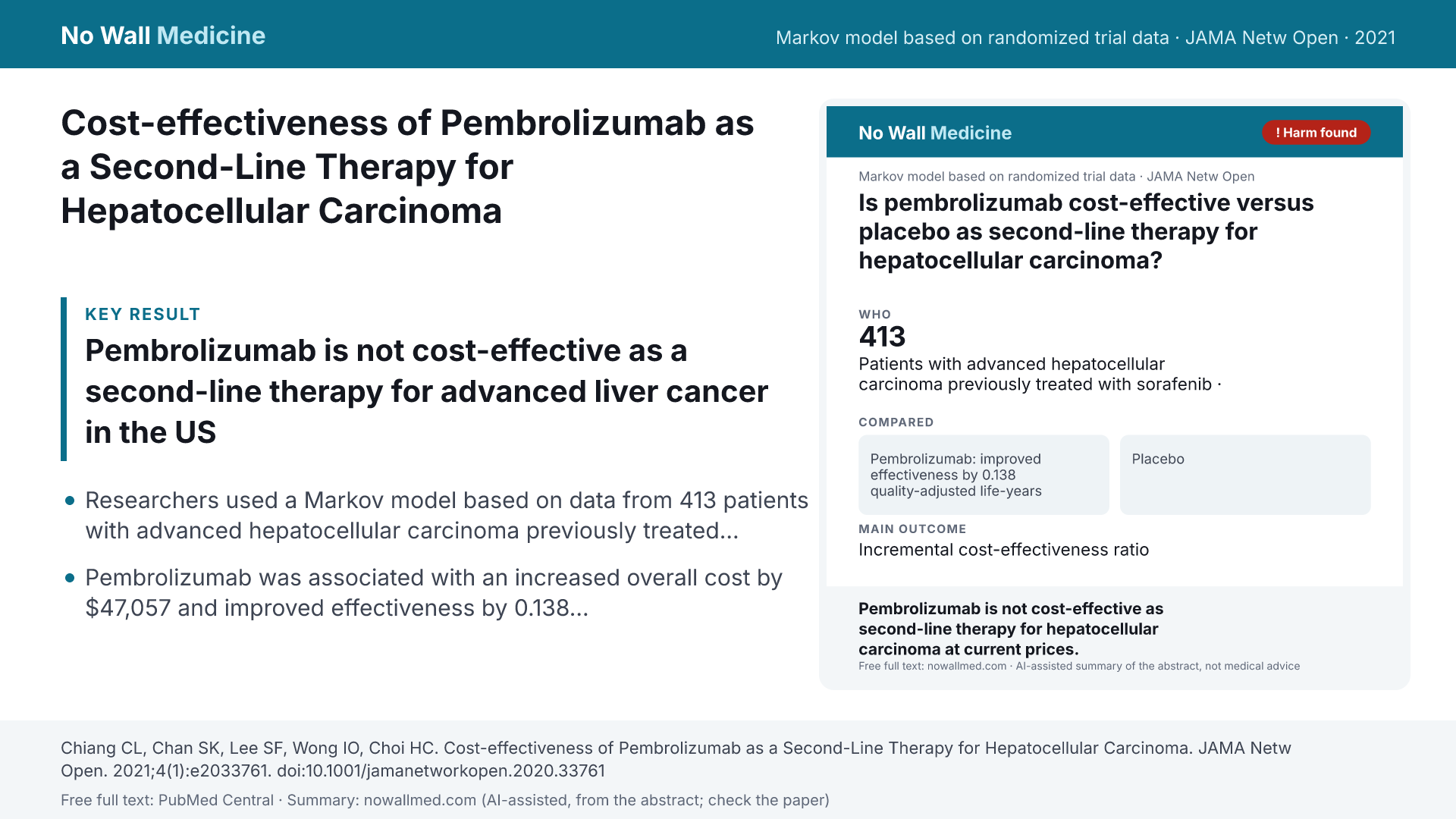
Pembrolizumab is not cost-effective as a second-line therapy for advanced liver cancer in the US
Cost-effectiveness of Pembrolizumab as a Second-Line Therapy for Hepatocellular Carcinoma
Markov model based on randomized trial dataHarm found
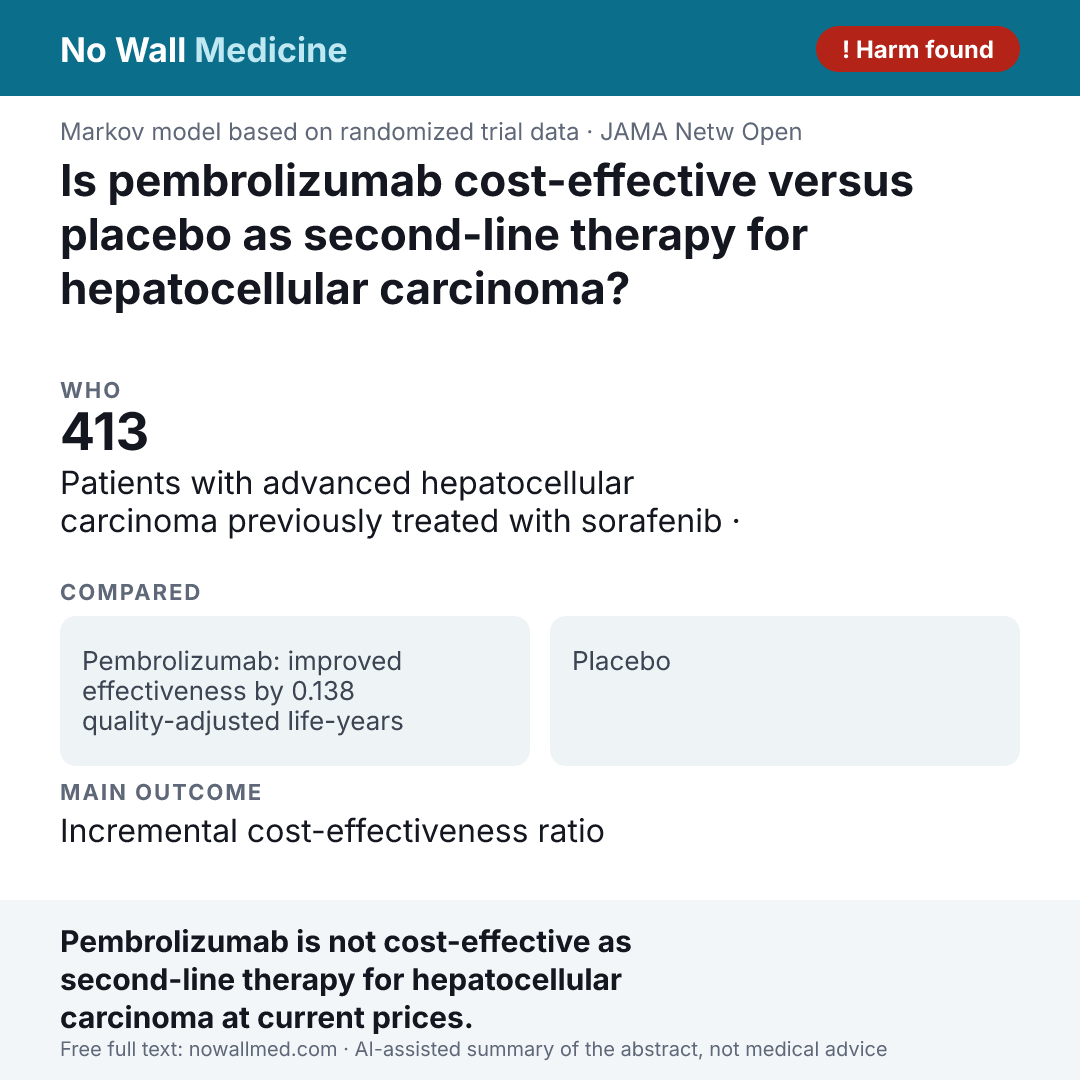
Is pembrolizumab cost-effective versus placebo as second-line therapy for hepatocellular carcinoma?
Who
413
Patients with advanced hepatocellular carcinoma previously treated with sorafenib · United States
Compared
Pembrolizumab: improved effectiveness by 0.138 quality-adjusted life-years
Placebo
Main outcome
Incremental cost-effectiveness ratio
Result: incremental cost-effectiveness ratio $340 409 per quality-adjusted life-year
Bottom line: Pembrolizumab is not cost-effective as second-line therapy for hepatocellular carcinoma at current prices.
Limitation: The model was sensitive to overall survival hazard ratio and drug price.
JAMA Netw Open · 2021-01-04 · Save PNG
Clinical question: Is pembrolizumab cost-effective versus placebo as second-line therapy for hepatocellular carcinoma?
Key points
- Researchers used a Markov model based on data from 413 patients with advanced hepatocellular carcinoma previously treated with sorafenib.
- Pembrolizumab was associated with an increased overall cost by $47,057 and improved effectiveness by 0.138 quality-adjusted life-years compared to placebo.
- The incremental cost-effectiveness ratio was $340,409 per quality-adjusted life-year, exceeding the $150,000 threshold.
Headline and key points written with AI from the paper’s abstract, with every number checked against it. Read the paper before relying on them.
Was this summary helpful?
Subject terms
Headline, design, result, key points, caveat and citation as plain text.
Cite this article
Chiang CL, Chan SK, Lee SF, Wong IO, Choi HC. Cost-effectiveness of Pembrolizumab as a Second-Line Therapy for Hepatocellular Carcinoma. JAMA Netw Open. 2021;4(1):e2033761. doi:10.1001/jamanetworkopen.2020.33761
Spotted a mistake? Suggest a correction