Pramipexole augmentation for treatment-resistant depression was found to be cost-effective over 12 and 48 weeks
Cost-effectiveness of pramipexole augmentation for acute phase and maintenance therapy of treatment-resistant depression compared to placebo augmentation: economic evaluation of the PAX-D randomised controlled trial
Economic evaluation of a randomized controlled trialBenefit found
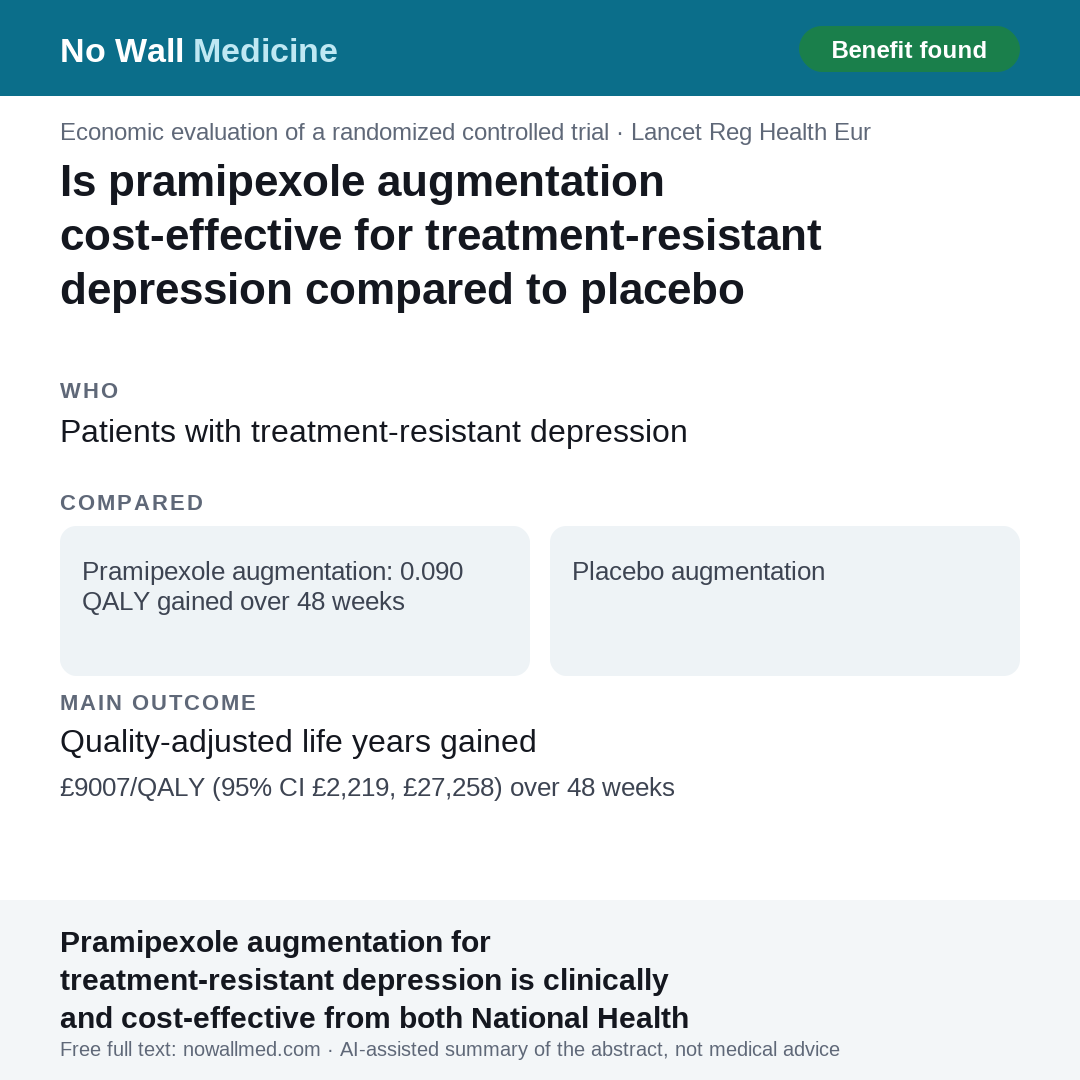
Is pramipexole augmentation cost-effective for treatment-resistant depression compared to placebo augmentation?
Who
Patients with treatment-resistant depression
Compared
Pramipexole augmentation: 0.090 QALY gained over 48 weeks
Placebo augmentation
Main outcome
Quality-adjusted life years gained
Result: £9007/QALY (95% CI £2,219, £27,258) over 48 weeks
Bottom line: Pramipexole augmentation for treatment-resistant depression is clinically and cost-effective from both National Health Service and societal perspectives.
Funded by: National Institute for Health and Care Research
Lancet Reg Health Eur · 2025-11-17Download image
Clinical question: Is pramipexole augmentation cost-effective for treatment-resistant depression compared to placebo augmentation?
Why it matters: The study addresses whether adding pramipexole to existing antidepressant treatments for treatment-resistant depression provides sufficient clinical benefit to justify the additional costs.
Key points
- Researchers evaluated the cost-effectiveness of adding pramipexole to antidepressant treatment for people with treatment-resistant depression during the PAX-D randomized controlled trial.
- Over 48 weeks, pramipexole had a mean incremental cost of £811 (95% CI: £110, £1513) and a QALY gain of 0.090 (95% CI: 0.036, 0.144).
- The incremental cost-effectiveness ratio was £9007/QALY (95% CI: £2,219, £27,258) over 48 weeks, with over 90% probability of cost-effectiveness at a £20,000/QALY threshold.
Headline and key points written with AI from the paper’s abstract, with every number checked against it. Read the paper before relying on them.
Cite this article
Łaszewska A, Helter T, Baldwin A, Cleare AJ, Cowen PJ, Evans J. Cost-effectiveness of pramipexole augmentation for acute phase and maintenance therapy of treatment-resistant depression compared to placebo augmentation: economic evaluation of the PAX-D randomised controlled trial. Lancet Reg Health Eur. 2025. doi:10.1016/j.lanepe.2025.101533
Spotted a mistake? Suggest a correction