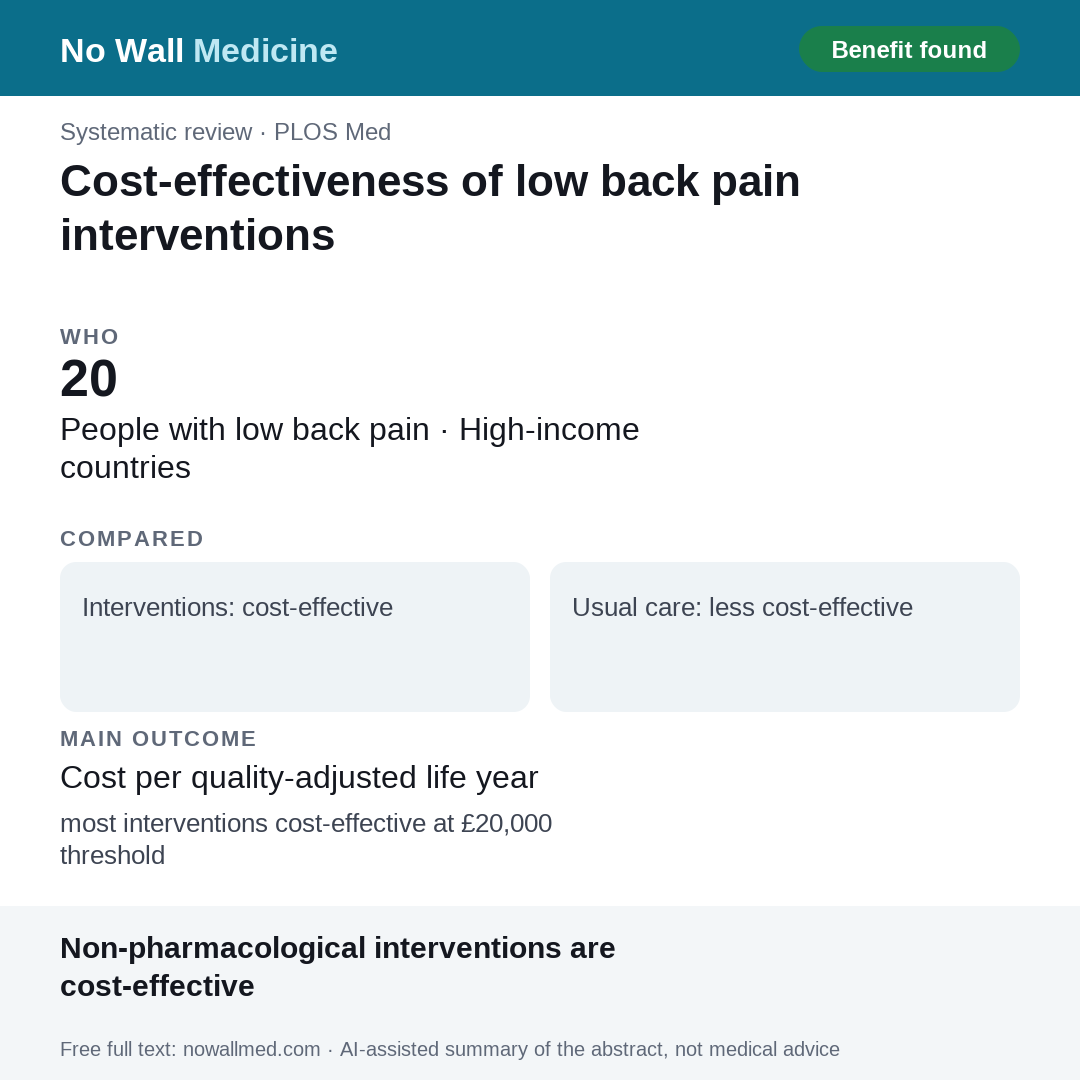
Most non-pharmacological interventions for low back pain are cost-effective at twenty thousand pounds threshold
Cost-effectiveness of recommended interventions for managing low back pain: A systematic review
Systematic reviewBenefit found
Cost-effectiveness of low back pain interventions
Who
20
People with low back pain · High-income countries
Compared
Interventions: cost-effective
Usual care: less cost-effective
Main outcome
Cost per quality-adjusted life year
Result: most interventions cost-effective at £20,000 threshold
Bottom line: Non-pharmacological interventions are cost-effective
Limitation: Limited evidence from low-income countries
PLOS Med · 2026-10-27Download image
Key points
- Twenty studies of 17 within-trial economic evaluations and 3 modelling studies were reviewed for cost-effectiveness.
- Most interventions are cost-effective at a willingness-to-pay threshold of twenty thousand pounds.
- Interventions like yoga, acupuncture, and cognitive therapy may be cost-saving from healthcare and societal perspectives.
Headline and key points written with AI from the paper’s abstract, with every number checked against it. Read the paper before relying on them.
Topics
Spotted a mistake? Suggest a correction
More in Orthopedics & Sports Medicine
Higher pre-treatment expectations associated with less pain and better function after physiotherapy
Higher pre-treatment expectations are associated with less pain and better physical function and quality of life after physiotherapy for knee osteoarthritis
Patellofemoral osteochondritis dissecans patients have distinct knee anatomy
Is There an Association Between Abnormal Patellofemoral Morphology and Patellofemoral Osteochondritis Dissecans in Pediatric Patients?
Newly Diagnosed Dyslipidemia Linked to Higher Risk of Osteoarthritis
Association Between Newly Diagnosed Dyslipidemia and Joint-Specific Incident Osteoarthritis: A Nationwide Propensity-Score-Matched Cohort Study