School mental health programs showed little impact on quality of life in English students
Cost-effectiveness of school-based interventions for well-being and mental health literacy of pupils in year 9 in England: AWARE cluster randomised controlled trial
Three-arm, parallel-group, cluster randomised controlled trialMixed results
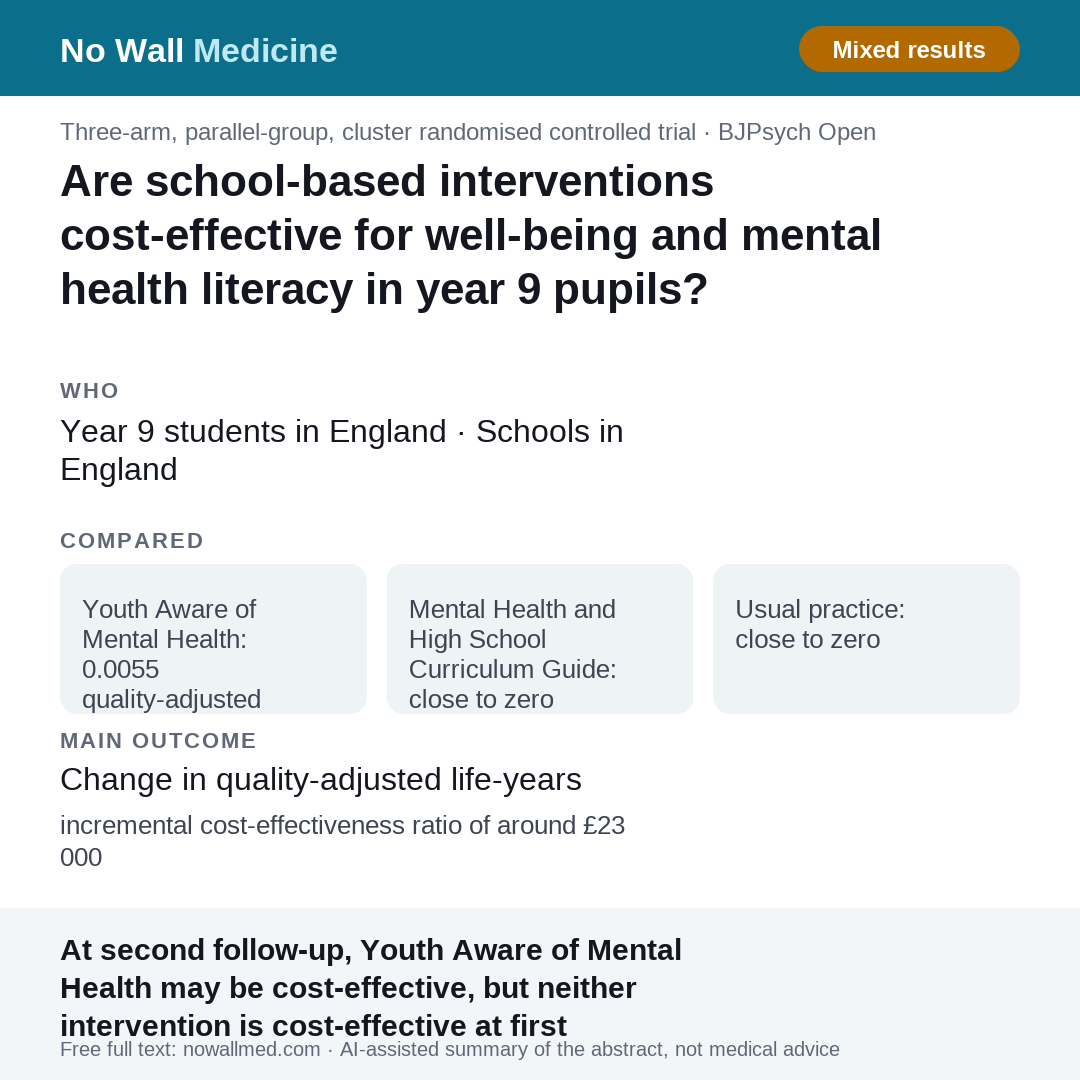
Are school-based interventions cost-effective for well-being and mental health literacy in year 9 pupils?
Who
Year 9 students in England · Schools in England
Compared
Youth Aware of Mental Health: 0.0055 quality-adjusted life-years improvement
Mental Health and High School Curriculum Guide: close to zero
Usual practice: close to zero
Main outcome
Change in quality-adjusted life-years
Result: incremental cost-effectiveness ratio of around £23 000
Bottom line: At second follow-up, Youth Aware of Mental Health may be cost-effective, but neither intervention is cost-effective at first follow-up.
BJPsych Open · 2026-06-08Download image
Clinical question: Are school-based interventions cost-effective for well-being and mental health literacy in year 9 pupils?
Why it matters: Policy decisions regarding the implementation of school-based mental health interventions require evidence on their cost-effectiveness.
Key points
- Researchers compared the Youth Aware of Mental Health program and a curriculum guide against usual practice among year 9 students in England.
- The largest change in quality-adjusted life-years, a measure of health-related quality of life, was 0.0055 at the second follow-up for the Youth Aware of Mental Health group.
- At the second follow-up, the Youth Aware of Mental Health program had an incremental cost-effectiveness ratio of around £23 000 per unit of improvement.
Headline and key points written with AI from the paper’s abstract, with every number checked against it. Read the paper before relying on them.
Spotted a mistake? Suggest a correction