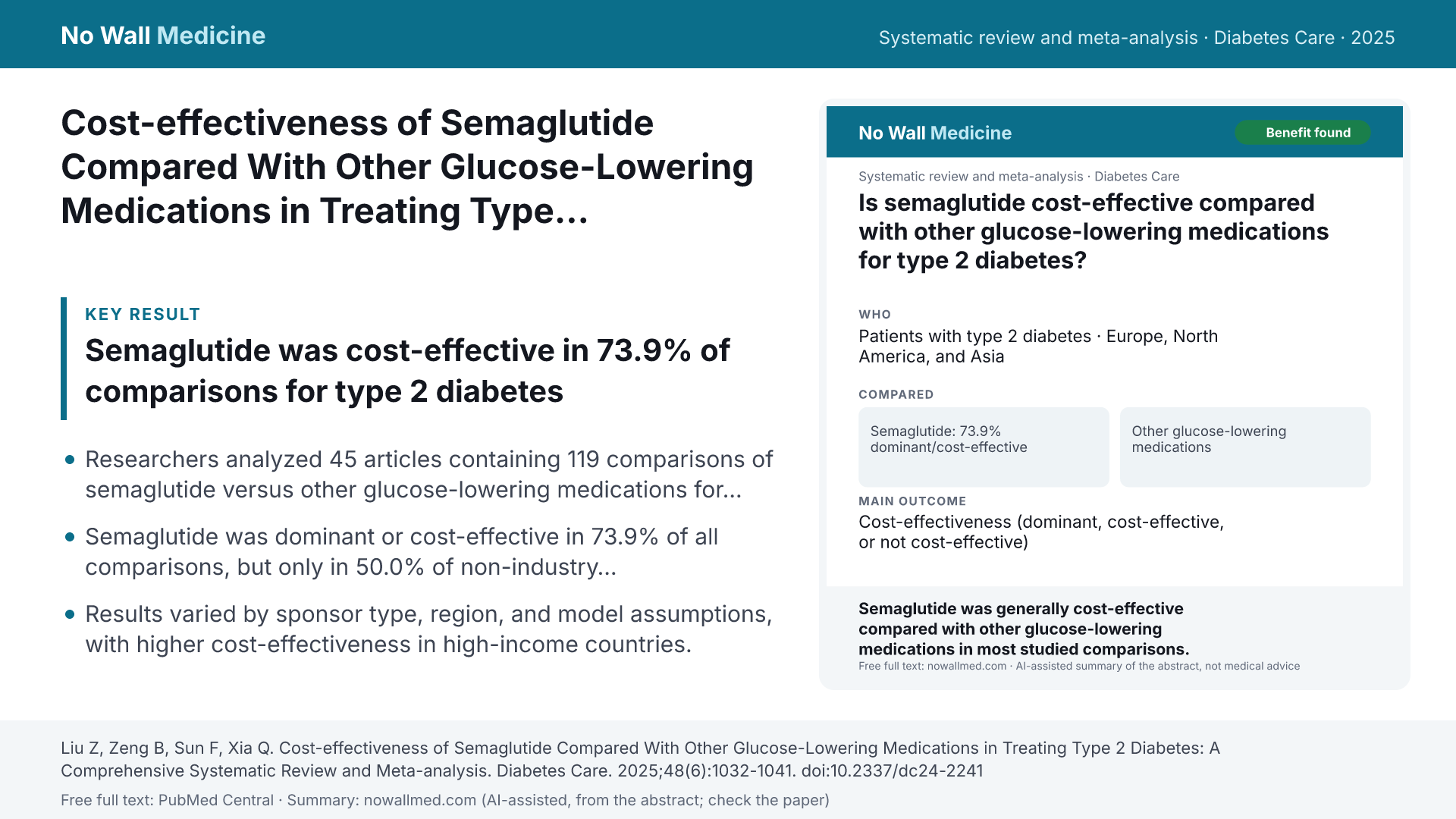
Cost-effectiveness of Semaglutide Compared With Other Glucose-Lowering Medications in Treating Type 2 Diabetes: A Comprehensive Systematic Review and Meta-analysis
Systematic review and meta-analysisBenefit found
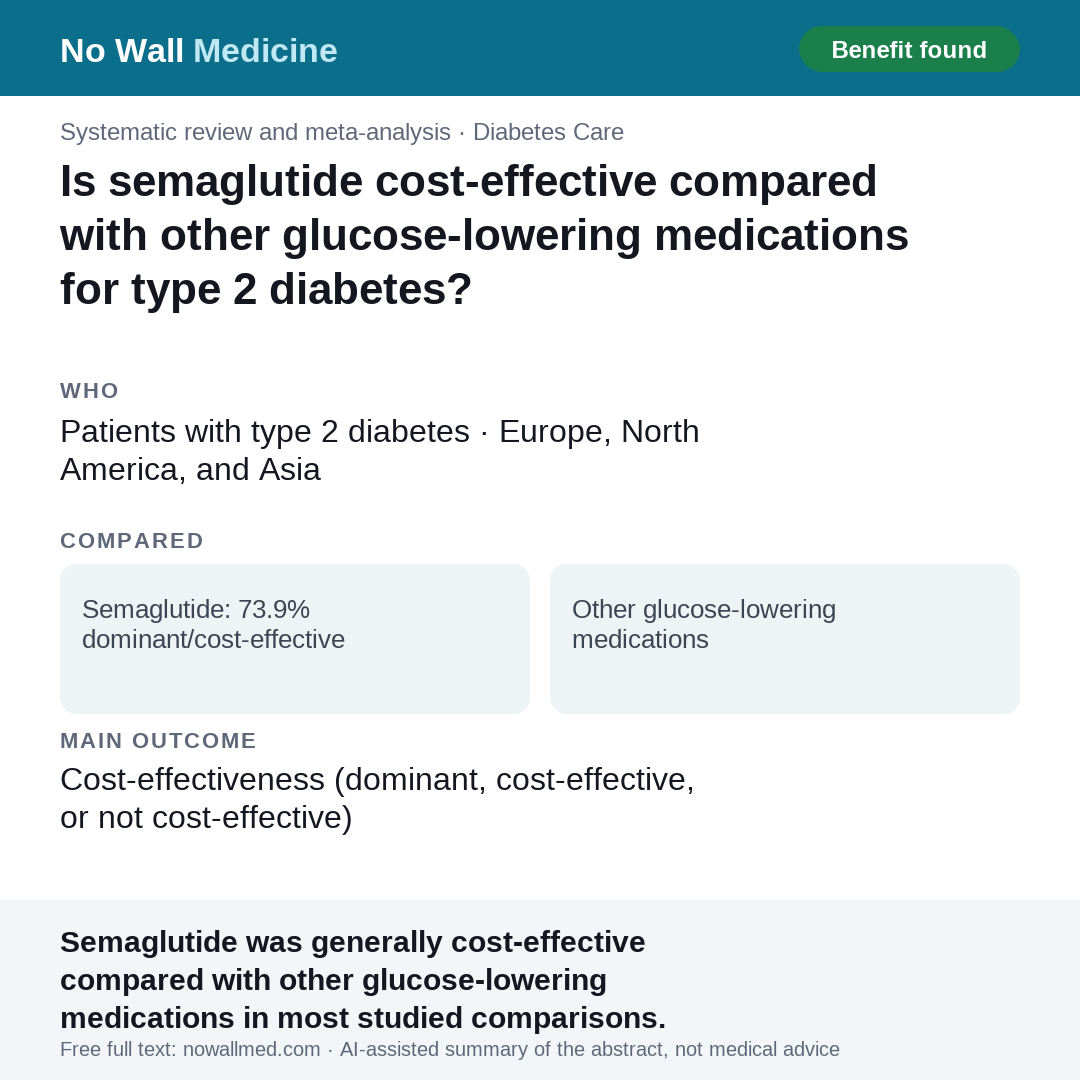
Is semaglutide cost-effective compared with other glucose-lowering medications for type 2 diabetes?
Who
Patients with type 2 diabetes · Europe, North America, and Asia
Compared
Semaglutide: 73.9% dominant/cost-effective
Other glucose-lowering medications
Main outcome
Cost-effectiveness (dominant, cost-effective, or not cost-effective)
Bottom line: Semaglutide was generally cost-effective compared with other glucose-lowering medications in most studied comparisons.
Limitation: Less detailed demographic information for more granular analyses.
Diabetes Care · 2025-05-20Download image
Clinical question: Is semaglutide cost-effective compared with other glucose-lowering medications for type 2 diabetes?
Abstract
Background
Significant clinical efficacy has been shown for semaglutide in managing type 2 diabetes (T2D); however, its cost-effectiveness remains uncertain. Purpose
To systematically review existing evidence on cost-effectiveness of semaglutide versus other T2D medications. Data sources
PubMed, Embase, and the Cost-Effectiveness Analysis Registry (by 11 June 2024). Study selection
A total of 45 articles (with 119 comparisons) from 2019 onward were included, representing Europe (n = 24), North America (n = 13), and Asia (all from China) (n = 8). Data extraction
Study characteristics and model characteristics/inputs/results were extracted. Lifetime costs and quality-adjusted life-years were evaluated. Proportions for cost-effectiveness outcomes (dominant, cost-effective, not cost-effective) were calculated. Subgroup analyses by region, sponsor type, comparator type, and model assumptions were performed. In sensitivity analysis a standard willingness-to-pay threshold was applied. Data synthesis
Of the articles included, 93.3% included adoption of a lifetime horizon and 84.4% a health care perspective and 68.9% were industry sponsored. For most studies reporting quality was high (86.7%). Overall, semaglutide was dominant/cost-effective in 73.9% of all comparisons. Notably, semaglutide was found to be dominant/cost-effective in all comparisons sponsored by Novo Nordisk versus in 50.0% of these funded by nonindustry sponsors and in none funded by other industry sponsors. Additionally, semaglutide was more cost-effective in high-income countries and in studies with adoption of a broader perspective, longer horizon, and lower discount rates. Results remained consistent with conversion with a common currency unit and willingness-to-pay threshold of US$50,000. Limitations
Less detailed demographic information for more granular analyses. Conclusions
Semaglutide is generally cost-effective compared with other glucose-lowering medications in evaluation against within-study willingness-to-pay thresholds; however, results varied by study sponsor type, region, and model assumptions, highlighting the need for transparent and context-sensitive economic evaluations.
Subject terms
Cite this article
Liu Z, Zeng B, Sun F, Xia Q. Cost-effectiveness of Semaglutide Compared With Other Glucose-Lowering Medications in Treating Type 2 Diabetes: A Comprehensive Systematic Review and Meta-analysis. Diabetes Care. 2025. doi:10.2337/dc24-2241
Spotted a mistake? Suggest a correction