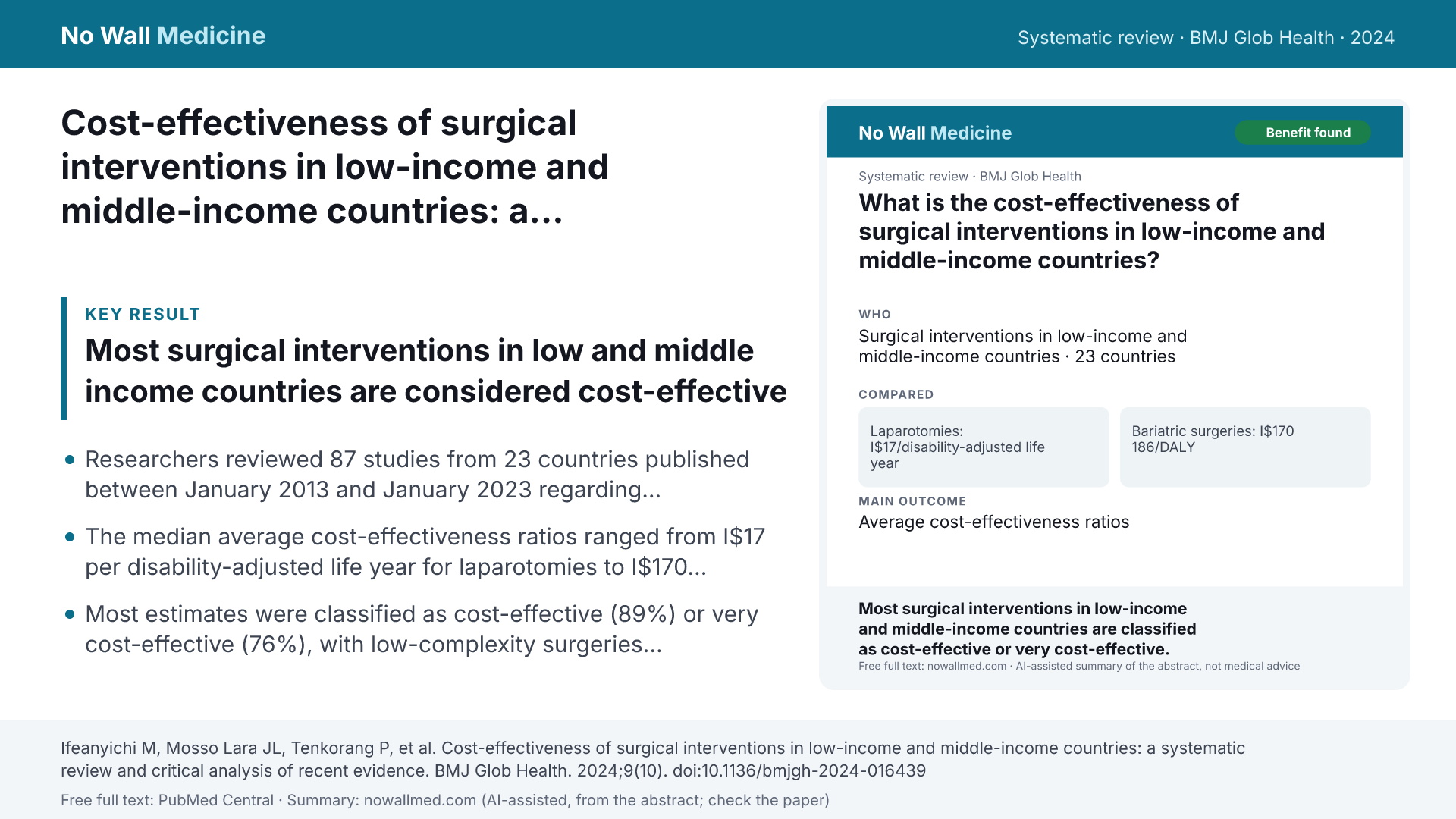
Most surgical interventions in low and middle income countries are considered cost-effective
Cost-effectiveness of surgical interventions in low-income and middle-income countries: a systematic review and critical analysis of recent evidence
Systematic reviewBenefit found
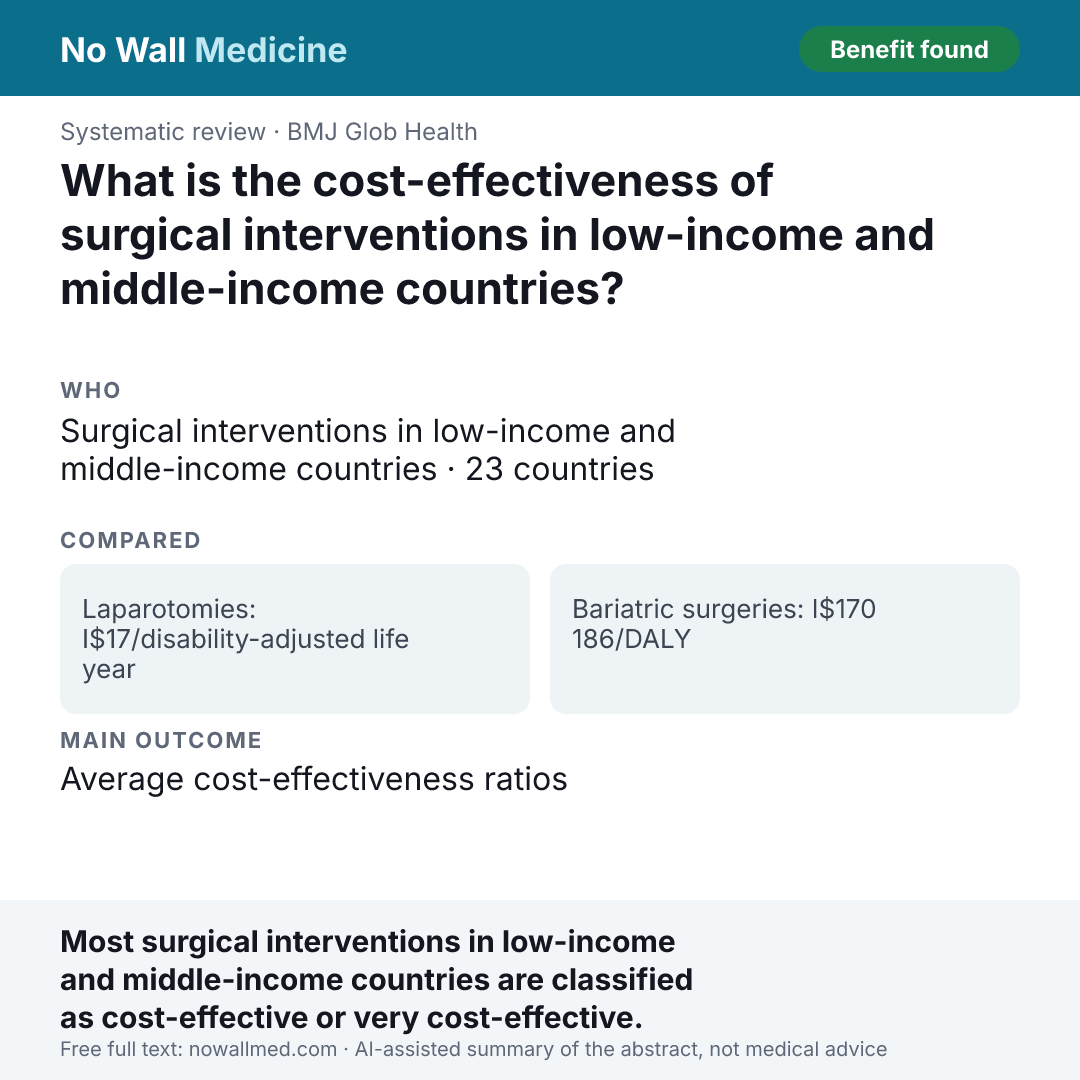
What is the cost-effectiveness of surgical interventions in low-income and middle-income countries?
Who
Surgical interventions in low-income and middle-income countries · 23 countries
Compared
Laparotomies: I$17/disability-adjusted life year
Bariatric surgeries: I$170 186/DALY
Main outcome
Average cost-effectiveness ratios
Bottom line: Most surgical interventions in low-income and middle-income countries are classified as cost-effective or very cost-effective.
Limitation: Paucity of high-quality evidence to assess comparative cost-effectiveness and determine best buys.
BMJ Glob Health · 2024-10-03 · Save PNG
Clinical question: What is the cost-effectiveness of surgical interventions in low-income and middle-income countries?
Why it matters: Decision-makers lack high-quality evidence to assess the comparative cost-effectiveness of surgery and determine the best investments across different specialties and interventions.
Key points
- Researchers reviewed 87 studies from 23 countries published between January 2013 and January 2023 regarding surgical cost-effectiveness.
- The median average cost-effectiveness ratios ranged from I$17 per disability-adjusted life year for laparotomies to I$170 186 per disability-adjusted life year for bariatric surgeries.
- Most estimates were classified as cost-effective (89%) or very cost-effective (76%), with low-complexity surgeries comparing favorably to common public health interventions.
Headline and key points written with AI from the paper’s abstract, with every number checked against it. Read the paper before relying on them.
Was this summary helpful?
Abstract
Background
Cost-effectiveness evidence is a critical tool to support resource allocation decisions. There is growing recognition that the development of benefit packages for surgical care should be guided by such evidence, particularly in resource-constraint settings. Methods
We conducted a systematic review of evidence (Medline, Embase, Global Health, EconLit and grey literature) on the cost-effectiveness of surgery across low-income and middle-income countries published between January 2013 and January 2023. We included studies with minor and major therapeutic surgeries and minimally invasive intraluminal and endovascular interventions. We computed and compared the average cost-effectiveness ratios (ACERs) for different surgical interventions to the respective national gross domestic product per capita to determine cost-effectiveness and to common traditional public health interventions. Results
We identified 87 unique studies out of 20 070 articles screened. Studies spanned 23 countries, with China (n=20), Thailand (n=12), Brazil (n=8) and Iran (n=8) accounting for about 55% of the evidence. Overall, the median ACERs across procedure groups ranged from I$17/disability-adjusted life year (DALY) for laparotomies to I$170 186/DALY for bariatric surgeries. Most of the ACER estimates were classified as cost-effective (89%) or very cost-effective (76%). Low-complexity surgical interventions compared favourably to common public health interventions. Conclusion
These findings reinforce the growing body of evidence that investments in surgery are economically smart. There remains however paucity of high-quality evidence that would allow decision-makers to assess the comparative cost-effectiveness of surgery and to determine best buys across a wide range of specialties and interventions. A concerted effort is needed to advance the generation and utilisation of economic evidence in the drive towards scale-up of surgical care across low-income and middle-income countries.
Abstract reproduced under the article’s CC BY NC licence.
Subject terms
Headline, design, result, key points, caveat and citation as plain text.
Cite this article
Ifeanyichi M, Mosso Lara JL, Tenkorang P, et al. Cost-effectiveness of surgical interventions in low-income and middle-income countries: a systematic review and critical analysis of recent evidence. BMJ Glob Health. 2024;9(10). doi:10.1136/bmjgh-2024-016439
Spotted a mistake? Suggest a correction