Iron supplements and micronutrient powders were not cost-effective for preventing anemia in rural Bangladesh
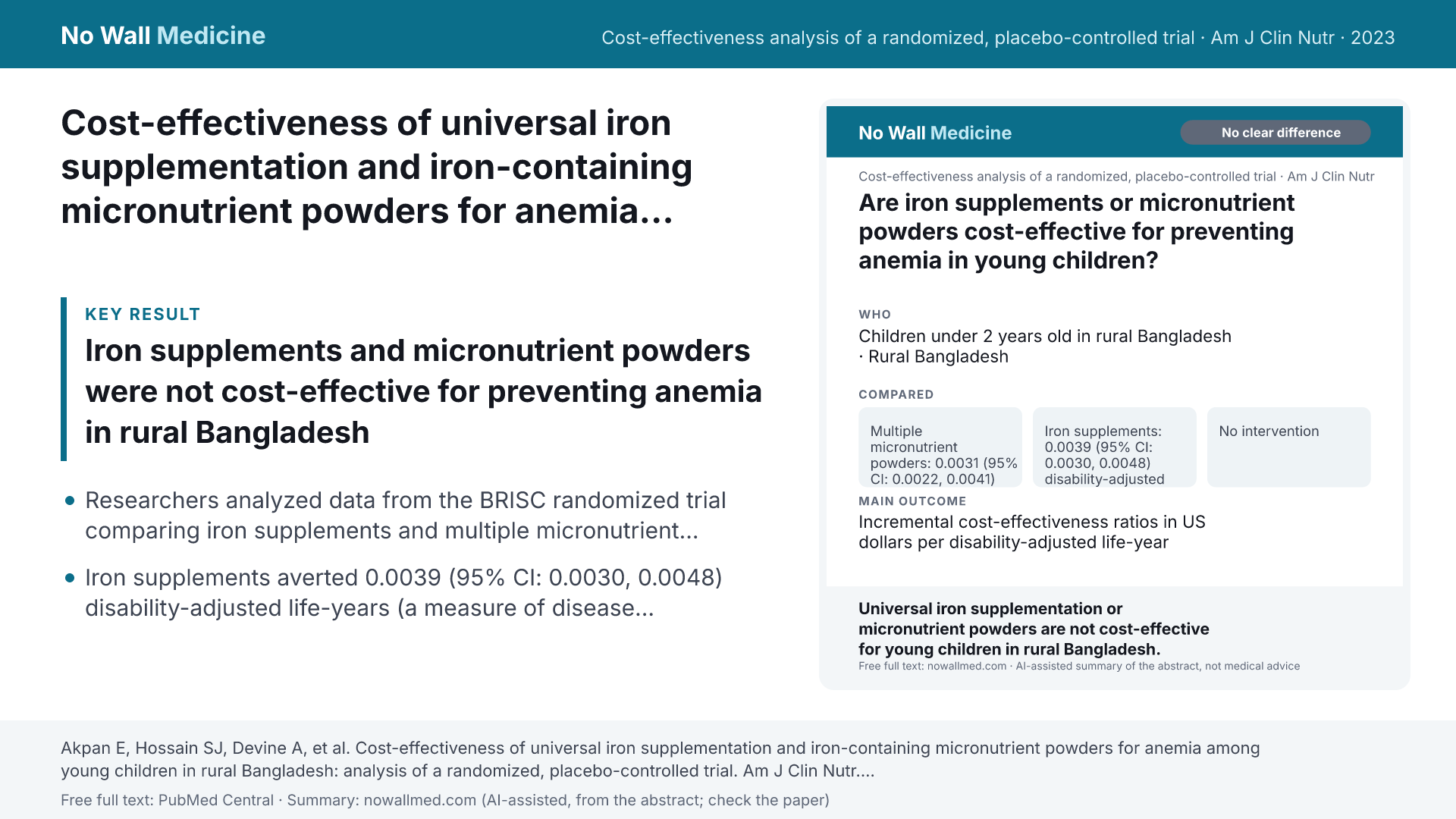
Cost-effectiveness of universal iron supplementation and iron-containing micronutrient powders for anemia among young children in rural Bangladesh: analysis of a randomized, placebo-controlled trial
Cost-effectiveness analysis of a randomized, placebo-controlled trialNo clear difference
Are iron supplements or micronutrient powders cost-effective for preventing anemia in young children?
Who
Children under 2 years old in rural Bangladesh · Rural Bangladesh
Compared
Multiple micronutrient powders: 0.0031 (95% CI: 0.0022, 0.0041) disability-adjusted life-years averted per child
Iron supplements: 0.0039 (95% CI: 0.0030, 0.0048) disability-adjusted life-years averted per child
No intervention
Main outcome
Incremental cost-effectiveness ratios in US dollars per disability-adjusted life-year averted
Result: $1645 ($1333, $2153) per disability-adjusted life-year averted for iron supplementation
Bottom line: Universal iron supplementation or micronutrient powders are not cost-effective for young children in rural Bangladesh.
Am J Clin Nutr · 2023-02-10 · Save PNG
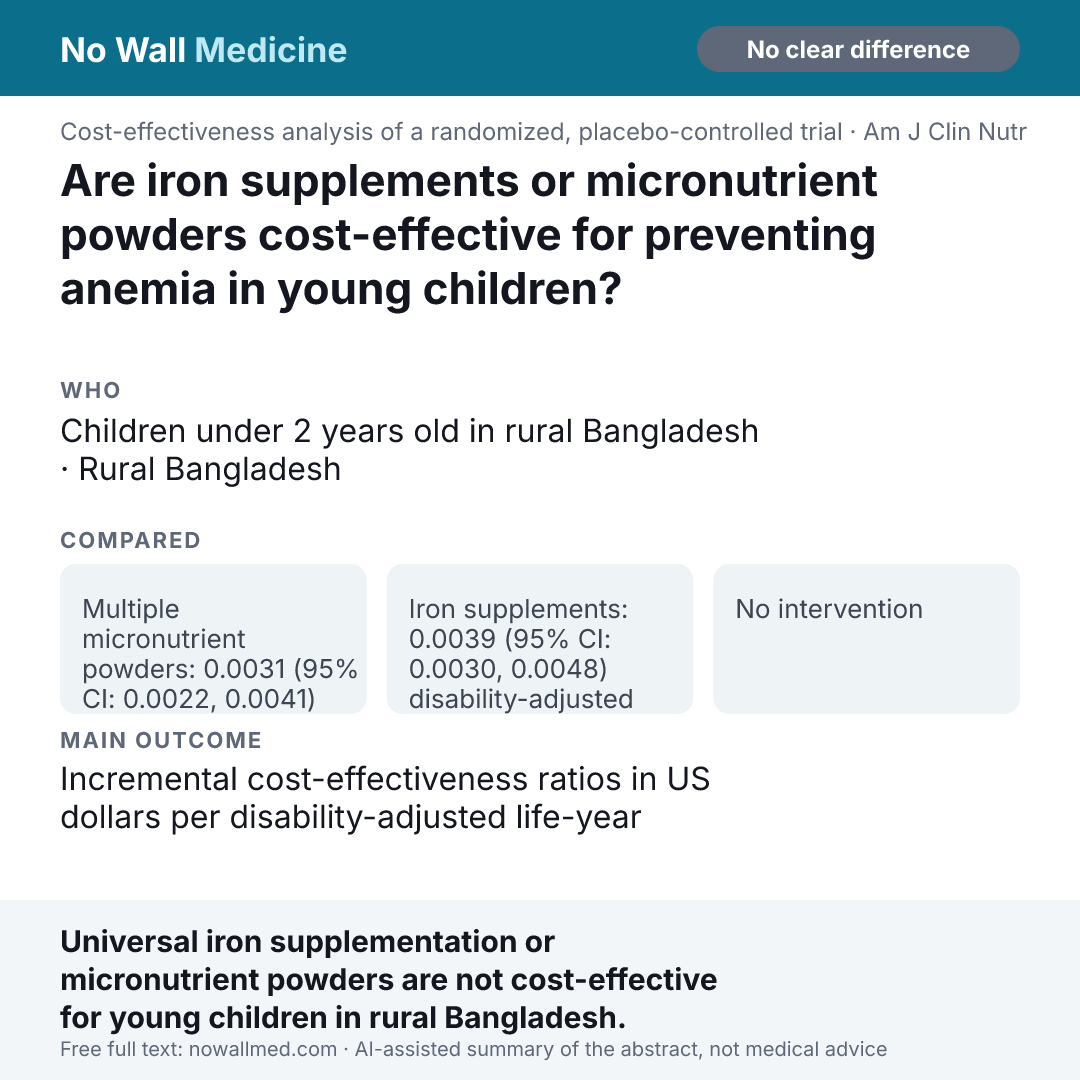
Clinical question: Are iron supplements or micronutrient powders cost-effective for preventing anemia in young children?
Key points
- Researchers analyzed data from the BRISC randomized trial comparing iron supplements and multiple micronutrient powders (powders containing several vitamins and minerals) to a placebo in children under 2 years old.
- Iron supplements averted 0.0039 (95% CI: 0.0030, 0.0048) disability-adjusted life-years (a measure of disease burden) per child, while powders averted 0.0031 (95% CI: 0.0022, 0.0041) per child.
- Iron supplementation had a 0% probability of being the optimal strategy at cost-effectiveness thresholds of $200 and $985 per disability-adjusted life-year averted.
Headline and key points written with AI from the paper’s abstract, with every number checked against it. Read the paper before relying on them.
Was this summary helpful?
Subject terms
Headline, design, result, key points, caveat and citation as plain text.
Cite this article
Akpan E, Hossain SJ, Devine A, et al. Cost-effectiveness of universal iron supplementation and iron-containing micronutrient powders for anemia among young children in rural Bangladesh: analysis of a randomized, placebo-controlled trial. Am J Clin Nutr. 2022;116(5):1303-1313. doi:10.1093/ajcn/nqac225
Spotted a mistake? Suggest a correction