Adapted problem adaptation therapy for depression in dementia showed no statistically significant cost or quality of life improvements
Cost-utility analysis of adapted problem adaptation therapy for depression in mild-to-moderate dementia caused by Alzheimer's disease: PATHFINDER randomised controlled trial
Randomized controlled trialNo clear difference
Is adapted problem adaptation therapy cost-effective for depression in mild-to-moderate Alzheimer's dementia?
Who
336
People with mild-to-moderate dementia caused by Alzheimer's disease and depression
Compared
Adapted PATH intervention plus treatment as usual
Treatment as usual alone
Main outcome
Quality-adjusted life-years
Result: mean difference in QALYs 0.027 (95% CI -0.004 to 0.059)
Bottom line: Adapted problem adaptation therapy showed potential cost savings and higher quality of life, but improvements were not statistically significant.
BJPsych Open · 2024-10-25Download image
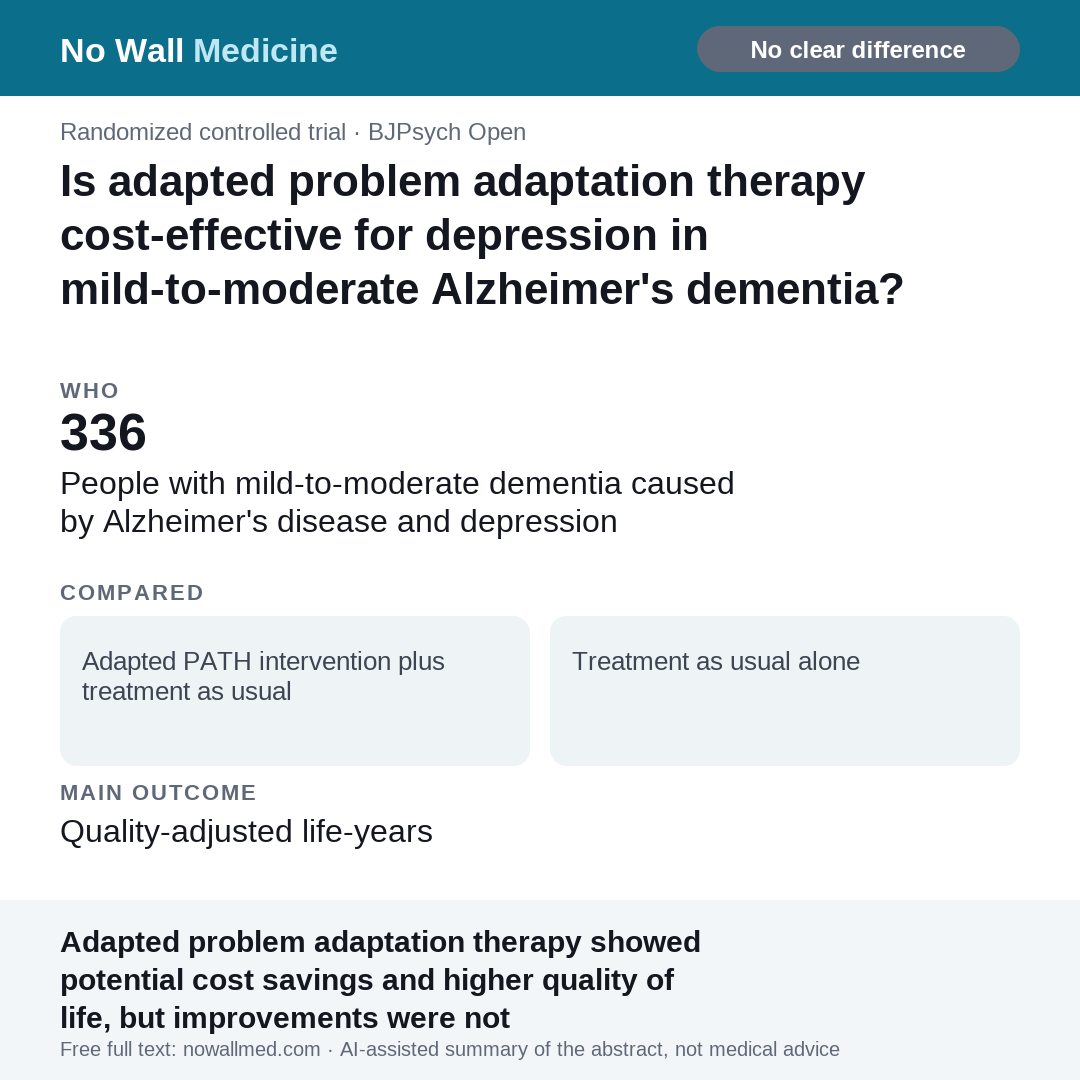
Clinical question: Is adapted problem adaptation therapy cost-effective for depression in mild-to-moderate Alzheimer's dementia?
Why it matters: It is unknown if adding adapted problem adaptation therapy to usual treatment is cost-effective for people with depression and mild-to-moderate Alzheimer's disease dementia.
Key points
- Researchers studied 336 participants with mild-to-moderate Alzheimer's disease dementia, comparing usual treatment to usual treatment plus adapted problem adaptation therapy.
- The mean difference in quality-adjusted life-years, a measure of health-related quality of life, was 0.027 (95% CI -0.004 to 0.059).
- Mean cost differences at 12 months were -£74 (95% CI -£1942 to £1793) from a health and social care perspective and -£671 (95% CI -£9144 to £7801) from a societal perspective.
Headline and key points written with AI from the paper’s abstract, with every number checked against it. Read the paper before relying on them.
Cite this article
Panca M, Howard R, Cort E, Rawlinson C, Gould RL, Wiegand M. Cost-utility analysis of adapted problem adaptation therapy for depression in mild-to-moderate dementia caused by Alzheimer's disease: PATHFINDER randomised controlled trial. BJPsych Open. 2024. doi:10.1192/bjo.2024.775
Spotted a mistake? Suggest a correction
Top studies every Monday
The week’s key trials and guidelines in your specialties, plus any topics you follow. By email, free.
Get the weekly digest