Dementia prevention programme shows cost-effectiveness for cognitive gain
Cost utility and cost-effectiveness of the APPLE-Tree programme: Active Prevention in People at risk of dementia through Lifestyle, bEhaviour change and Technology to build REsiliEnce: economic evaluation embedded within a randomised controlled trial
Randomised controlled trial economic evaluationMixed results
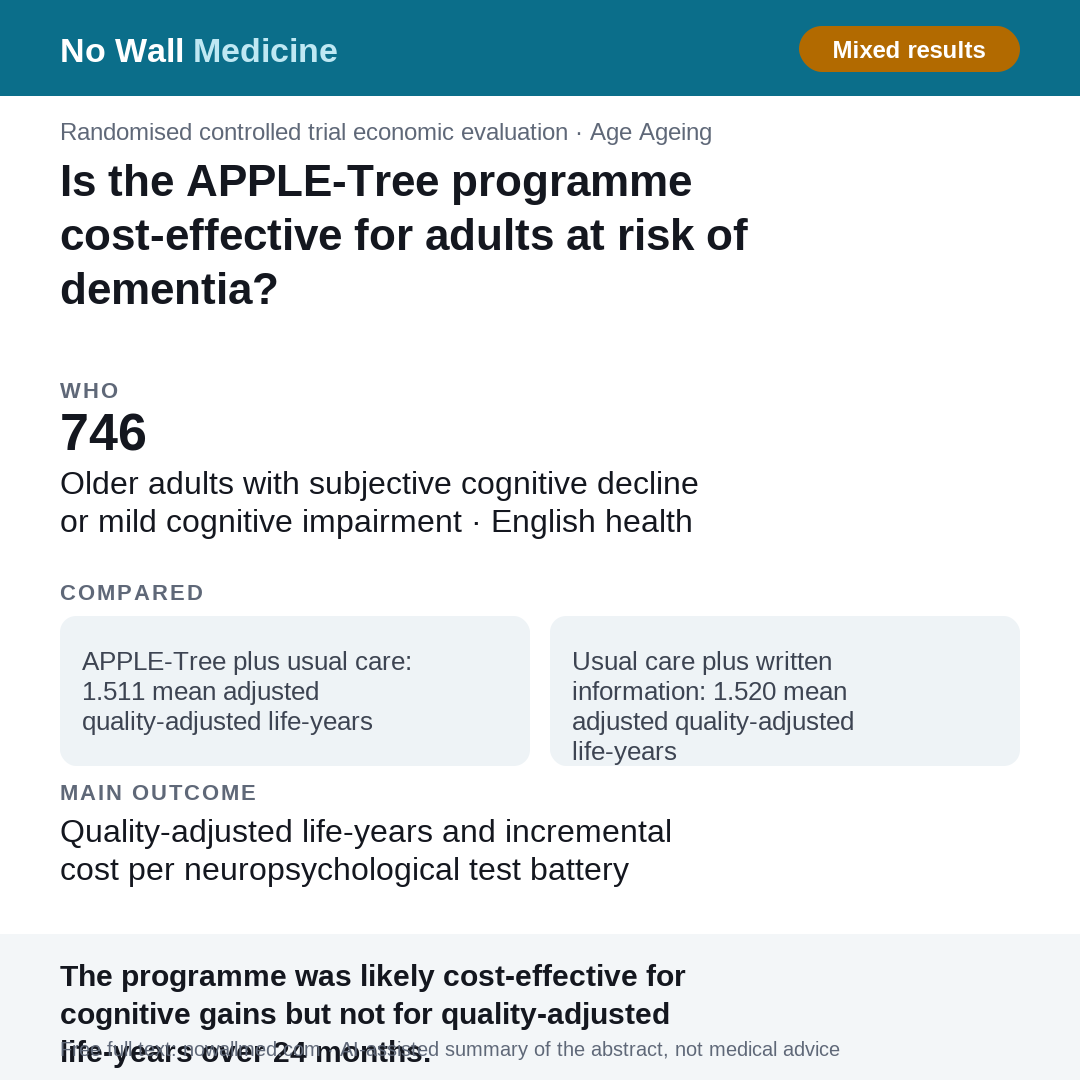
Is the APPLE-Tree programme cost-effective for adults at risk of dementia?
Who
746
Older adults with subjective cognitive decline or mild cognitive impairment · English health and community settings
Compared
APPLE-Tree plus usual care: 1.511 mean adjusted quality-adjusted life-years
Usual care plus written information: 1.520 mean adjusted quality-adjusted life-years
Main outcome
Quality-adjusted life-years and incremental cost per neuropsychological test battery change
Result: -0.010 (95%CI -0.04 to -0.022) difference in quality-adjusted life-years
Bottom line: The programme was likely cost-effective for cognitive gains but not for quality-adjusted life-years over 24 months.
Age Ageing · 2026-06-22Download image
Clinical question: Is the APPLE-Tree programme cost-effective for adults at risk of dementia?
Why it matters: Doctors have had little trial evidence on cost-effectiveness of dementia prevention programmes
Key points
- Researchers studied 746 older adults with cognitive decline, comparing a dementia prevention programme to usual care.
- The programme was associated with a mean difference of 0.06 in cognitive test scores, with a cost of £6809 per 1-point change.
- Cost-effectiveness varied by subgroup, with higher probability of cost-effectiveness in non-White and socioeconomically disadvantaged participants.
Headline and key points written with AI from the paper’s abstract, with every number checked against it. Read the paper before relying on them.
Topics
Spotted a mistake? Suggest a correction