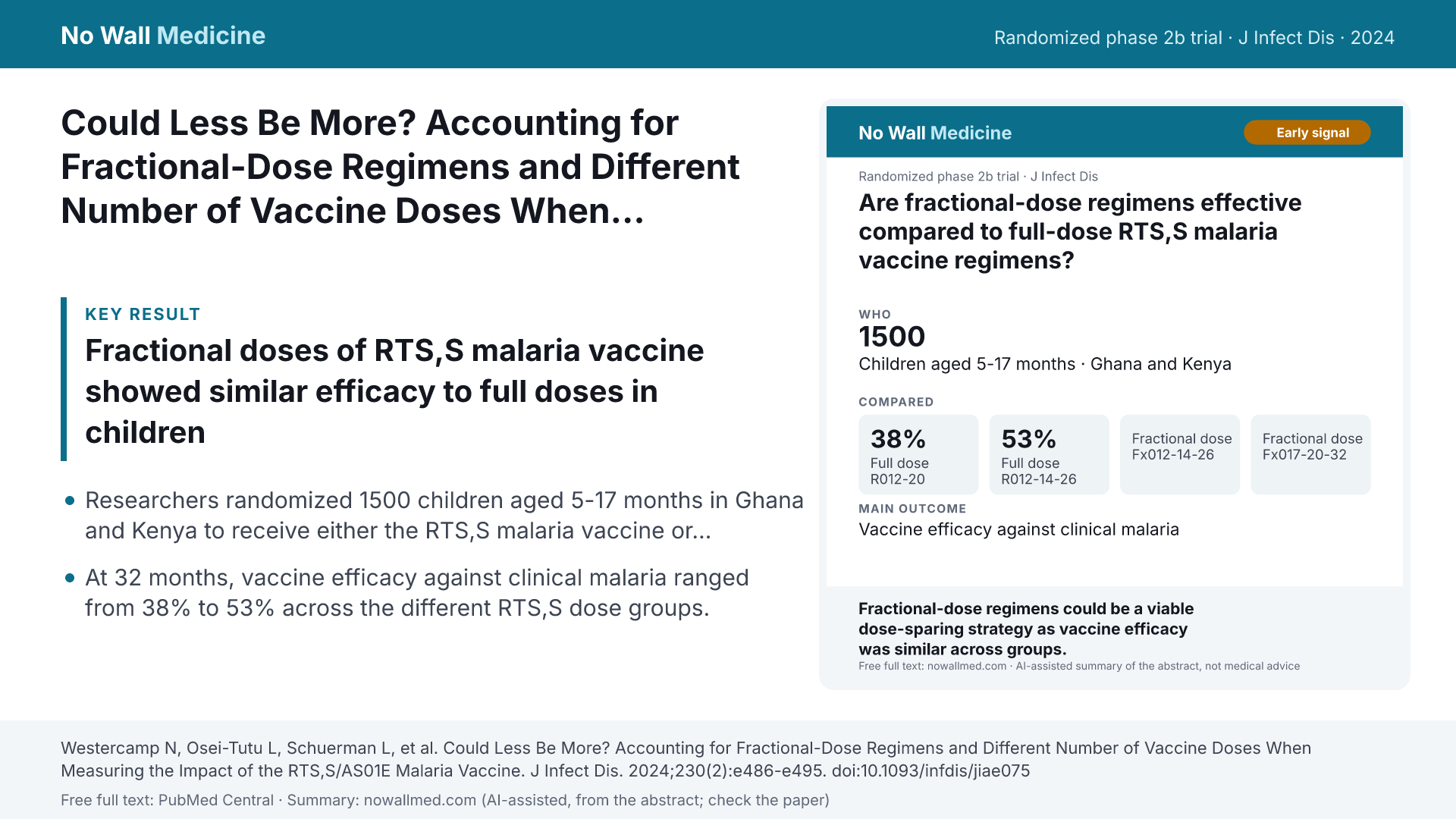
Fractional doses of RTS,S malaria vaccine showed similar efficacy to full doses in children
Could Less Be More? Accounting for Fractional-Dose Regimens and Different Number of Vaccine Doses When Measuring the Impact of the RTS,S/AS01E Malaria Vaccine
Randomized phase 2b trialEarly signal
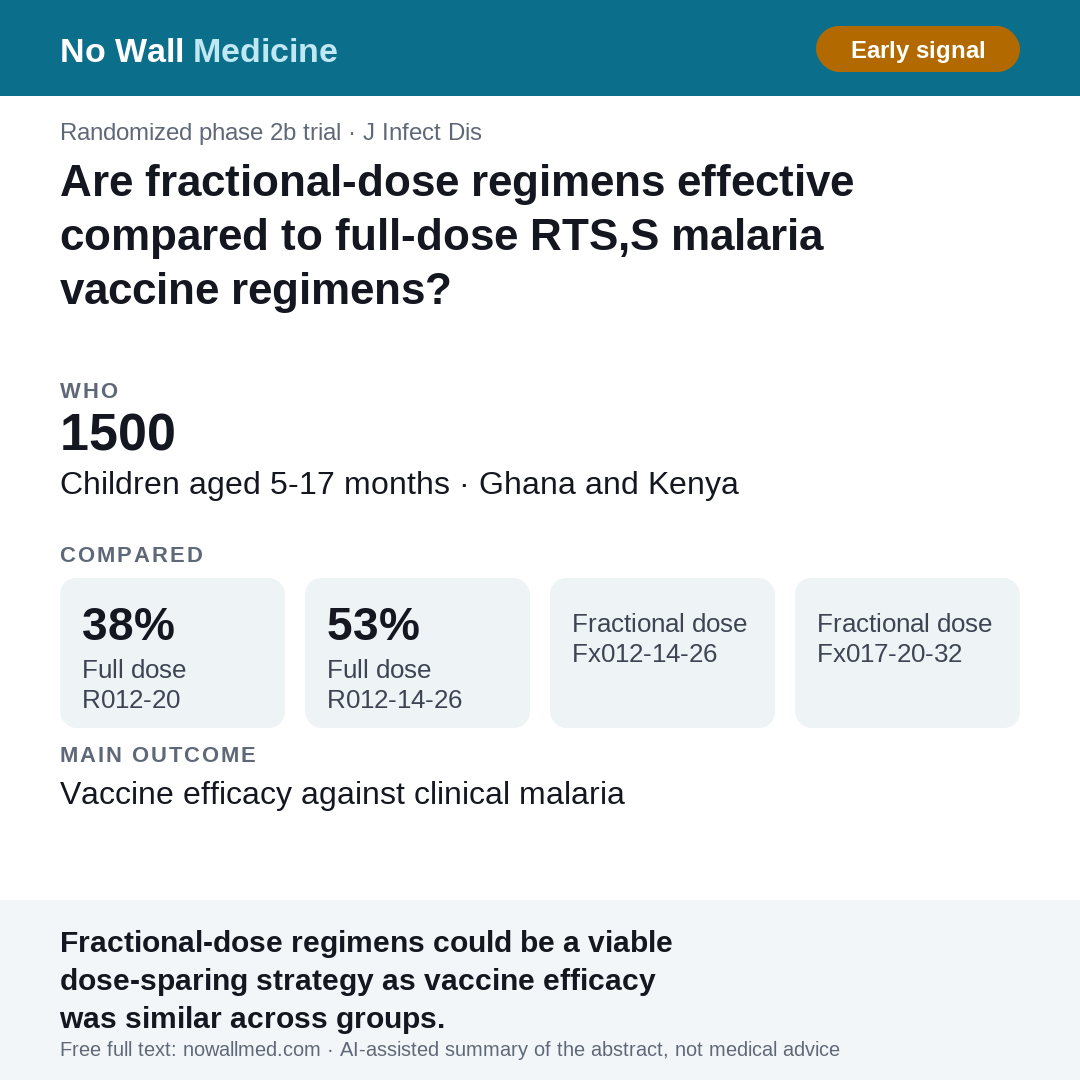
Are fractional-dose regimens effective compared to full-dose RTS,S malaria vaccine regimens?
Who
1500
Children aged 5-17 months · Ghana and Kenya
Compared
38%Full dose R012-20 (95% CI: 24%-49%)
53%Full dose R012-14-26 (95% CI: 42%-62%)
Fractional dose Fx012-14-26
Fractional dose Fx017-20-32
Main outcome
Vaccine efficacy against clinical malaria
Bottom line: Fractional-dose regimens could be a viable dose-sparing strategy as vaccine efficacy was similar across groups.
J Infect Dis · 2024-03-05Download image
Clinical question: Are fractional-dose regimens effective compared to full-dose RTS,S malaria vaccine regimens?
Why it matters: It was unknown if using smaller fractional doses of the RTS,S malaria vaccine would maintain efficacy compared to standard full-dose regimens.
Key points
- Researchers randomized 1500 children aged 5-17 months in Ghana and Kenya to receive either the RTS,S malaria vaccine or a rabies control vaccine.
- At 32 months, vaccine efficacy against clinical malaria ranged from 38% to 53% across the different RTS,S dose groups.
- When accounting for full-dose equivalents, fractional-dose regimens showed a potential for dose-sparing to maximize vaccine supply and impact.
Headline and key points written with AI from the paper’s abstract, with every number checked against it. Read the paper before relying on them.
Was this summary helpful?
Subject terms
Cite this article
Westercamp N, Osei-Tutu L, Schuerman L, et al. Could Less Be More? Accounting for Fractional-Dose Regimens and Different Number of Vaccine Doses When Measuring the Impact of the RTS,S/AS01E Malaria Vaccine. J Infect Dis. 2024. doi:10.1093/infdis/jiae075
Spotted a mistake? Suggest a correction