App-based high intensity interval training and yoga were linked to lower depressive symptoms
COVID-19 Pandemic and Exercise (COPE) trial: a multigroup pragmatic randomised controlled trial examining effects of app-based at-home exercise programs on depressive symptoms
6-week, parallel, multiarm, pragmatic randomised controlled trialBenefit found
Do app-based at-home exercise programs reduce depressive symptoms in the general population?
Who
334
Low active, English-speaking, non-retired Canadians aged 18-64 years · Canada
Compared
High intensity interval training: significant treatment effects
Yoga: significant treatment effects
High intensity interval training and yoga: significant treatment effects
Waitlist control
Main outcome
depressive symptoms
Bottom line: At-home exercise programs significantly improve depressive symptoms, especially for those with high baseline symptoms.
Br J Sports Med · 2021-09-27Download image
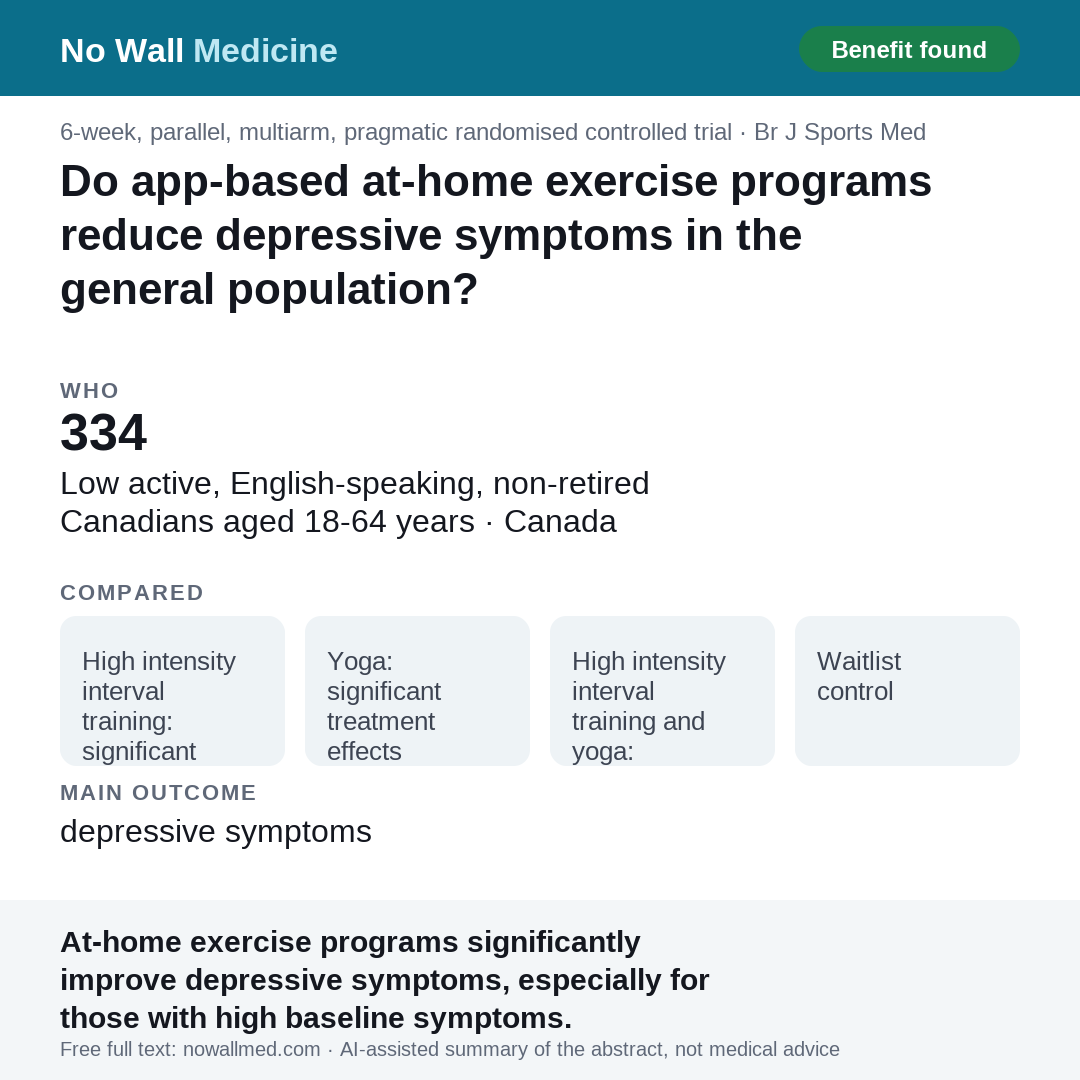
Clinical question: Do app-based at-home exercise programs reduce depressive symptoms in the general population?
Why it matters: It was unknown if app-based at-home exercise programs like high intensity interval training or yoga could reduce depressive symptoms in the general population during the COVID-19 pandemic.
Key points
- Researchers studied 334 English-speaking, non-retired Canadians aged 18-64 who were randomized into high intensity interval training, yoga, a combination of both, or a waitlist control group.
- All three active exercise groups showed significant treatment effects on depressive symptoms compared to the waitlist control, though the groups were not significantly different from each other.
- For participants with high depressive symptoms at baseline, the effect sizes at week 6 were very large, ranging from -2.34 to -2.52.
Headline and key points written with AI from the paper’s abstract, with every number checked against it. Read the paper before relying on them.
Was this summary helpful?
Abstract
Background
The number of adults across the globe with significant depressive symptoms has grown substantially during the COVID-19 pandemic. The extant literature supports exercise as a potent behaviour that can significantly reduce depressive symptoms in clinical and non-clinical populations. Objective
Using a suite of mobile applications, at-home exercise, including high intensity interval training (HIIT) and/or yoga, was completed to reduce depressive symptoms in the general population in the early months of the pandemic. Methods
A 6-week, parallel, multiarm, pragmatic randomised controlled trial was completed with four groups: (1) HIIT, (2) Yoga, (3) HIIT+yoga, and (4) waitlist control (WLC). Low active, English-speaking, non-retired Canadians aged 18-64 years were included. Depressive symptoms were measured at baseline and weekly following randomisation. Results
A total of 334 participants were randomised to one of four groups. No differences in depressive symptoms were evident at baseline. The results of latent growth modelling showed significant treatment effects in depressive symptoms for each active group compared with the WLC, with small effect sizes (ESs) in the community-based sample of participants. Treatment groups were not significantly different from each other. Effect sizes were very large (eg, week 6 ES range=-2.34 to -2.52) when restricting the analysis only to participants with high depressive symptoms at baseline. Conclusions
At-home exercise is a potent behaviour to improve mental health in adults during the pandemic, especially in those with increased levels of depressive symptoms. Promotion of at-home exercise may be a global public health target with important personal, social and economic implications as the world emerges scathed by the pandemic. Trial registration number
NCT04400279.
Abstract reproduced under the article’s CC BY NC licence.
Subject terms
Cite this article
Puterman E, Hives B, Mazara N, Grishin N, Webster J, Hutton S. COVID-19 Pandemic and Exercise (COPE) trial: a multigroup pragmatic randomised controlled trial examining effects of app-based at-home exercise programs on depressive symptoms. Br J Sports Med. 2021. doi:10.1136/bjsports-2021-104379
Spotted a mistake? Suggest a correction
Top studies every Monday
The week’s key trials and guidelines in your specialties, plus any topics you follow. By email, free.
Get the weekly digest