COVID-19 vaccines show high effectiveness against infection and hospitalization in people on immunosuppressive therapies
COVID-19 vaccine effectiveness in people on immunosuppressive therapies: a systematic review and meta-analysis
Systematic review and meta-analysisBenefit found
What is the vaccine effectiveness in people on immunosuppressive therapies?
Who
34
Adults with haematological malignancies or autoimmune and immune-mediated inflammatory disorders
Compared
Vaccinated on immunosuppressive therapies: 82·3% (95% CI 72·4-88·7) against infection
Unvaccinated individuals
Main outcome
SARS-CoV-2 infection, hospitalisation, severe disease, or death
Result: relative risk 1·57 (95% CI 1·25-1·96) for SARS-CoV-2 infection
Bottom line: Vaccination provides substantial benefit for people on immunosuppressive therapy, though they face higher risks than healthy vaccinated individuals.
Limitation: Assessing booster effectiveness against current circulating variants remains a priority.
Funded by: National Health and Medical Research Council (Australia)
Lancet Microbe · 2026-09-15Download image
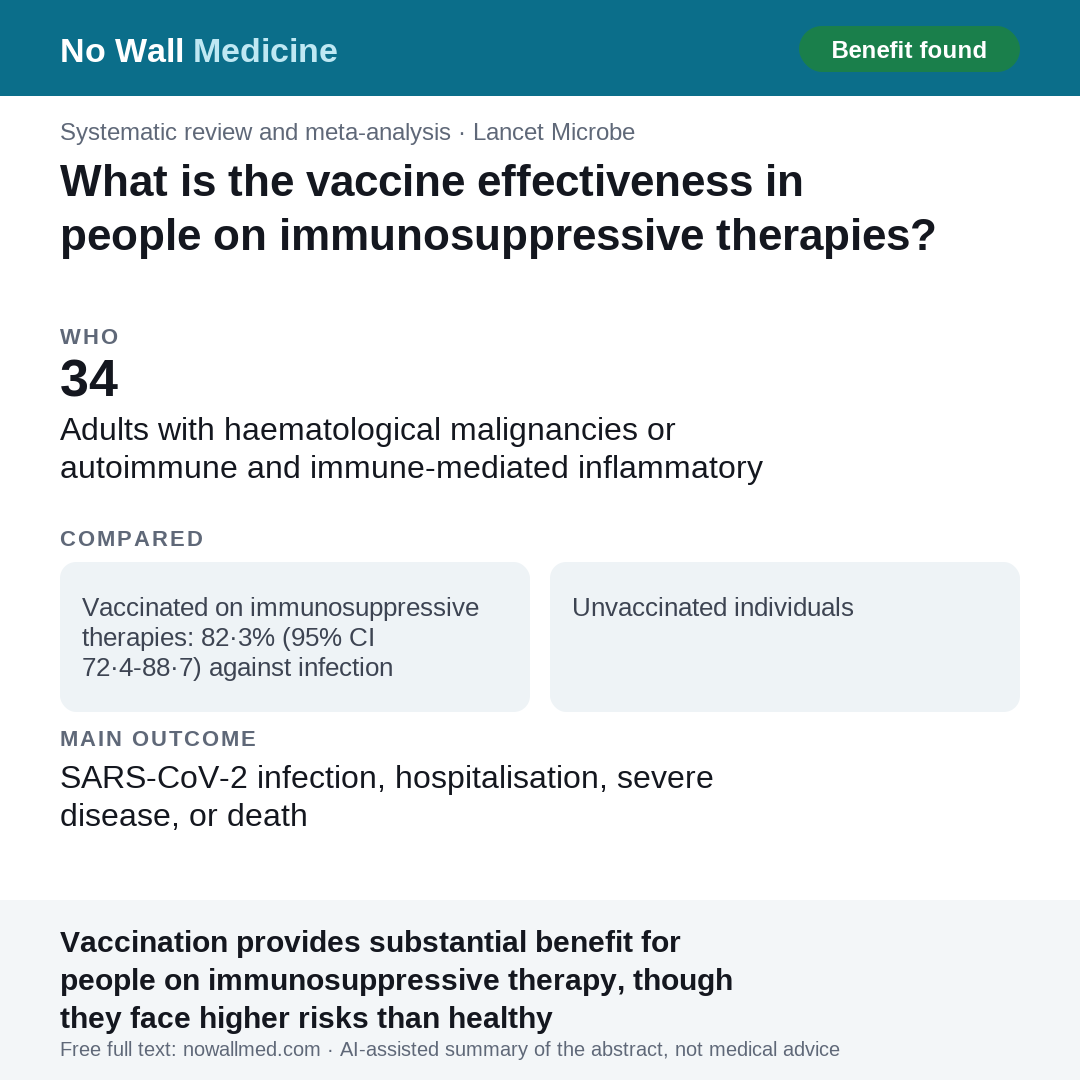
Clinical question: What is the vaccine effectiveness in people on immunosuppressive therapies?
Why it matters: Vaccine efficacy in individuals receiving conventional synthetic or targeted immunosuppressive therapies has been inadequately assessed in randomized controlled trials.
Key points
- Researchers analyzed 34 studies involving adults with blood cancers or autoimmune and immune-mediated inflammatory disorders to measure vaccine effectiveness.
- After three doses, vaccine effectiveness was 82.3% against infection with pre-omicron variants and 88.4% against hospitalization.
- Compared to vaccinated healthy individuals, those on immunosuppressive therapies had a higher risk of infection (RR 1.57), hospitalization (RR 3.72), and death (RR 3.14).
Headline and key points written with AI from the paper’s abstract, with every number checked against it. Read the paper before relying on them.
Topics
Cite this article
Stadler E, Khan SR, Elias KM, Egilmezer E, Phetsouphanh C, Hastak P. COVID-19 vaccine effectiveness in people on immunosuppressive therapies: a systematic review and meta-analysis. Lancet Microbe. 2026. doi:10.1016/j.lanmic.2026.101424
Spotted a mistake? Suggest a correction