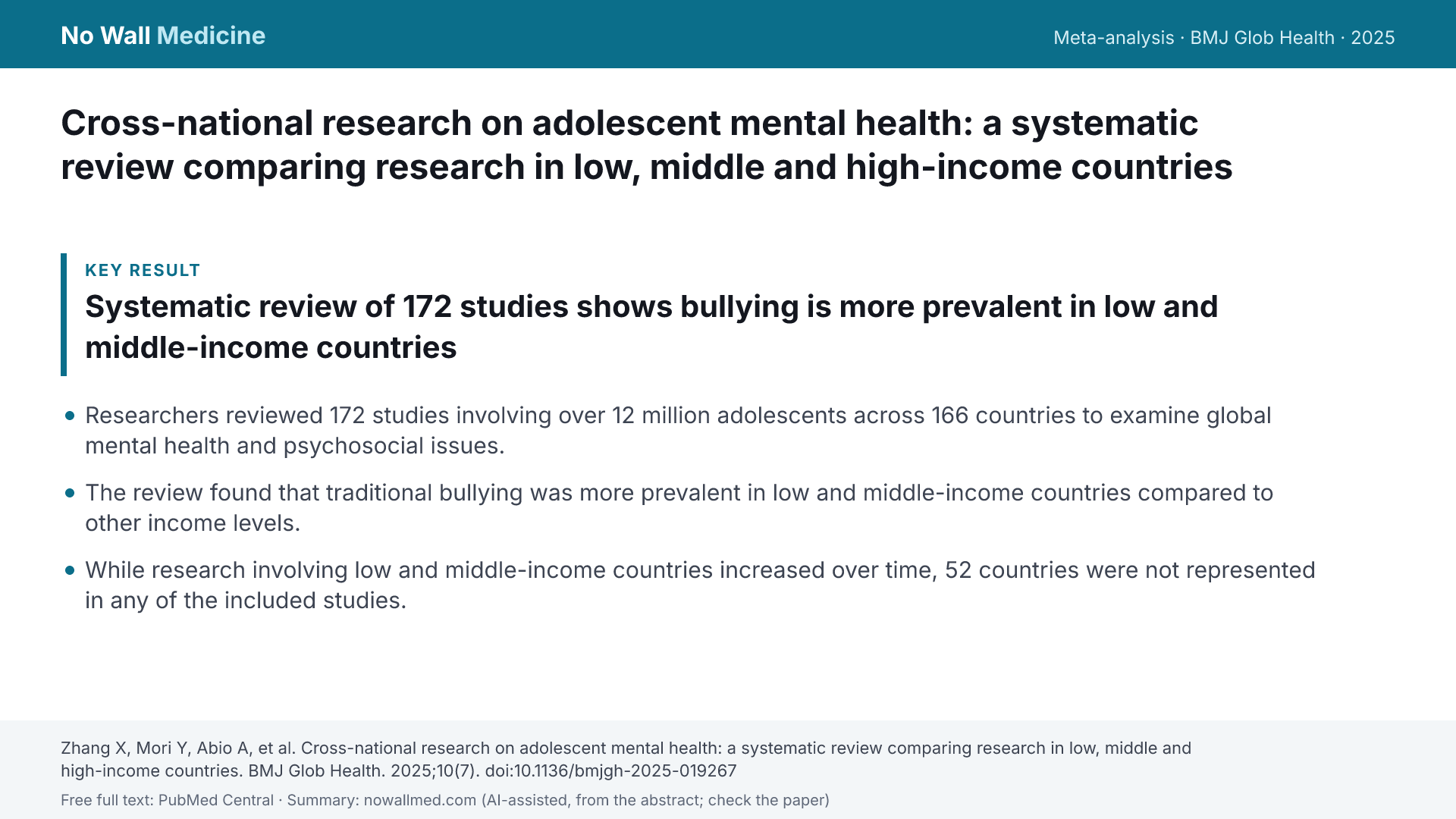
Systematic review of 172 studies shows bullying is more prevalent in low and middle-income countries
Cross-national research on adolescent mental health: a systematic review comparing research in low, middle and high-income countries
Why it matters: Most global adolescent mental health research has focused on high-income countries despite 90% of the adolescent population living in low and middle-income countries.
Key points
- Researchers reviewed 172 studies involving over 12 million adolescents across 166 countries to examine global mental health and psychosocial issues.
- The review found that traditional bullying was more prevalent in low and middle-income countries compared to other income levels.
- While research involving low and middle-income countries increased over time, 52 countries were not represented in any of the included studies.
Limitation the authors note: The review noted methodological heterogeneity, including the need for better use of validated and culturally adapted measures and more comprehensive reporting of sampling procedures.
Headline and key points written with AI from the paper’s abstract, with every number checked against it. Read the paper before relying on them.
Was this summary helpful?
Abstract
Background
Although 90% of the global adolescent population resides in low and middle-income countries (LMICs), cross-national mental health research has primarily focused on high-income countries. This systematic review aims to examine cross-national studies, including LMICs, focusing on adolescent mental health and psychosocial problems. Methods
Peer-reviewed articles comparing adolescent mental health or psychosocial issues across countries were included if published in English and based on observational study designs. Six databases were searched from inception to January 2024. Risk of bias was assessed using the JBI tool and additional cross-national quality criteria. A narrative synthesis was conducted following the Synthesis Without Meta-analysis guidelines. Results
The search identified 172 studies including data from over 12 million adolescents across 166 countries. The most used international survey was the Health Behaviour in School-aged Children study, and most studies employed cross-sectional designs with school-based, self-reported questionnaires. Adolescent mental health research involved 166 countries, while 52 countries were not represented in any of the studies. The inclusion of LMICs in cross-national research increased over time. Internalising problems and bullying were well-researched topics, but studies on externalising behaviours were limited. The number of publications increased over time, particularly after 2020. Variations by income level were observed, with traditional bullying more prevalent in LMICs. Discussion
This review provides important insights into global patterns and gaps in adolescent mental health research. It highlights the need to address methodological heterogeneity, including the use of validated and culturally adapted measures, comprehensive reporting of sampling procedures, sample sizes, response rates and greater attention to generalisability. In addition, the targeted inclusion of under-represented regions is essential to addressing global disparities and informing effective interventions. Prospero registration number
CRD42024505077.
Abstract reproduced under the article’s CC BY licence.
Subject terms
Headline, design, result, key points, caveat and citation as plain text.
Cite this article
Zhang X, Mori Y, Abio A, et al. Cross-national research on adolescent mental health: a systematic review comparing research in low, middle and high-income countries. BMJ Glob Health. 2025;10(7). doi:10.1136/bmjgh-2025-019267
Spotted a mistake? Suggest a correction