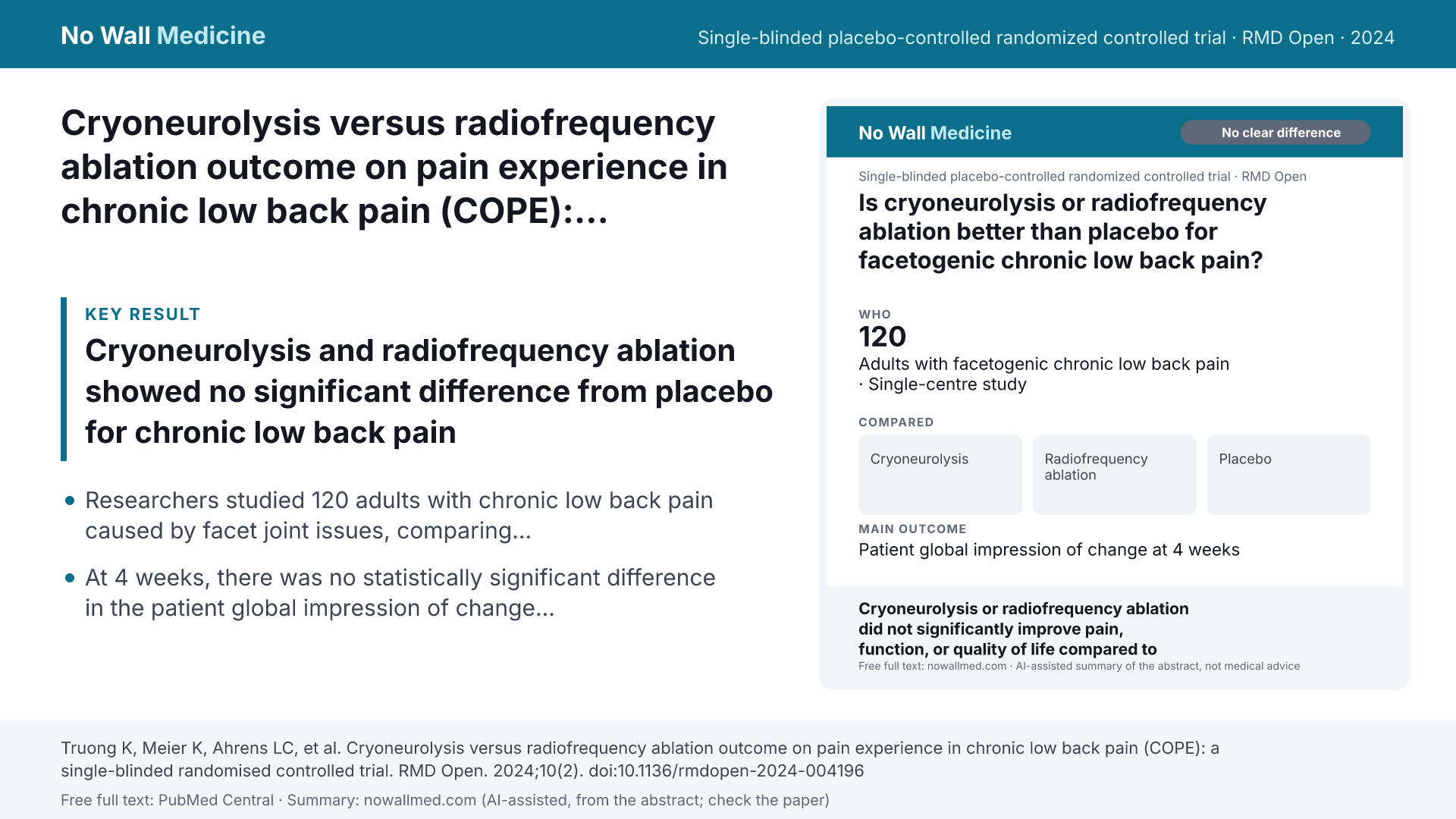
Cryoneurolysis and radiofrequency ablation showed no significant difference from placebo for chronic low back pain
Cryoneurolysis versus radiofrequency ablation outcome on pain experience in chronic low back pain (COPE): a single-blinded randomised controlled trial
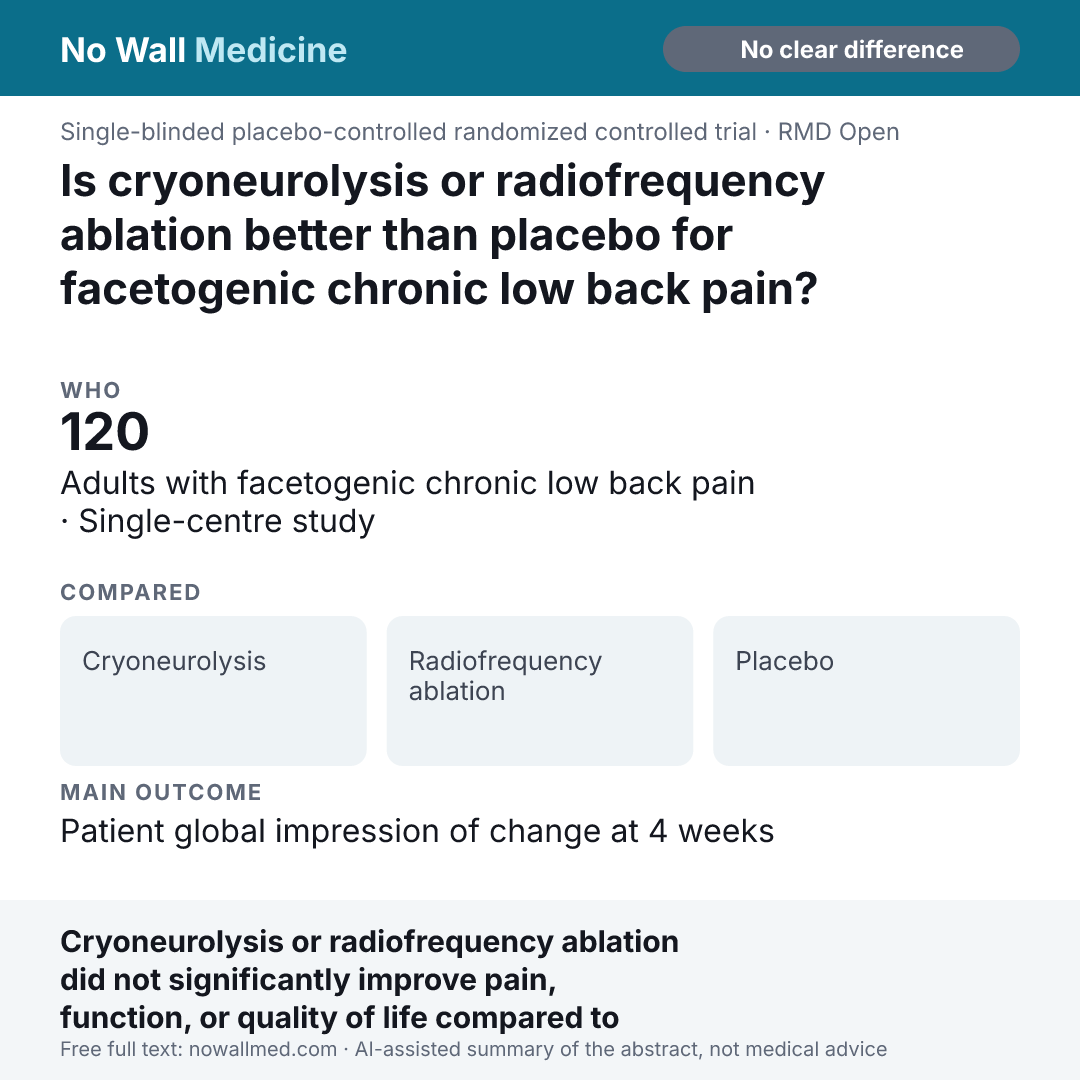
Single-blinded placebo-controlled randomized controlled trialNo clear difference
Is cryoneurolysis or radiofrequency ablation better than placebo for facetogenic chronic low back pain?
Who
120
Adults with facetogenic chronic low back pain · Single-centre study
Compared
Cryoneurolysis
Radiofrequency ablation
Placebo
Main outcome
Patient global impression of change at 4 weeks
Result: risk ratio 2 (95% CI 0.75 to 5.33) for cryoneurolysis vs placebo
Bottom line: Cryoneurolysis or radiofrequency ablation did not significantly improve pain, function, or quality of life compared to placebo.
RMD Open · 2024-05-09 · NCT04786145
Headline and visual abstract written with AI from the paper’s abstract, with every number checked against it. Read the paper before relying on them.
Was this summary helpful?
Abstract
Objective
A comparison of cryoneurolysis or radio frequency (RF) with placebo in patients with facetogenic chronic low back pain (LBP) for patient global impression of change (PGIC), pain intensity, function and quality of life, with 1-year follow-up. Design
Single-centre, single-blinded placebo-controlled randomised controlled trial. Setting
Single-centre study. Participants
Inclusion from March 2020 to September 2022: consenting adults over 18 years of age, LBP>3 months, average Numeric Rating Scale LBP≥4 average last 14 days and a positive response to a diagnostic medial branch block (>50% pain reduction after 60 min). Interventions
120 patients were block randomised 1:1:1 to cryoneurolysis, RF or placebo of the medial branch nerves. Physical therapy was added after 4 weeks for all groups. Main outcome measures
Primary outcome was PGIC 4 weeks after the intervention. Secondary outcomes included pain intensity (Numeric Rating Scale, NRS), quality of life (Short Form 36, EQ-5D-5L), disability (Oswestry Disability Index), depression (Major Depression Inventory) and catastrophising (Pain Catastrophising Scale). Outcomes were measured at 4 weeks, 3, 6 and 12 months. Results
There was no statistically significant difference in PGIC at 4 weeks between cryoneurolysis and placebo (risk ratio (RR) 2; 95% CI 0.75 to 5.33, p=0.17) and RF and placebo (RR 1.6; 95% CI 0.57 to 4.49, p=0.37), except PGIC for cryoneurolysis at 6-month follow-up (RR 5.1; 95% CI 1.20 to 22.03, p=0.03). No statistically significant differences were found in secondary follow-up endpoints. Conclusions
Denervation of the medial branch nerve by either cryoneurolysis or RF compared with placebo did not demonstrate significant improvement in PGIC, pain intensity, function and quality of life in patients with facetogenic chronic LBP at short-term or long-term follow-up. Trial registration number
NCT04786145.
Abstract reproduced under the article’s CC BY NC licence.
Subject terms
Cite this article
Truong K, Meier K, Ahrens LC, et al. Cryoneurolysis versus radiofrequency ablation outcome on pain experience in chronic low back pain (COPE): a single-blinded randomised controlled trial. RMD Open. 2024;10(2). doi:10.1136/rmdopen-2024-004196
Spotted a mistake? Suggest a correction