Cryoprecipitate transfusion was associated with stronger clots and less clot breakdown than fibrinogen concentrate
Cryoprecipitate transfusion in trauma patients attenuates hyperfibrinolysis and restores normal clot structure and stability: Results from a laboratory sub-study of the FEISTY trial
Laboratory sub-study of a randomized controlled trialBenefit found
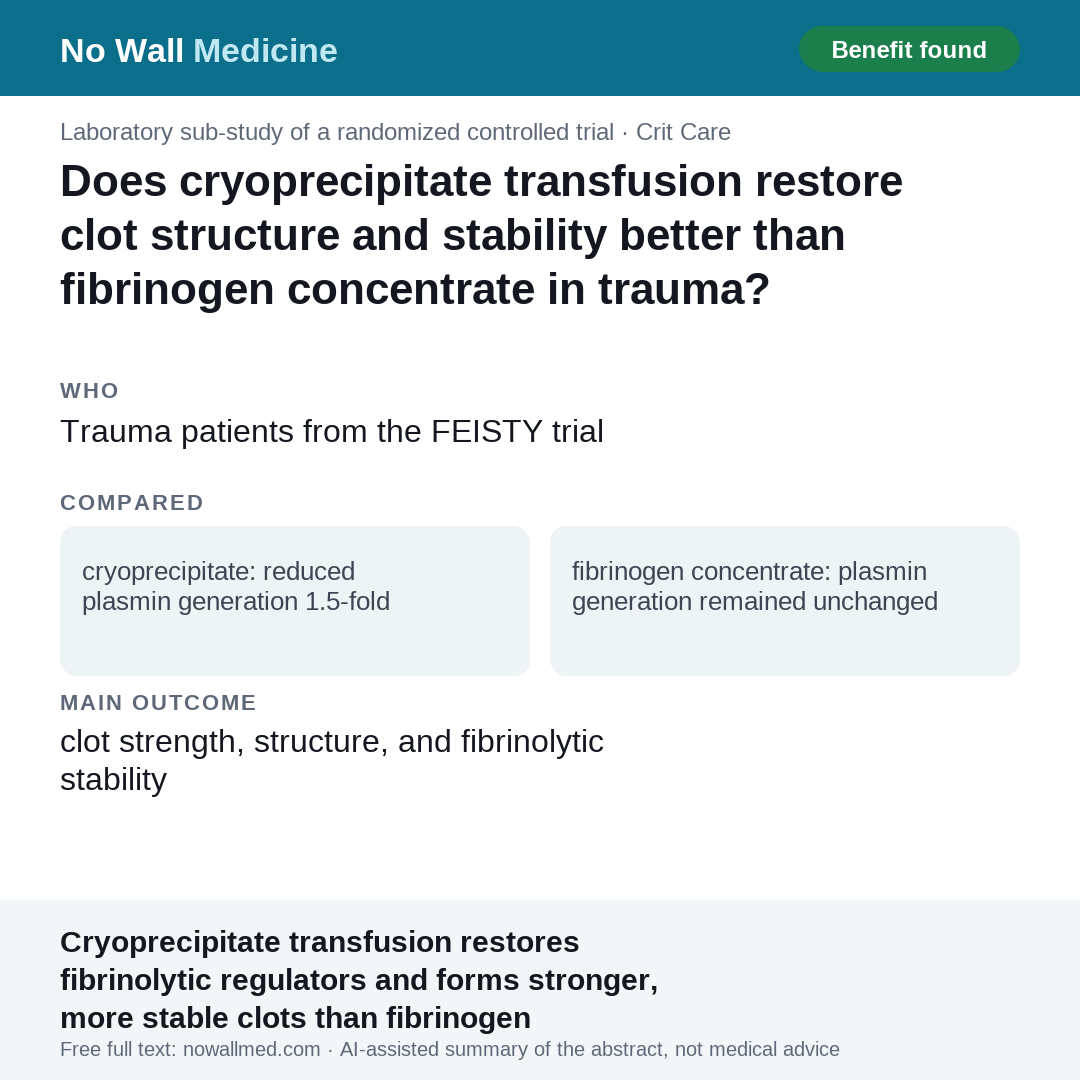
Does cryoprecipitate transfusion restore clot structure and stability better than fibrinogen concentrate in trauma?
Who
Trauma patients from the FEISTY trial
Compared
cryoprecipitate: reduced plasmin generation 1.5-fold
fibrinogen concentrate: plasmin generation remained unchanged
Main outcome
clot strength, structure, and fibrinolytic stability
Bottom line: Cryoprecipitate transfusion restores fibrinolytic regulators and forms stronger, more stable clots than fibrinogen concentrate.
Crit Care · 2022-09-26Download image
Clinical question: Does cryoprecipitate transfusion restore clot structure and stability better than fibrinogen concentrate in trauma?
Why it matters: It was unknown how different fibrinogen replacement products affect the physical structure and stability of blood clots in trauma patients.
Key points
- Researchers analyzed paired plasma samples from the FEISTY randomized controlled trial to compare cryoprecipitate and fibrinogen concentrate in trauma patients.
- Cryoprecipitate transfusion was associated with a 1.5-fold reduction in the rate of plasmin generation, which is an enzyme that breaks down clots.
- Cryoprecipitate transfusion was associated with increased levels of plasminogen activator inhibitor 1 and Factor XIII, while fibrinogen concentrate was not.
Headline and key points written with AI from the paper’s abstract, with every number checked against it. Read the paper before relying on them.
Was this summary helpful?
Subject terms
Cite this article
Morrow GB, Feller T, McQuilten Z, Wake E, Ariëns RAS, Winearls J. Cryoprecipitate transfusion in trauma patients attenuates hyperfibrinolysis and restores normal clot structure and stability: Results from a laboratory sub-study of the FEISTY trial. Crit Care. 2022. doi:10.1186/s13054-022-04167-x
Spotted a mistake? Suggest a correction
Top studies every Monday
The week’s key trials and guidelines in your specialties, plus any topics you follow. By email, free.
Get the weekly digest