Culturally adapted psychoeducation reduced mood episode recurrence in bipolar disorder
Culturally adapted psychoeducation for bipolar disorder: a multicentre, assessor-masked, randomised controlled trial
Randomised controlled trialBenefit found
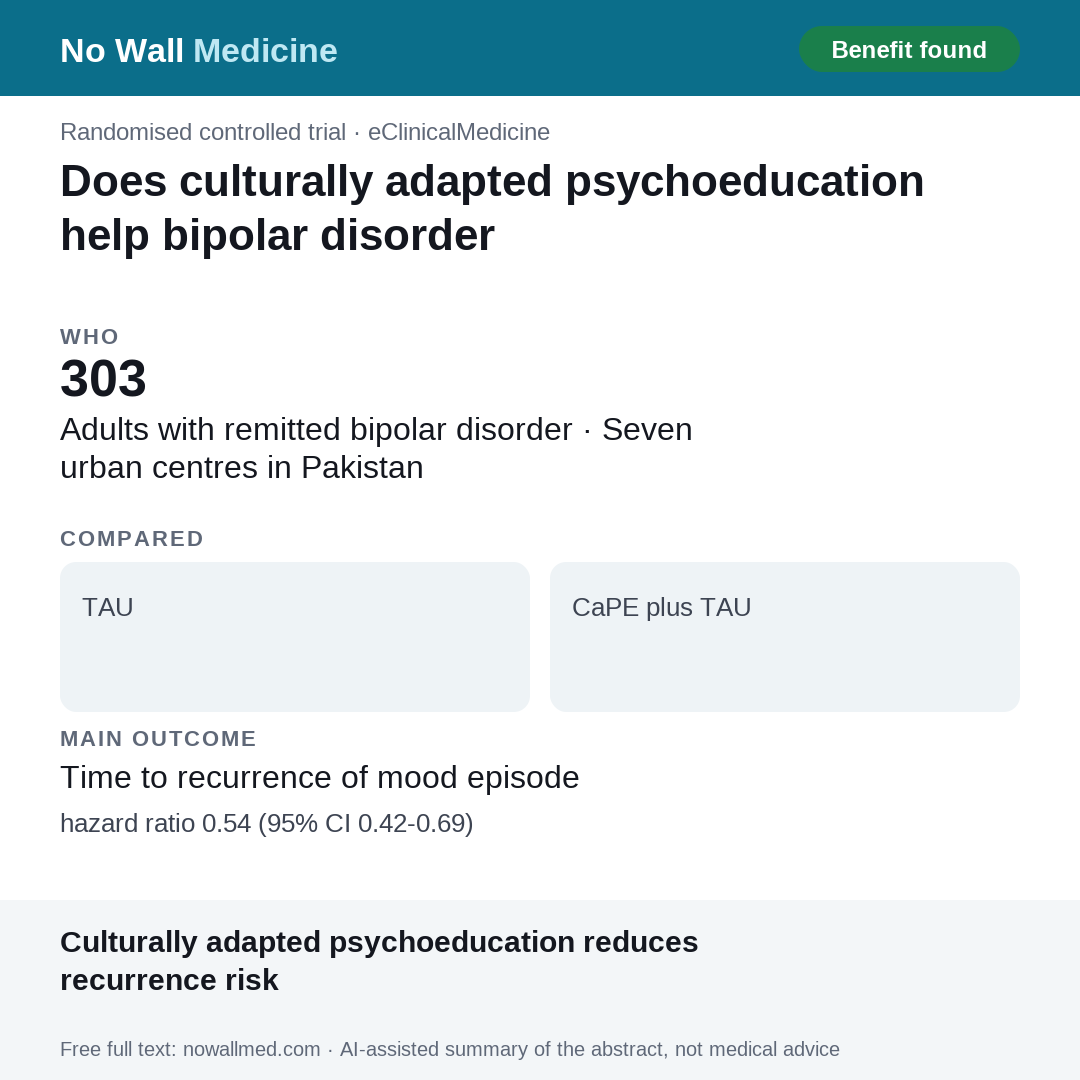
Does culturally adapted psychoeducation help bipolar disorder
Who
303
Adults with remitted bipolar disorder · Seven urban centres in Pakistan
Compared
TAU
CaPE plus TAU
Main outcome
Time to recurrence of mood episode
Result: hazard ratio 0.54 (95% CI 0.42-0.69)
Bottom line: Culturally adapted psychoeducation reduces recurrence risk
Funded by: Canadian Institutes of Health Research
eClinicalMedicine · 2026-10-24Download image
Why it matters: Evidence on psychoeducation for bipolar disorder is scarce in low-resource settings
Key points
- 303 adults with remitted bipolar disorder in Pakistan were randomly assigned to two groups.
- Psychoeducation plus treatment-as-usual prolonged time to recurrence of any mood episode over 48 weeks.
- Psychoeducation also improved recovery, knowledge, and medication adherence at 12 months.
Headline and key points written with AI from the paper’s abstract, with every number checked against it. Read the paper before relying on them.
Cite this article
Husain MI, Asif M, Khoso AB, Umer M, Shakoor S, Kiran T. Culturally adapted psychoeducation for bipolar disorder: a multicentre, assessor-masked, randomised controlled trial. eClinicalMedicine. 2026. doi:10.1016/j.eclinm.2026.104271
Spotted a mistake? Suggest a correction