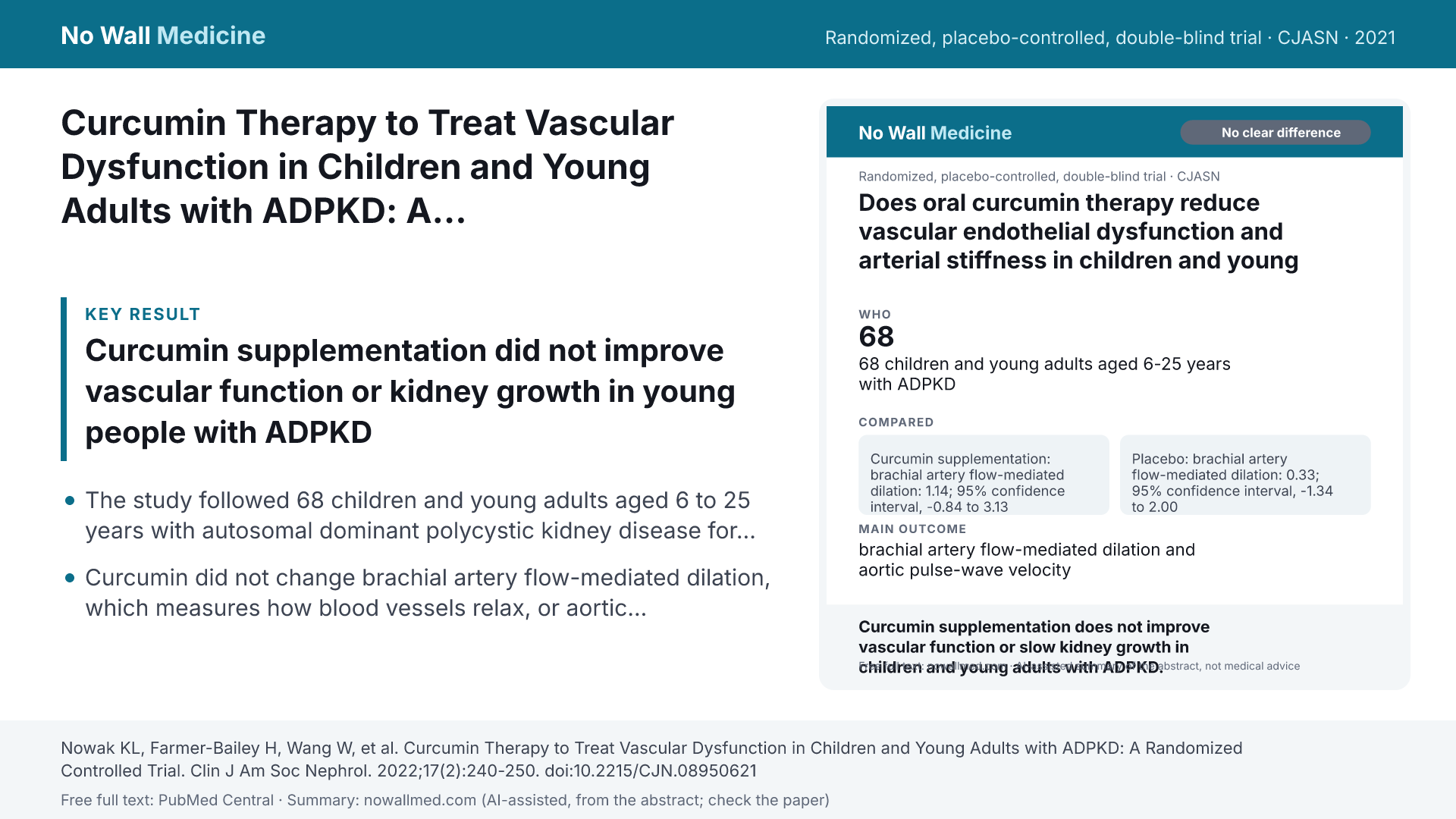
Curcumin supplementation did not improve vascular function or kidney growth in young people with ADPKD
Curcumin Therapy to Treat Vascular Dysfunction in Children and Young Adults with ADPKD: A Randomized Controlled Trial
Randomized, placebo-controlled, double-blind trialNo clear difference
Does oral curcumin therapy reduce vascular endothelial dysfunction and arterial stiffness in children and young adults with ADPKD?
Who
68
68 children and young adults aged 6-25 years with ADPKD
Compared
Curcumin supplementation: brachial artery flow-mediated dilation: 1.14; 95% confidence interval, -0.84 to 3.13
Placebo: brachial artery flow-mediated dilation: 0.33; 95% confidence interval, -1.34 to 2.00
Main outcome
brachial artery flow-mediated dilation and aortic pulse-wave velocity
Result: estimated difference for change: 0.81; 95% confidence interval, -1.21 to 2.84
Bottom line: Curcumin supplementation does not improve vascular function or slow kidney growth in children and young adults with ADPKD.
CJASN · 2021-12-14Download image
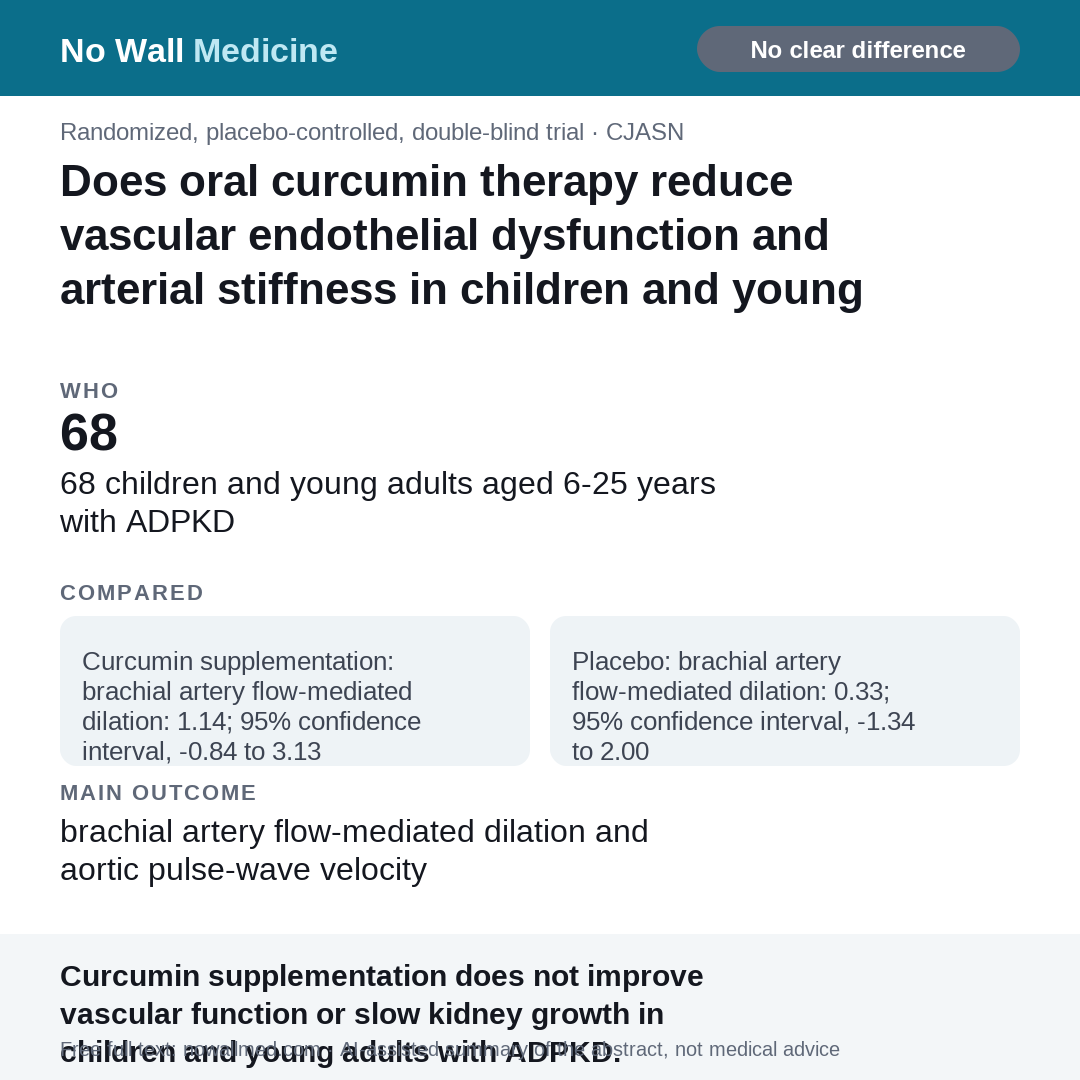
Clinical question: Does oral curcumin therapy reduce vascular endothelial dysfunction and arterial stiffness in children and young adults with ADPKD?
Key points
- The study followed 68 children and young adults aged 6 to 25 years with autosomal dominant polycystic kidney disease for 12 months.
- Curcumin did not change brachial artery flow-mediated dilation, which measures how blood vessels relax, or aortic pulse-wave velocity, which measures arterial stiffness.
- There were no curcumin-specific changes in vascular oxidative stress, inflammatory biomarkers, or height-adjusted total kidney volume compared to a placebo.
Headline and key points written with AI from the paper’s abstract, with every number checked against it. Read the paper before relying on them.
Was this summary helpful?
Subject terms
Cite this article
Nowak KL, Farmer-Bailey H, Wang W, et al. Curcumin Therapy to Treat Vascular Dysfunction in Children and Young Adults with ADPKD: A Randomized Controlled Trial. Clin J Am Soc Nephrol. 2022;17(2):240-250. doi:10.2215/CJN.08950621
Spotted a mistake? Suggest a correction